









Duplex sector gates for Södertälje Lock
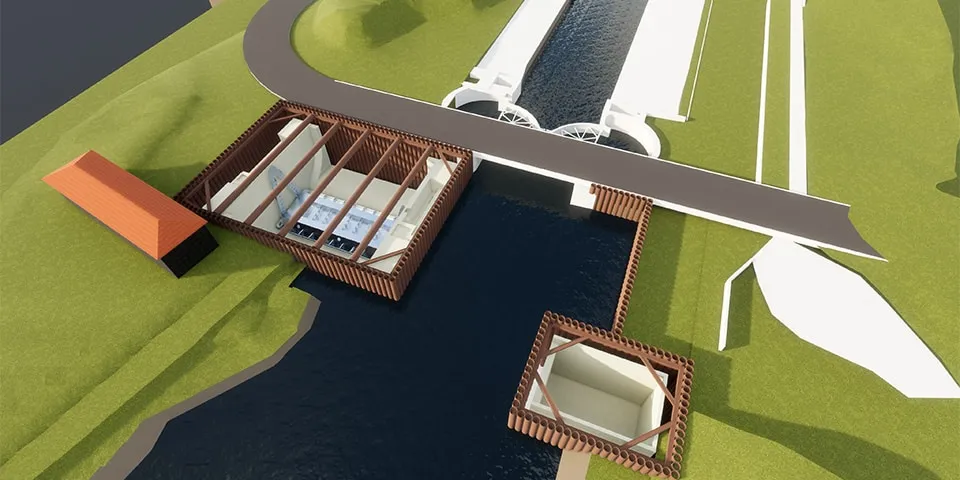
Rebuilding a lock without interrupting navigation, a client wanting a particular type of lock gate and state-of-the-art design techniques: there are plenty of challenges involved in expanding the largest lock in Scandinavia. The existing lock in Södertälje is 135 metres long and 20 metres wide. To accommodate growing maritime traffic, the lock chamber is being enlarged to 170 metres long and 25.3 metres wide.
MH Poly and Iv-Infra have joined forces and are involved in the project as a joint venture called S3P. Their work includes designing the new lock heads, including the sector gates and mechanical components, as well as the guide structures in the lock head that protect the gate arms.
Minimal disruption to shipping
Construction is now under way in Södertalje. A key requirement set by the client, Sjöfartsverket (Swedish Maritime Administration), is that shipping should be disrupted as little as possible during construction. To minimise the impact on shipping, cofferdams are being built alongside the existing lock heads. The complete lock heads, including the gates, will be built and tested inside them. During a short closure, the new lock heads will be floated into their permanent position and a grout layer applied underneath.

Visualisation of the reference design by Sweco.
Duplex sector gates
The lock gates will be sector gates made from duplex stainless steel. This is a unique application in the Netherlands. The water in the Södertälje Canal is slightly brackish, and its salt content is expected to rise further as sea levels rise. Duplex steel is a type of stainless steel with corrosion-resistant properties. Using this material keeps maintenance costs over the service life very low because no protective coating is required.
Sector gates offer major advantages under the environmental conditions of this project, including the limited space available for accommodating the lock head and the hydraulic requirements for retaining water and discharging it in both directions. A sector gate rotates around a horizontal axis. When open, the gate lies at the bottom of the lock head. Another advantage is that the lock can be levelled by opening the gate, eliminating the need for gate sluices or bypass culverts in the lock head. The sector gates can also be used to discharge water when a large outflow from Lake Mälaren is needed. For maintenance or replacement, the structure can be rotated above water into various positions.
Lock gate design
The gate skin plate is circular and fitted with longitudinal stiffeners. The skin plate has a specially shaped geometry at the bottom to create an optimal flow profile when the gate is in the levelling position. Cross-members transfer the loads to two box-section main girders, which have openings to allow water to flow in and out. The gate has buoyancy chambers on both sides, making its operating weight virtually zero. The buoyancy chambers are positioned across the gate so that a self-closing moment is maintained in every position. If the power supply fails completely, the gate can close by itself. When closed, the gate rests on two supports against the sill (end stops) to ensure it is in the correct position.
The connections for the arms are located at the ends of the main girders. On each side, two arms meet at the main shaft, which is made from a tubular section. The main shaft rotates in two bearings mounted in a steel frame. A bracket for attaching a hydraulic cylinder is fitted between the primary and secondary bearings. The bracket creates a lever arm between the hydraulic cylinder and the main shaft. This controls the position of the gate and enables it to be locked in various positions. The structures are arranged symmetrically, with a drive on each side of the gate.
The sector gates in the two lock heads will be installed facing in opposite directions. If a vessel collides with a gate while entering the lock chamber, it will always hit the concave side of the gate, putting the arms under tension. To ensure availability, a third gate leaf and set of arms will be manufactured and stored at the lock complex. The gate leaves and arms are interchangeable.
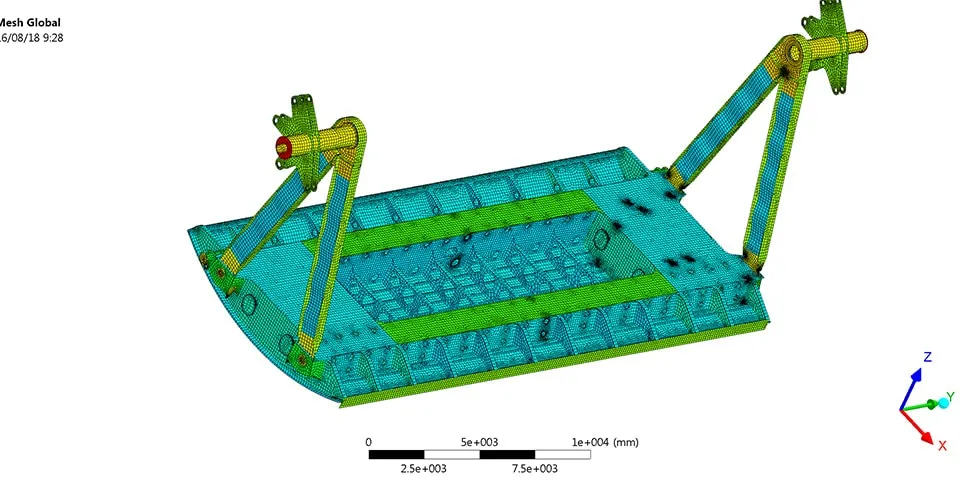
FEM overview of the sector gate.
Internal ring stiffeners aligned with the longitudinal stiffeners
Fatigue is an important consideration in the design of the steel structure, particularly when detailing the buoyancy chambers, arms and main shafts. The buoyancy tanks move from the waterline to below the lock floor during every operating cycle. This places the structure and the plate stiffeners in the buoyancy chambers under considerable cyclic loading. Internal ring stiffeners aligned with the longitudinal stiffeners on the skin plate have been chosen. Each side has six separate compartments, each with an access hatch for inspection and maintenance. To allow for possible future modifications to the gate or greater-than-expected marine growth, ballast equal to approximately 2.5% of the gate weight will be placed in the buoyancy chambers.
The seals are essential to the operation of the lock gate. Leakage must be kept to a minimum and a certain service life must also be guaranteed. Double-lip seals with a circular profile will be fitted on both sides. To reduce wear caused by gate movements, the seal's centre point has been positioned so that, as the gate moves, it undergoes a small radial movement as well as tangential movement. This reduces the contact length between the seal and the cast-in steel plate.
Bottom seal design
Designing the bottom seal proved challenging because of the deformations involved, construction tolerances and stiffness requirements. The gate leaf deforms considerably under the head difference, so the contact surface with the sill has been made parallel to the direction of deflection. The bottom seal's capacity to accommodate deformation has been designed to account for deformation of the sill and construction tolerances for both the gate and the sill. The design assumes that the closing moment will always hold the gate against its end stops. This maximises the stiffness of the bottom seal.
Construction of the lock gates
The lock gates and mechanical components are being manufactured and assembled by Cimolai in Italy. The gates are expected to be ready for transport to Sweden in early 2020.
Question about this story? Ask your question
Keep following this
Get an email when a new story is published. No account needed.
- SubjectBridge construction







