









Cloudburst tunnel eases pressure on Copenhagen
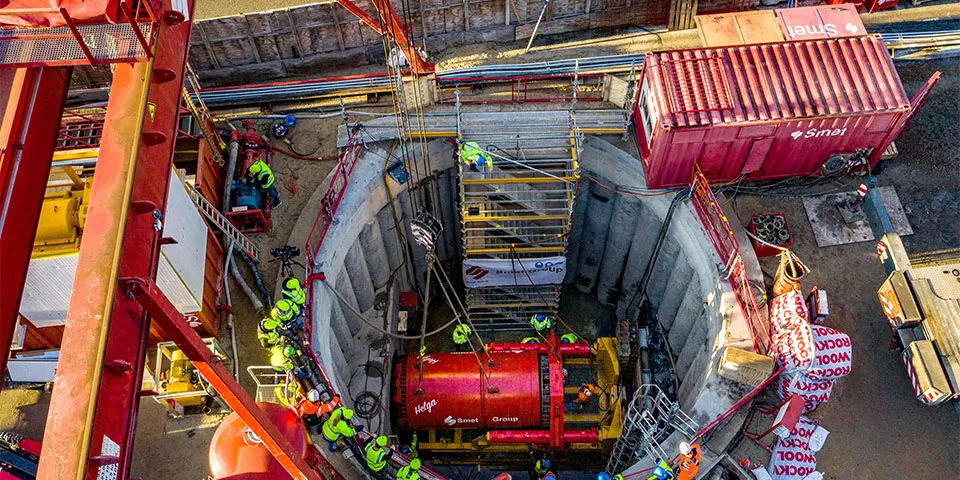
Climate change is now all too clear. During the summer months, we face short but often intense downpours. A cloudburst like this can cause considerable flooding. Copenhagen faces the same problem. The city has therefore decided to build a so-called cloudburst tunnel to relieve the pressure on the sewer system during these events and prevent flooding and inundated basements. The project comprises several phases, one of which, the construction of the tunnel beneath Strandboulevarden in Østerbro, has been awarded to Belgian company Smet Group.
Over the coming years, a large part of Copenhagen will be equipped with cloudburst tunnels. “The capacity of the existing sewer system is often insufficient to store all the water from heavy summer downpours,” says Pieter Hermans of Smet Group. “A cloudburst tunnel can store and carry away these large volumes of water. We are currently building a tunnel beneath Strandboulevarden and a discharge shaft leading towards the harbour for Danish client Hofor. The total length is 1.1 kilometres. The aim is for excess rainwater to be safely discharged through the tunnel from summer 2021.”
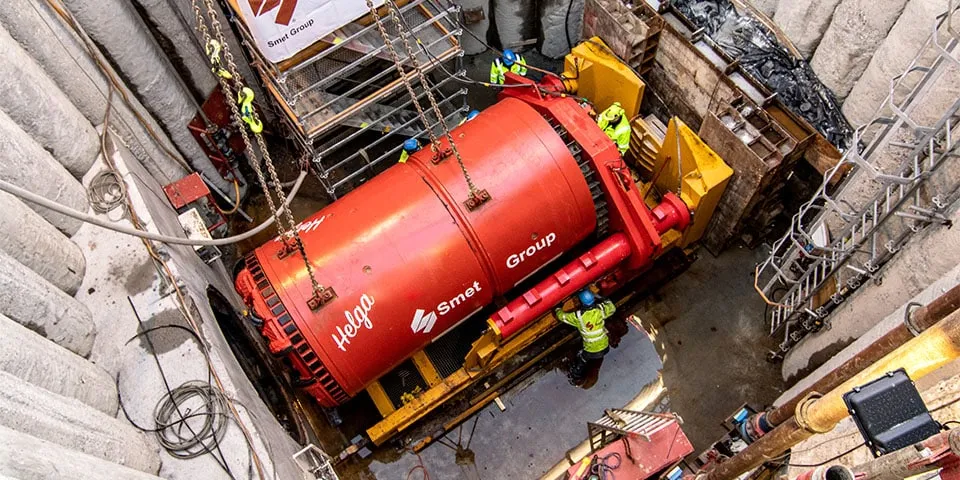
Smet Group is using the so-called AVND technique to bore the tunnel.
Closed circuit
From a launch shaft beneath Strandboulevarden, Smet Group is carrying out three pipe jacks at a depth of around 6 metres below the road surface. “We are using the so-called AVND technique,” explains Hermans. “The 50-tonne tunnelling shield, named Helga, advances through the ground, with the face stabilised using drilling fluid and bentonite and supported by an air-pressure chamber. It is a closed-circuit system. At the same time, concrete rings are pushed into the bore to form the tunnel itself. Throughout the jacking operation, the surrounding area, including adjacent buildings and junctions, is continuously monitored for settlement, noise and vibration. We started a drive southwards at the end of 2019, building a 350-metre-long tunnel. We will then turn around and bore northwards from the launch shaft. This tunnel will be 600 metres long. The tunnel beneath Strandboulevarden will therefore have a total length of 950 metres and an internal diameter of 2 metres. We will then once again jack a tunnel from the launch shaft, following a natural gradient eastwards for 210 metres, with an internal diameter of 2.5 metres. This will form the discharge shaft, which will connect to an existing shaft leading to the harbour, with an overflow to the sea.”
The three shafts being built by Smet Group are so-called storage shafts. Hermans explains: “The sewers in the streets running perpendicular to Strandboulevarden will be connected to this cloudburst tunnel. We are also installing overflow valves at road level on Strandboulevarden so that rainwater can flow directly into the tunnel. According to the schedule, we will hand over the shafts to the City of Copenhagen by summer 2021.”
Question about this story? Ask your question
Who worked on it
Strandboulevarden cloudburst tunnel Kopenhagen in Copenhagen
- aanleg van de tunnelSmet Group
Keep following this
Get an email when a new story is published. No account needed.
- ProjectStrandboulevarden cloudburst tunnel Kopenhagen
- SubjectBridge construction
- CompanySmet Group







