









With the new Klic notifications, you can do so much more
The way cable and pipeline information is accessed is undergoing major change. This is due to the Kadaster’s new working methods. As a result, KLIC now offers not only a legal framework, but also a wealth of options for accessing data. We spoke to Floris Konings, who represented Heijmans Infra during the Kadaster’s testing phase.
First, a little background. For several years, the Kadaster has been modernising the Klic notification process to meet legislative and regulatory requirements. This so-called KLIC-WIN programme has resulted in an approach to information exchange that complies with both the Dutch WIBON Act and the European INSPIRE Directive. The transition period began on 1 January, but the entire civil engineering sector must have switched over by 1 July.
Far-reaching implications
The new approach has major implications for everyone working with cable and pipeline information. First, network operators can now upload their cable and pipeline data to a central Kadaster database. The Kadaster can then quickly and efficiently share it with applicants. The added value lies in the fact that the information is now supplied in vector format. This means all the data provided can be used far more easily in, for example, CAD systems. That is particularly useful because the information now covers more than just location: it also includes a wide range of additional details, from materials and diameters to symbols for joints and valves, for example. The Klic notification process has changed for legal reasons, but it also brings significant benefits in terms of quality and efficiency.
Quick to spot the potential
Floris Konings has already seen the benefits in practice. He is lead engineer in the Cable and Pipeline Systems department at Heijmans Infra, where the team plans cable and pipeline routes and designs, among other things, water pipelines and district heating networks. He was quick to spot the potential when he heard about KLIC-WIN. “We work on all kinds of cable and pipeline projects. Sometimes they are small, standard diversions in a town, but we also design entire cable routes for large wind farms. So we deal with a very wide variety of Klic notifications. We are also always on the lookout for ways to improve our drawings and work more efficiently.
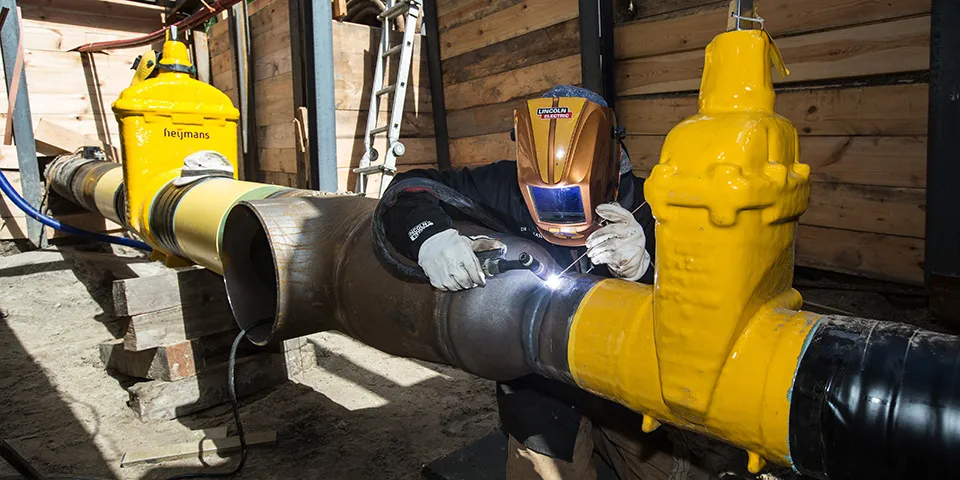
Preparing a directional drilling operation for the transport water pipeline from Loosbroek to Oss (Photo: Maikel Samuels).
We therefore saw the Kadaster’s new approach as an opportunity, especially when we became involved in the Keten AcceptatieTest for KLIC-WIN through Bouwend Nederland.”
The Kadaster set up the test to check whether the new approach would work in the day-to-day practice of applicants and other users. “It was a great learning experience,” says Floris. “Particularly because so much additional information is now made available ‘automatically’. We immediately saw that this had to bring major efficiency gains. And that’s before you even consider the possibilities for BIM …”
The right software
Floris did find that software plays a major role. Heijmans Infra has long used InfraCAD, including for processing Klic notifications. During the Keten AcceptatieTest, however, InfraCAD did not recognise the Klic notifications. “So the test gave us data, but we couldn’t do anything with it yet.” To test whether the data was usable, it had to be linked to the software. Floris therefore contacted CAD Accent, the supplier of InfraCAD. This brought an immediate bonus: CAD Accent had already been working for some time on a new KLIC module for InfraCAD Map, which will replace the KLIC module in InfraCAD. “We got to work together on testing the new approach.”
Richer data
For about two years, Floris had had an idea of what the new approach could make possible. That idea was soon confirmed. “What a wealth of additional data!” says Floris. “Everything is much faster, clearer, more accurate and more complete … and yet you only need a few buttons and functions. With the new Klic notifications, you can do so much more.”
In the old system, ‘details’ in drawings would often disappear. “What used to show up as a vague patch of pixels can now actually be recognised as a valve, as it should be. And five lines close together now show up as five lines, not one. Symbols and ducting are now clear; you can click through to attachments; the required precautionary measures are displayed clearly; and object data appears in handy pop-ups … KLIC has suddenly become so much more than a legal framework. Combined with InfraCAD Map, it marks a huge leap forward in the quality of your drawings.”
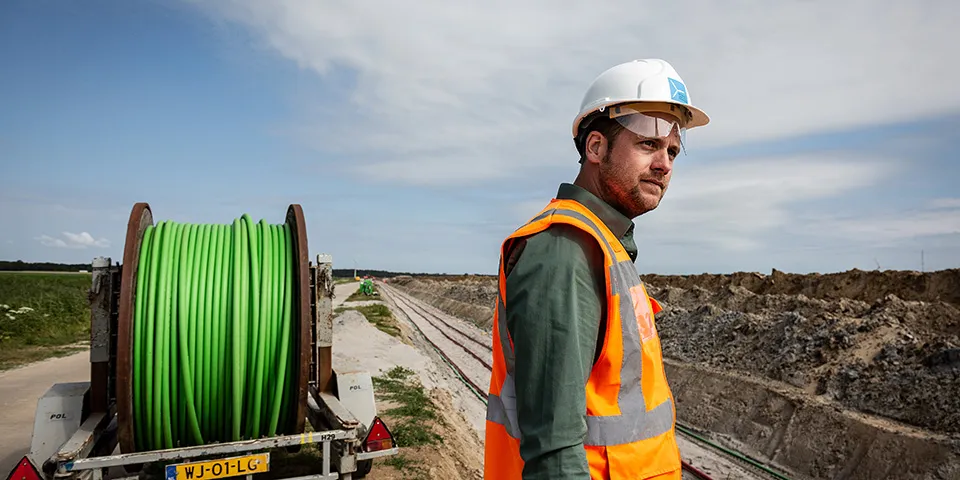
Installing cables for Windpark Wieringermeer (Image: Martine Krekelaar).
Efficiency
The new Klic module also makes the work more efficient, the team at Heijmans found. For instance, there is no longer any need to clean up your drawings first, and you can now import multiple Klic notifications as a single batch. “These might seem like small things to an outsider, but every drafter will recognise the frustration of having to clean up a drawing. Now you can get straight to work! It saves time, which is useful when preparing a tender, but more importantly, it makes the work so much more pleasant.” All in all, the wait for KLIC-WIN was worth it, Floris concludes. “Together with InfraCAD Map, it really heralds a new era.”
Transition period: until 1 July 2019
The move to vector-based cable and pipeline information is a major change for the entire sector. The Kadaster has therefore introduced a transition period. Network operators can continue to submit their data in the ‘traditional’ way, as raster data, until 1 July. After that, it must be submitted as vector data. From 1 July, everyone will therefore have to work exclusively with vector data.
Question about this story? Ask your question
Keep following this
Get an email when a new story is published. No account needed.
- SubjectBouwMat







