









Water transport: a sustainable solution for the civil engineering sector
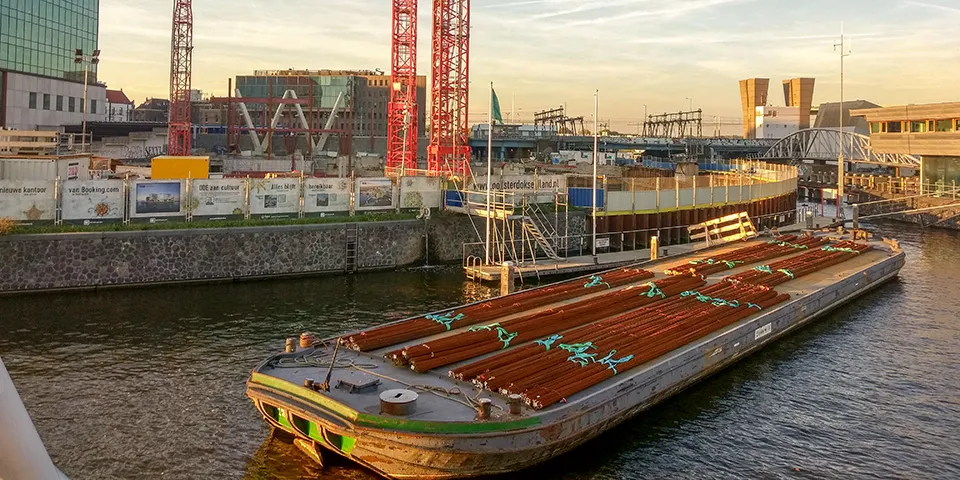
Since the early 20th century, deck barges have been used as work and storage vessels on construction projects, as well as for transporting goods. Their very shallow draught makes them ideal for transport by water, including in city centres, where low bridges and a range of navigation profiles need to be taken into account.
Blom BV tugboat services and deck barge hire has many years’ experience in hiring out and transporting, among other things, deck barges, cargo barges and hopper barges. The company has its own storage and transhipment quay in Amsterdam’s Coenhaven. In recent years, its fleet has grown to include coupled deck barges (15-42 metres), pontoons, painters’ rafts and tugboats, bringing the total to more than 70 vessels. Nancy Blom, director at Blom, explains: “Our favourable location and spacious loading and unloading quay, with a 70-tonne crane, allow us not only to combine road and water transport, but also to tranship cargo directly from vessel to vessel. Our equipment can be deployed throughout the country on all kinds of water projects, as well as in Belgium, Germany and France.”
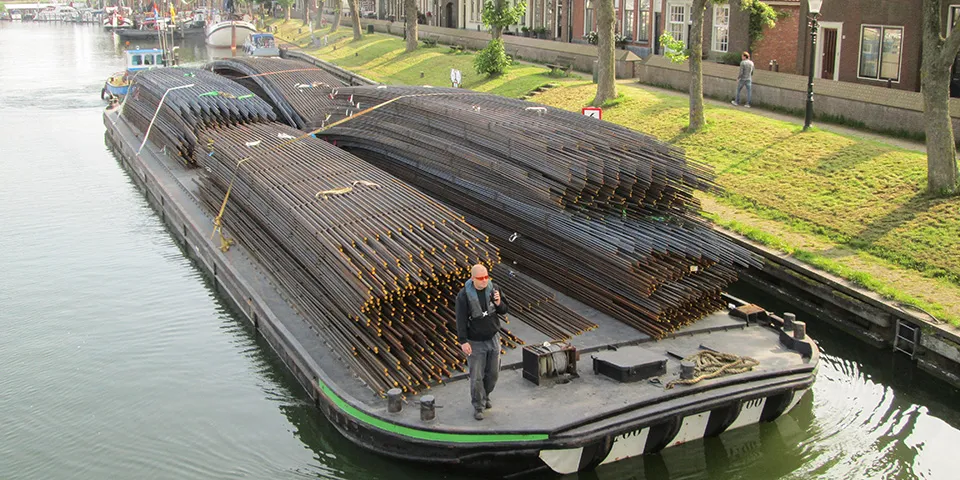
The reinforcing steel was then transported by water to the construction site.
Versatile
“A logistics operation starts with a request from the client. What do you want to transport? How big, how wide? We draw up a plan. We have a solution for every challenge.” Blom’s deck barges and pontoons are not only used for the sustainable delivery and removal of construction materials, building products and equipment. The possibilities are endless. “Our deck barges are often used as floating work platforms or construction hubs. The coupled deck barges are used for projects involving cranes or piling rigs. And the pontoons can even be used for events. Or for the world’s largest inflatable fish…”
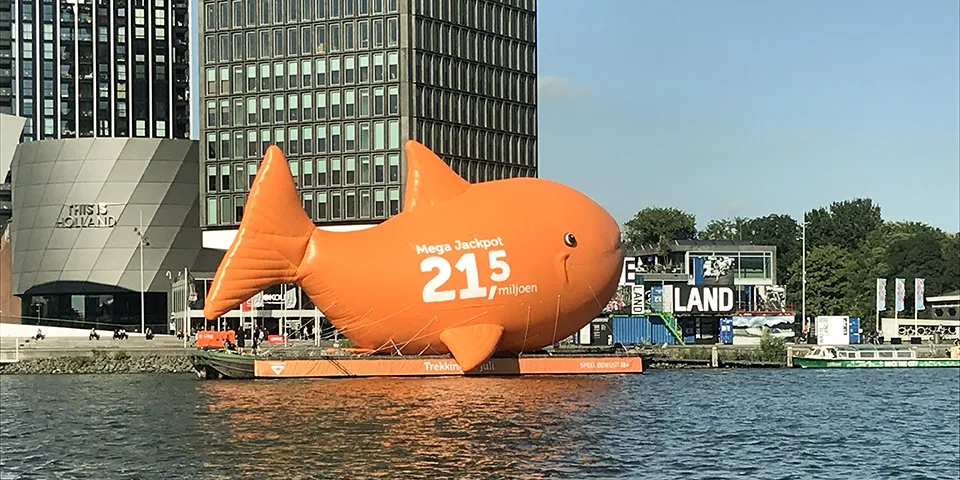
The pontoons can even be used for events. Or for the world’s largest inflatable fish.
Sustainable transport in city centres
Many current and future construction projects in Amsterdam are located right alongside a canal or the IJ. “That makes them very easy to reach by water,” says Blom. “Blom has developed ‘Green Development’ to sustainably deliver and remove construction materials and building products to and from central Amsterdam. This forward-thinking approach reduces freight traffic in the city centre and, in turn, CO2 emissions, while encouraging sustainable logistics.” Blom gives the example of the Egelantiersgracht in the Jordaan, where transporting materials by water for a quay improvement project saved 1,000 lorry journeys. On another major project, almost all the construction materials, including sand, concrete piles and even 300 tonnes of reinforcing steel, were transported by water. “The huge quantity of reinforcing steel was brought from Germany to our own quay and transhipped directly onto our deck barges, which then sailed into the city centre. You can safely say that we can transport anything that needs to be moved by water. We know the city inside out and always have a solution!” Blom concludes: “Our current tugboats run on biodiesel. To operate even more sustainably and responsibly, we are currently having an electric tugboat developed. That means we’ll be fully ready for the future!”
Question about this story? Ask your question
Keep following this
Get an email when a new story is published. No account needed.
- SubjectBouwMat







