









This Panther does not compromise on safety
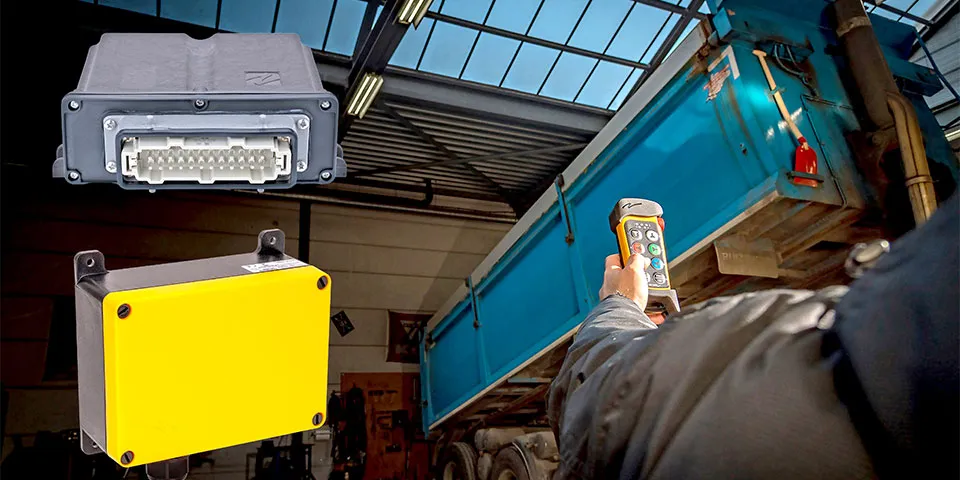
Some working environments demand a high level of safety. In these situations, a reliable remote control is a major advantage, such as Tele Radio’s Panther PLd. It is independently certified, giving users complete confidence in its safety. A new receiver adds extra functionality.
Demolition work and the movement of heavy loads, particularly in difficult locations, involve significant safety risks. Within Tele Radio’s Panther range of wireless radio remote controls, the PLd version was developed for these situations. When used with one of the two PLd receivers, the PN-T19-2 provides the required Performance Level d for the emergency stop function, equivalent to Safety Integrity Level 2.
When carrying out work with a high safety risk, you must be able to rely on the emergency stop at all times. Tele Radio’s PLd certificate is issued by an independent certification body, giving you that assurance.
Ready to go
Using a Panther PLd set is straightforward. The remote control comes as standard with various lifting, hoisting and crane configurations, and the receivers are supplied pre-wired. Tele Radio also offers the unique option of configuring the receiver from ground level. The transmitter can also be replaced without opening the receiver. This is a good example of the flexibility and ease of use that come alongside the robustness required for operation in a harsh environment.
Expandable receiver
The PN-R23 is a new receiver for the Panther PLd, available for wired use or with a Han connector. It is highly flexible and can be expanded with additional functionality through a modular design, including an extra relay, CAN bus, repeaters, digital input, analogue output and more. All this without compromising PLd safety.
Everything for safe operation
The software also contributes to safe operation in many ways, including when multiple transmitters and receivers are in use and/or in sensitive environments. For example, a unique signal code between transmitter and receiver is essential, and you must be able to set it yourself. The same applies to the group code, which allows multiple transmitters to control one receiver. In addition, Direct Sequence Spread Spectrum technology reduces interference and makes the signal harder to intercept.
Question about this story? Ask your question
Companies in this story
Keep following this
Get an email when a new story is published. No account needed.
- SubjectBouwMat
- CompanyTele Radio







