









The solution for strong flood defences and keeping feet dry
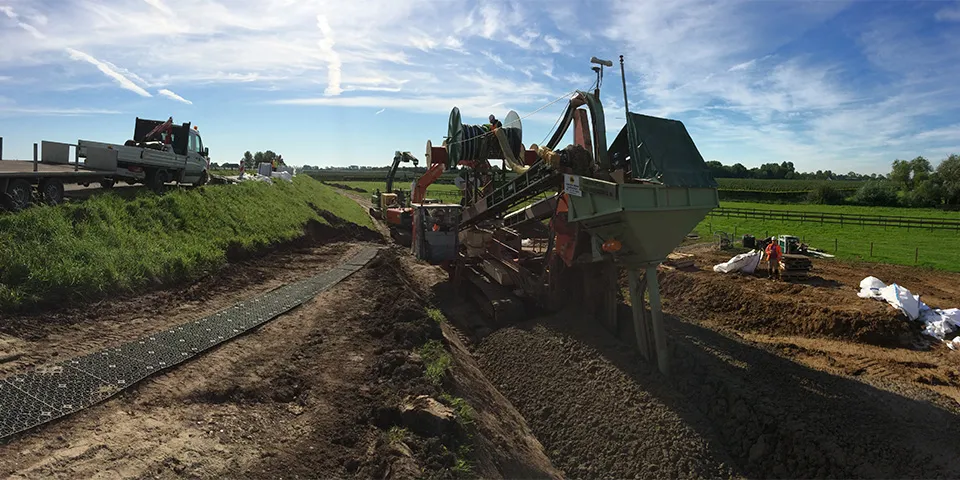
Family-owned Van den Herik has water engineering in its DNA. Its passion for working with water began in 1945, when large parts of the Port of Rotterdam had been destroyed. The founder, Jan Hendrik van den Herik, worked as a stone setter on the reconstruction effort. The company has since grown into a multi-disciplinary business, with strengths in both water engineering projects and the detection of conventional explosives. Van den Herik is characterised by its versatility, sustainable approach and innovative capacity. One of its innovations is Piping Control.
A major challenge is the safety of river dikes. In the coming years, we face a huge dike reinforcement task, involving an estimated 1,900 kilometres of dikes. One of the main causes of dike failure is piping. Water seeps beneath the dike, carrying sand with it, which weakens the structure and can cause it to fail. The good news is that there is a solution: installing vertical, sand-tight geotextile. “In 2013, Waterschap Rivierenland asked us to develop a method for installing this geotextile,” says Jeroen Terlingen, manager of project support departments. “Our idea for developing a possible installation technique was selected as the best: Piping Control. This is an innovative method developed in-house to install geotextile vertically in the toe of the dike, thereby stopping piping.”
Deep into the ground
Van den Herik uses a deep-milling machine to install the material. The company has built a module about 3.5 metres high onto the machine, enabling it to install the geotextile deep underground. This causes comparatively little disruption to the surrounding area. “The deep-milling machine unfolds the fabric underground, while immediately backfilling both sides with sand and clay in accordance with the original soil profile. We can install 350 metres a day. The section of dike in question is sealed immediately. This offers significant advantages over traditional methods. First, it is no longer visible; second, it requires no additional land, unlike the construction of an extra berm.”
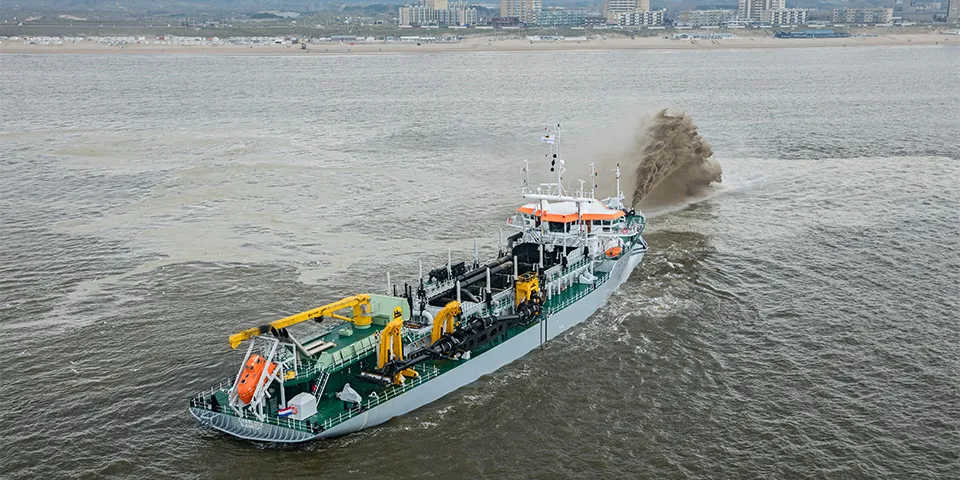
The ‘clean ship’-certified trailing suction hopper dredger (TSHD) Charlock in action off the coast of Bloemendaal.
More sustainable and cost-effective
Research by six water boards shows that around 540 km of the more than 940 km of dikes surveyed are insufficiently resistant to piping failure. Piping Control has further advantages. In practice, it has proved more cost-effective than traditional methods. “Looking at the 540 kilometres of dikes covered by the research mentioned, the cost of traditional solutions is very high. It is estimated at three to four billion euros. Piping Control can halve the cost. It also saves 1,000 kg of CO2 for every 100 m of dike. That amounts to a CO2 saving of about 35%.”
Just the tip of the iceberg
The method has now been proven in practice at Rijswijk and Ingen, as well as on the LiveDijk at Willemspolder. It was recently used for the Twentekanaal dike improvement project, where the system was further developed so that the geotextile can now also be connected to structures in a sand-tight manner, and unlimited lengths of geotextile can be installed without interruption. We also now have a monitoring system that can verify that every metre of Piping Control installed meets the requirements. In short, it is the solution for safe dikes and keeping feet dry, with plenty of opportunities to apply Piping Control as a preventive measure abroad too.
Van den Herik
Industrieweg 24, 3361 HJ Sliedrecht
T +31 184 41 28 81
www.herik.nl
Question about this story? Ask your question
Keep following this
Get an email when a new story is published. No account needed.
- SubjectBouwMat







