









The Pen | Peter van Westendorp, Director of Strukton Immersion Projects
You can’t learn expertise in your field from a book. Nor can you buy it. Expertise comes from practical experience. The learning process that builds expertise is inextricably linked to making mistakes. Anyone who wants to grow in their profession can only do so if they are given the opportunity to make mistakes. For me, that also means taking, or rather claiming, the opportunity to continue developing yourself.
Employees need to be given, and take, the opportunity to develop
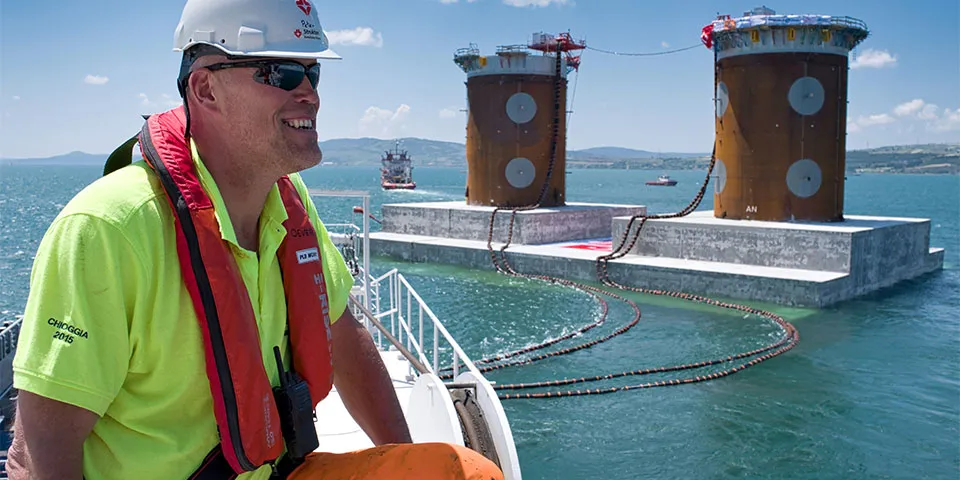
My own expertise lies in immersed tunnels and caissons. To reach the position I’m in today, I seized and made the most of the opportunities that came my way. Strukton has given me that opportunity for 30 years, and the learning process never stops. Yet there is a big difference in how we work in general when we compare today with 30 years ago.
The chief site supervisor was at the centre of everything
In the past, you would move from one department to another within a project, literally going back and forth. Computers had tentatively made their way into the workplace, but were used mainly for administrative purposes. Because there was no clear overview of the whole picture, the consequences of decisions were not immediately apparent. It was often too late before you realised something wasn’t working. The chief site supervisor was at the centre of everything on a project. You really had to rely blindly on employees’ experience, and all the information was centralised, literally, in one person’s head. A shorter working week or a day off for that person could therefore be disastrous: all the knowledge went “on holiday”.
Today, almost everyone is a manager
That may sound unusual, but it isn’t. Employees can now work a four-day week or take a day off from a project, even in management roles. That’s possible because of the way we work together today, which allows for a better division of work. We now accept that we can’t, and don’t have to, do or know everything ourselves. Almost everyone is a manager now. Systems are more advanced than they used to be, work can be carried out more accurately and margins of error have been drastically reduced. Just compare that with the past: structures were much larger and more robust, because they incorporated margins to compensate for inaccuracies. That’s why we work more efficiently today, and are therefore more sustainable.
The danger is that we forget the human factor
Because we often rely blindly on technology today, the human factor can sometimes be overlooked. But things can still go wrong. That’s why it’s important to retain robustness in the design, so that we can deal with unforeseen factors. If, as a construction company, you can strike the right balance between technology and the human factor, and allow for the possibility of mistakes, you’ll have achieved a great deal. You’ll be able to deal with emergencies as you should. Use the resources at your disposal to reduce the cost of failures, so that not everything collapses when things do go wrong.
Our level of professional knowledge could be higher
In the past, professional knowledge resided in the individual. Now the focus is on technology, and the very essence of construction itself is sometimes forgotten. But the laws of physics will always hold sway. Then, now and tomorrow. That’s why it’s valuable for employees to start at the bottom of the ladder, with their boots deep in the mud. Fall down, get back up and learn from it. What we see, however, is that people are no longer willing to get their hands dirty first. Everyone wants to enter the profession at a certain level, without any practical experience at all. That encourages the mistakes mentioned above. They don’t know what’s happening “in the field”. They can’t put themselves in the shoes of the men and women out there working hard. Who still takes the time to learn the trade?
Be a teacher, not a tormentor
As a company, make sure you teach your employees every aspect of the trade, whatever their role. Give them the opportunity and let them learn from their mistakes. I was given that chance myself, and I believe in the principle of “paying it forward”. I want everyone to have the same learning journey I had. That can be difficult for companies with a rigid corporate culture, but it’s certainly possible. What do you need? Trust, determination and perseverance, from both employer and employee. Be a teacher, not a tormentor, and you’ll reap the rewards in time.
It’s still people who have to get the job done.
A business enquiry for Strukton Civiel? Get in touch
Companies in this story
Keep following this
Get an email when a new story is published. No account needed.
- SubjectBouwMat
- CompanyStrukton Civiel







