









Sustainable rubber level crossings at Amstelveen Line stabling yard
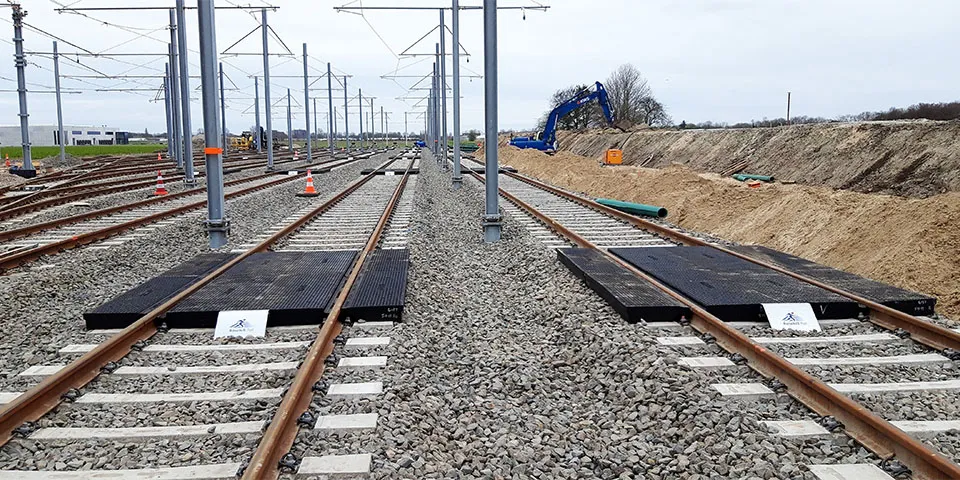
The upgraded Amstelveen Line is getting a completely new stabling yard for its trams in the Legmeerpolder. In addition to stabling positions for the fleet, there will also be facilities for activities including minor tram maintenance. Staff can reach the stabling positions via a large number of level-crossing paths made from solid rubber, sustainably manufactured from 100 per cent recycled tyres.
A bespoke solution for every track structure
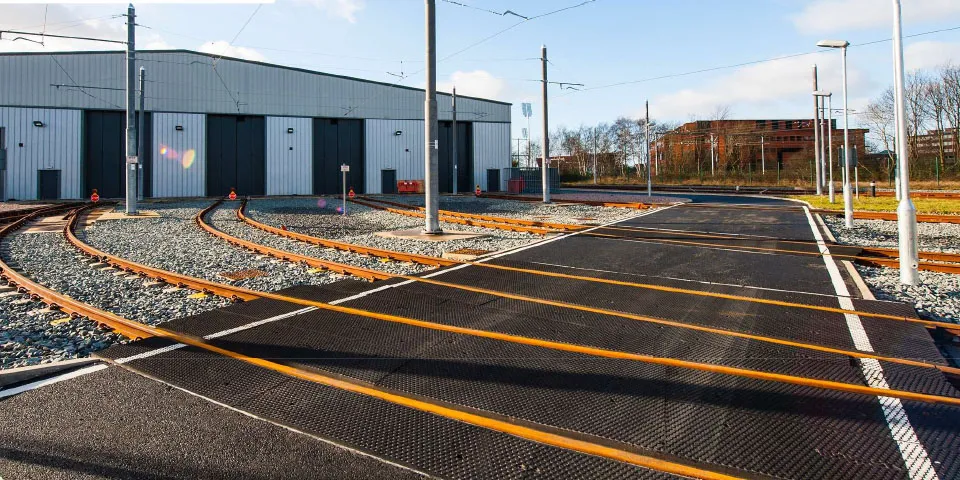
Depot reference, United Kingdom.
The complete rubber level crossings are supplied by Alom, an engineer and supplier of railway materials. The level-crossing system manufactured by British company Rosehill Rail offers many advantages, says Alom director Mark van den Rijen. “The solid rubber crossing panels can be installed quickly and efficiently. Installing the 1.80-metre-long panels, each weighing around 200-250 kilograms, does not require large cranes. Thanks to so-called lifting pins, two panels can be lowered simultaneously into a channel profile between the rails. The panels can also be removed individually and easily using these lifting pins for track maintenance and inspection, without having to dismantle the entire crossing.”
Depending on how the crossing is used, panels of different strengths can be installed. The ‘baseplate’ is intended for lighter use, for example by pedestrians and cyclists. These panels rest on the sleepers and are linked underneath by steel plates. Where heavy traffic uses the crossing, the Rosehill Rail ‘Rodded’ system is used. These panels have an integrated steel frame, with the panels bolted together using bolts protected by rubber cover plates.
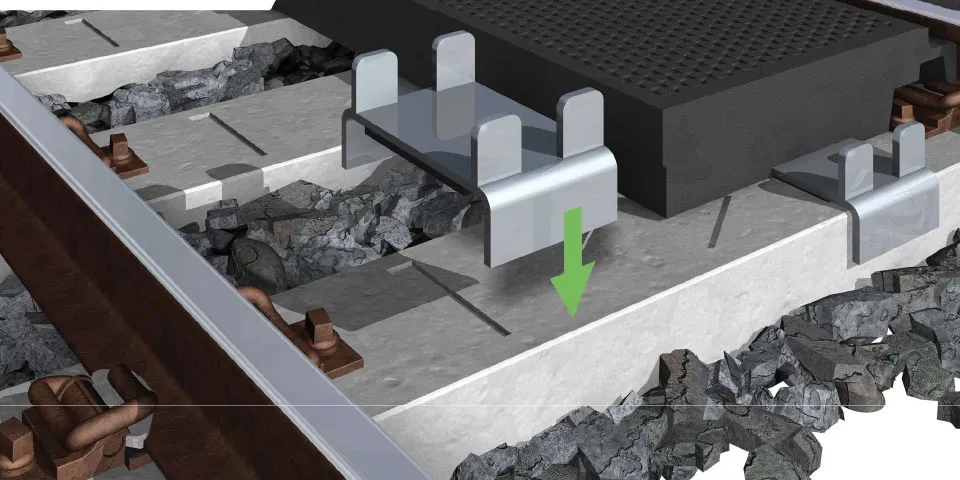
The baseplate for lighter traffic is connected to a steel frame underneath.
The crossing panels are manufactured in a press using an innovative, environmentally friendly “Cold Curing” method to ensure a long service life. Van den Rijen says: “These crossings are hard-wearing, extremely easy to maintain and able to withstand many years of heavy traffic and all weather conditions.”
Crossings can be made to measure for points, or cut to fit other special track infrastructure. For such specific situations, Alom prepares a laying plan. “Rosehill crossings can also be laid on curves. We design a bespoke solution for each track structure,” says Van den Rijen. “At the Amstelveen Line stabling yard, the panels are also being installed around the sand-filling installation and the quick-service point.”
According to Van den Rijen, the Rosehill system offers a solution as rail traffic in the Netherlands is set to increase over the coming years. “It is therefore important to increase track availability as well. The Netherlands has around 2,500 level crossings in total. 1,800 of these are on public roads and are public crossing points. Reducing the duration of track possessions for maintenance is an important part of this.”
“You could think of Alom as the one-stop shop for the railway industry,” says Van den Rijen. “To continue the comparison, you can come to us for everything from a crate of Heineken to delicacies and all kinds of specialist ingredients. But we are also very happy to work things through with our customers, and we offer them added value. We can provide bespoke solutions to meet their specific needs. We (co-)engineer our own rail systems, and we can also supply what we design. For example, we developed our own rail system for the North-South Line in Amsterdam. We are extremely proud of that.”
Question about this story? Ask your question
Keep following this
Get an email when a new story is published. No account needed.
- SubjectBouwMat







