









Sewer built using a double-wall pipe system
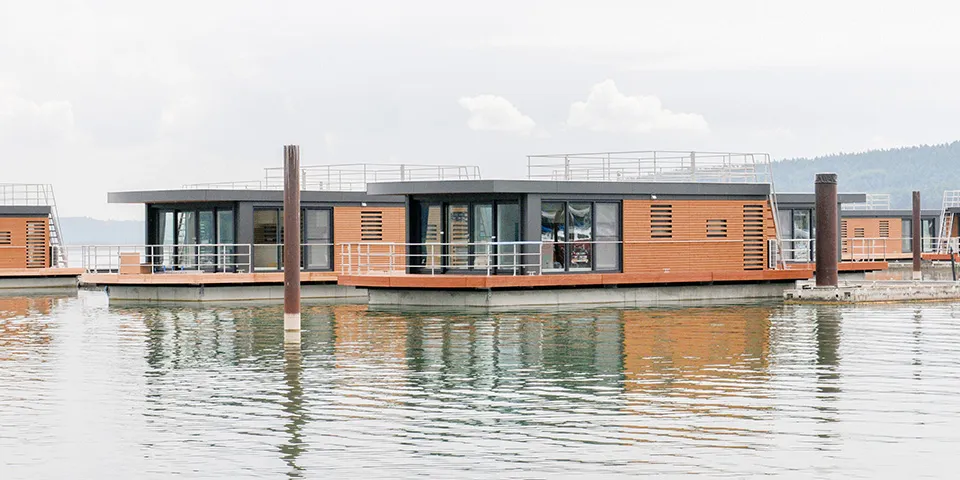
The Great Brombachsee lies about 40 km south of Nuremberg. The lake was opened in 2000 and is home to one of Germany’s largest dams, both in terms of surface area and storage capacity. In response to the growing number of tourists, 20 floating houses were built on the lakeshore in February 2018. Alongside various other facilities, each house has a carefully designed sanitary installation. The sewer pipes were welded from the double-wall AGRU Poly-Flo pipe system, made from PE 100-RC.
Wastewater is safely transported through a pressure sewer in Brombachsee to a collection tank on the mainland. From there, the collected wastewater is pumped on to the wastewater treatment plant. Special precautions must be taken when constructing and operating sewers in water catchment areas such as Brombachsee. In this zone, pressure pipelines with a very high risk potential must have double walls. Another challenge in planning and carrying out the project was the changing water levels. This was because the pipes connected to the pontoons, which provide a floating foundation for the houses, extend to the mainland. The pipeline therefore had to be flexible enough to accommodate a difference in water level of up to 8 m.
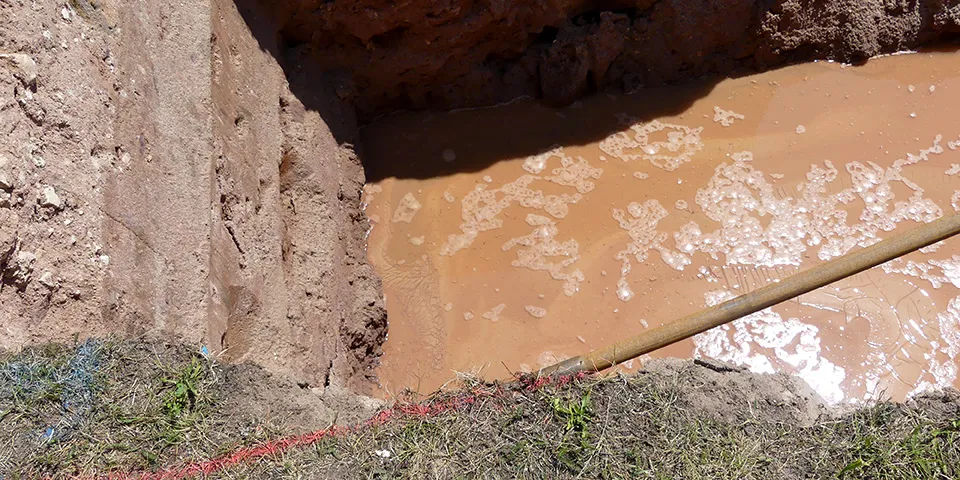
In the shoreline area, a 10 m-wide section had to be crossed using horizontal directional drilling.
Troubleshooting
FRANK GmbH succeeded in providing an economical and technically sound solution to all these challenges with the AGRU Poly-Flo double-wall pipe system, made from the thermoplastic material PE 100-RC. The Poly-Flo system features a double-wall pipe extruded as a single strand, providing a high level of system safety. Potential leaks in the inner pipe can be detected in the integral annulus by the leak detection system installed there. The outer pipe contains the conveyed medium, preventing it from entering the lake. A positive-pressure leak detection system was selected to monitor the double-wall pipe system. In this process, both walls of the system are checked for leaks. The monitoring pressure is higher than any internal or external pressure on the walls during operation, so a drop in pressure indicates a leak.
A constant monitoring pressure of 1.5 bar is maintained in the annulus of the Poly-Flo pipe system. The pipes and fittings for this highly compact double-wall system are produced in a single manufacturing process, by extrusion (pipes) or moulding (fittings). Continuously extruded webs make it easy to align the inner and outer pipes. One advantage of the continuous webs is that the pipes can be separated at any point, as required by the isometric design. The components are considerably smaller, allowing for straightforward installation even in confined spaces. The individual double-wall pipe components were joined by simultaneous welding. As this process welds the inner and outer pipes at the same time in a single step, it was the ideal solution from both an economic and a processing perspective. A double-wall pipeline made from PE 100-RC is highly flexible, allowing it to accommodate the large difference in height between the connection point on the mainland and the pontoons without additional fittings.
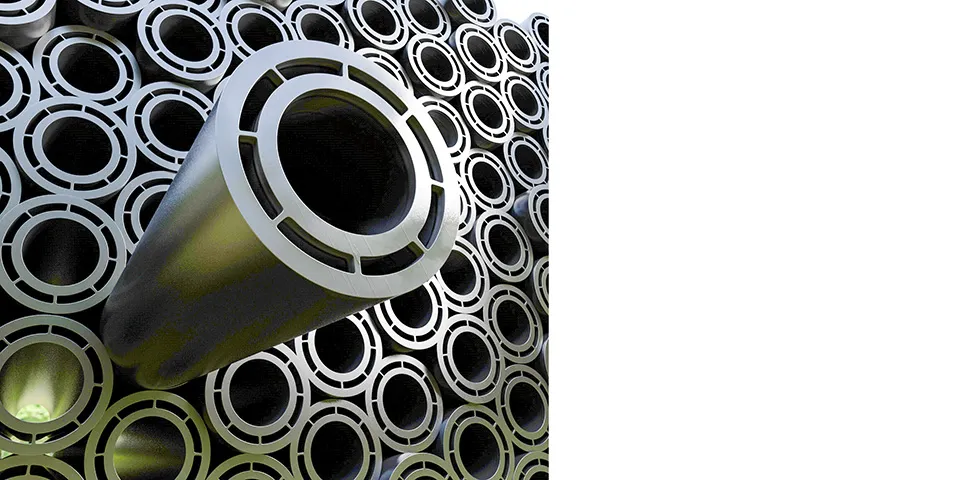
AGRU Kunststofftechnik extrudes the Poly-Flo double-wall pressure sewer as a single strand.
Why PE 100-RC?
PE 100-RC was selected for the project. The innovative PE 100-RC material (resistant to cracking) has much greater resistance to slow crack growth than PE 100. Thanks to this increased resistance to stress cracking, pipe systems made from PE 100-RC can also be installed without a sand bed. As well as its resistance to corrosion from the surrounding water, PE 100-RC’s resistance to the changing temperatures in Brombachsee was an advantage over other materials. Since the wastewater may also contain larger solid particles, PE 100-RC’s excellent abrasion resistance was another decisive factor in the material selection.
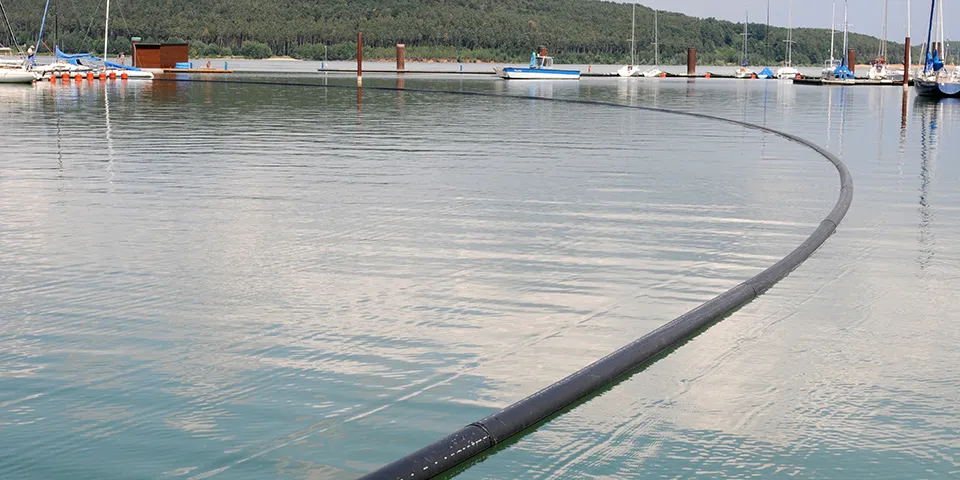
The highest safety standards apply to wastewater disposal in a water catchment area. AGRU’s Poly-Flo pipeline is equipped with a leak detection system in the annulus.
Implementation
The pipes serving as connection sewers between the individual houses are made from Poly-Flo PE 100-RC OD 90/63 pipes manufactured by AGRU Kunststofftechnik. Once installed, the wastewater collected from all the floating houses is pumped into the main sewer. The main sewer, made from Poly-Flo PE 100-RC 160/110 pipe, and the connection pipes were welded directly on site. A 10 m-wide public footpath lies between the lake and the wastewater holding tank on the mainland, so the route had to be drilled underground. The horizontal directional drilling (HDD) method was used. To allow the pipe section to sink slowly to the bottom of the lake, it had to be weighted down. This was done by filling the pipe with water and adding pipe clamps embedded in reinforced concrete. The project was completed within the planned timeframe. The “Floating Houses” quickly became popular after completion, offering tourists comfortable accommodation on the beautiful Brombachsee.
Question about this story? Ask your question
Keep following this
Get an email when a new story is published. No account needed.
- SubjectBouwMat







