









Push-off system gains market share in the Netherlands
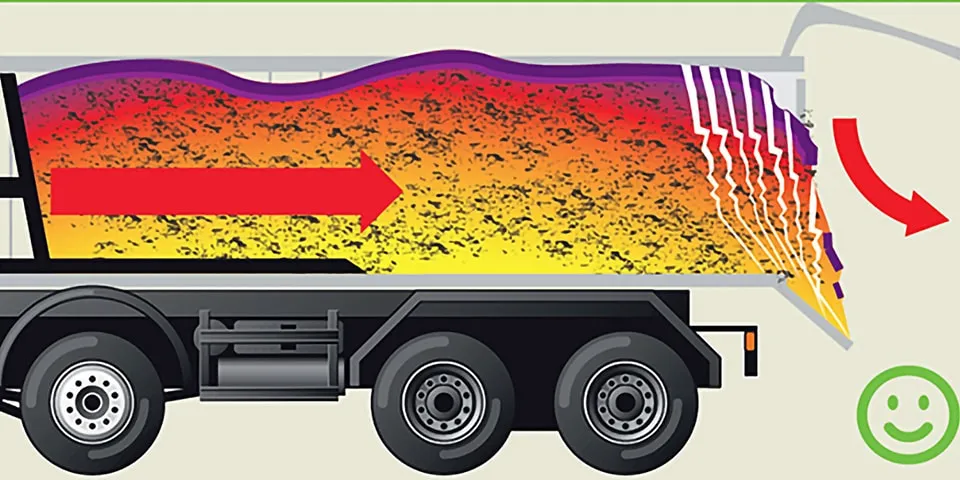
Their push-off system celebrates its 21st anniversary this year. Since 2008, the Fliegl push-off system has also been built to transport road construction materials such as sand, gravel, soil, (fat) clay, (crushed) rubble, etc. In the early years, it was mainly used as a soil dumper and was extensively tested in extreme off-road conditions. The first Fliegl push-off systems were adapted for asphalt in 2012. This has resulted in a fully developed product that is very well suited to practical needs.
The practical benefits
There is no risk of the trailer tipping over during unloading. Safety comes first, and the system delivers operational reliability. Loads can be discharged in tunnels and buildings, beneath traffic lights, viaducts and trees. Downtime is kept to a minimum because the body is always clean after unloading, even when transporting materials such as ZOAB, OPA, SURF asphalt and very sticky clay. The load is discharged horizontally, while still allowing all road construction materials to be transported. When Fliegl user Ton van de Laarse (Millenaar en van Schaijk) was asked to sum up his push-off trailer in one sentence, he said: ‘Safe, manoeuvrable and very easy to maintain’.
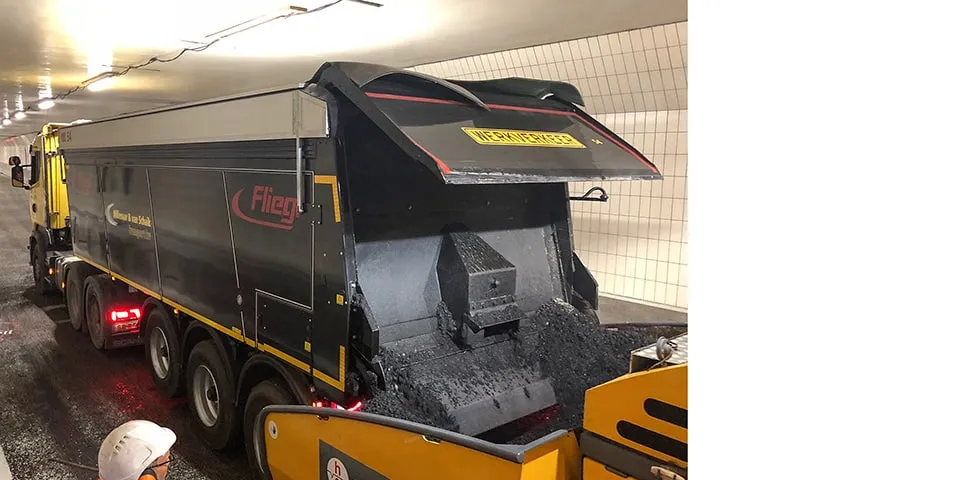
Loads can be discharged in tunnels and buildings, beneath traffic lights, viaducts and trees.
A practical solution to prevent asphalt segregation
In recent years, Fliegl has conducted research, including in collaboration with TU Wien (A) and TU Darmstadt (DE), into the effect of the Fliegl push-off system on asphalt segregation. The research found that conventional tipping causes both thermal and mechanical segregation. This means that the discharged material is not delivered homogeneously into the paver, resulting in very poor areas in the newly laid road surface. The research also led to the following conclusion: the use of the Fliegl push-off system greatly reduces the segregation of bitumen and temperature variations during transport. With the push-off system, all layers of asphalt in the body, including large and small bitumen particles and both warm and cooler material, are fed into the paver at the same time. The result is a highly homogeneous product, which gives the asphalt a much longer service life. This significantly reduces the client’s maintenance costs during the warranty period, while enabling the client and haulier to work together sustainably.
Question about this story? Ask your question
Keep following this
Get an email when a new story is published. No account needed.
- SubjectBouwMat







