









Push-off system gains market share in the Netherlands
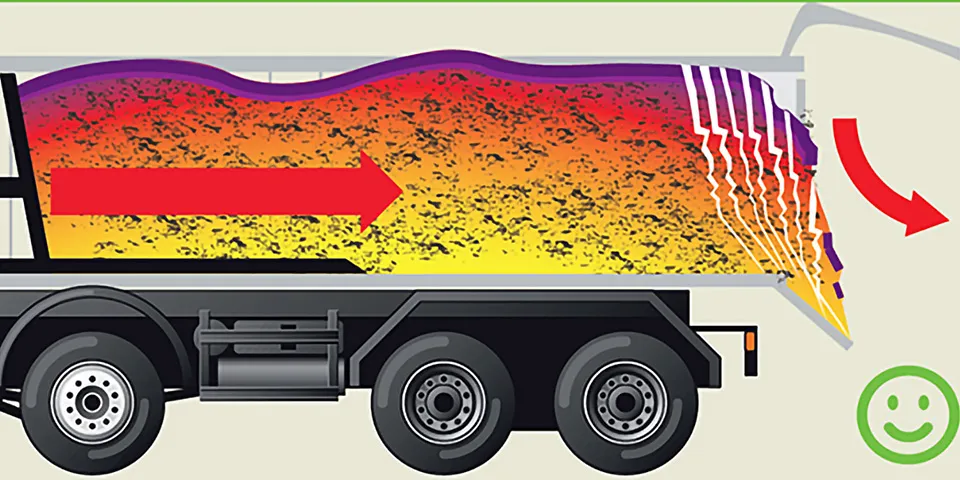
Their push-off system is 21 years old this year. Since 2008, the Fliegl push-off system has also been built for transporting road construction materials such as sand, gravel, soil, (wet) clay, (crushed) rubble, etc. In its early years, it was used mainly as a soil dumper and extensively tested in extreme off-road conditions. The first Fliegl push-off systems were adapted for asphalt in 2012. Today, the result is a further-developed product that meets the demands of real-world applications very well.
The practical benefits
There is no risk of overturning during unloading. Safety comes first, and the system offers operational reliability. Loads can be discharged in tunnels and buildings, beneath traffic lights, viaducts and trees. Downtime is kept to a minimum because the body is always clean after unloading, even when carrying materials such as ZOAB, OPA and SURF asphalt, or very sticky clay. Loads are discharged horizontally, while the trailer can still transport all types of road construction material. When Fliegl user Ton van de Laarse (Millenaar en van Schaijk) was asked to sum up his push-off trailer in one sentence, he said: “Safe, manoeuvrable and very easy to maintain.”
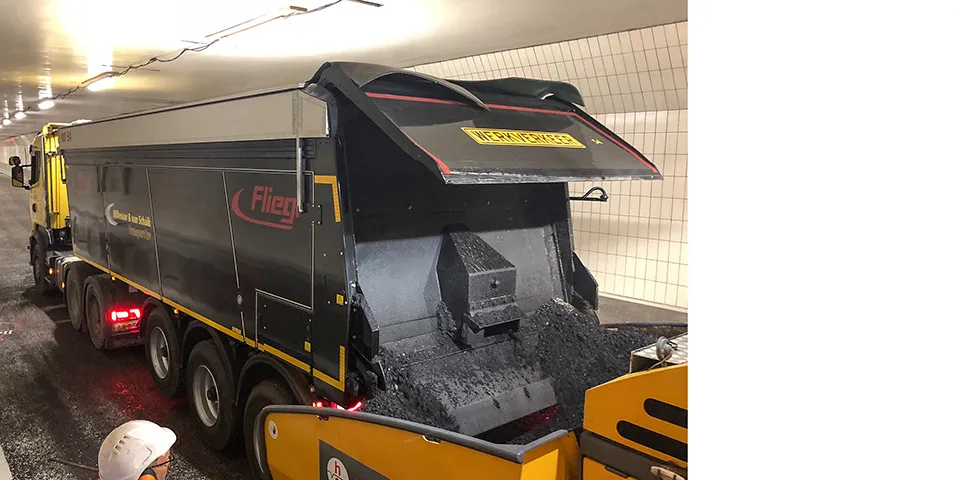
Loads can be discharged in tunnels and buildings, beneath traffic lights, viaducts and trees.
A practical solution to prevent asphalt segregation
In recent years, Fliegl has conducted research in collaboration with, among others, TU Wien (A) and TU Darmstadt (DE) into the effect of the Fliegl push-off system on asphalt segregation. The studies found that conventional tipping causes both thermal and mechanical segregation. This means that the discharged material is not delivered homogeneously into the paver, resulting in very poor sections of newly laid road surface. The research also led to the following conclusion: the use of the Fliegl push-off system greatly reduces the separation of bitumen and temperature variations during transport. The system feeds all layers of asphalt in the body, including large and small bitumen particles, as well as warm and cooler material, into the paver at the same time. The result is a highly homogeneous product and a much longer asphalt service life. This significantly reduces the maintenance required by the client during the warranty period. At the same time, the client and haulier can operate in a more sustainable way together.
Question about this story? Ask your question
Keep following this
Get an email when a new story is published. No account needed.
- SubjectBouwMat







