









New wood waste grinder guarantees an excellent cost per tonne
A passion for trees and forests. In 2000, Kristof Mouton decided to turn it into his profession. In just twenty years, Groep Mouton has grown into a leading name in forest management and operations.
Guided by Lansink’s Ladder, the right ecological and economic destination is found for every piece of timber, from the largest trunk to the smallest woodchip. With its recent purchase of the Vermeer HG4000 wood waste grinder, Mouton is showing the way forward for the coming years: a greater focus on biomass and wood recycling.
His studies in garden design and landscaping already revealed his green fingers, but when Kristof Mouton began building his professional career, he chose forestry. “Trees and wood are materials that inspire me. I inherited my entrepreneurial spirit from home.” When he started out in 2000, his days were initially filled with simple jobs such as pruning. Today, with around 25 employees, Group Mouton specialises in all-round forest management, operating across Flanders, Brussels and Hainaut, and even extending across the borders into France and the Netherlands. The company is contributing to the second phase of the Oosterweel connection, for example, while also helping to remove shoots that have taken hold on Ghent’s Gravensteen. “We always aim to treat the surrounding environment as carefully as possible. Simply picking up a chainsaw is an overly simplistic approach. If we want to build a valuable future, we need to keep recycling and recovering materials,” Mouton says.
Specialist people and machinery
“On the one hand, our strength lies in our years of experience. When I started out, you could count our competitors on one hand. This gave us the opportunity, as a company, to build up our fleet of machinery step by step, so that we can now carry out every stage in-house. That means everything from mapping forests, trees and timber, to managing permits, carrying out all the work and recovering materials.” The guiding principle is to look for the best solution for the materials in each case, following Lansink’s Ladder. Groep Mouton also has its own sales channels. “On the other hand, our strength also lies in the wide range of work we can handle. We have the capacity and specialist expertise, as well as the people and machinery, to complete large projects in a short time. We also have the right machines for specialist work. Two people in our workshop are permanently responsible for maintenance and repairs, and for adapting standard equipment even more closely to our needs.”
HG4000: mobility and flexibility are key
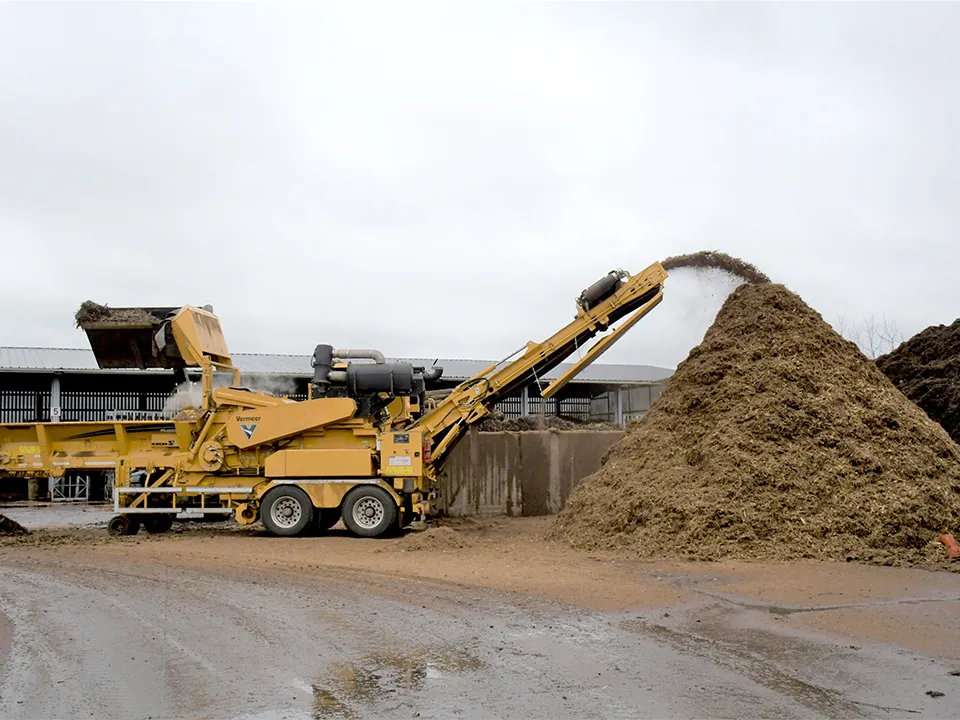
The latest addition to the fleet is the Vermeer HG4000. It is an investment in the future, as Mouton wants to continue growing and sees opportunities to expand its activities in biomass processing and the recycling of grade A and B wood. “Vermeer was actually one of our first suppliers. In recent years, there was a trend towards tailoring every block of wood to specific requirements. That meant we had to look across the border for machines designed for a particular waste stream. These were often expensive investments. The trend has now shifted again, and we can look at Vermeer machines, which are affordable, offer an excellent cost per tonne and come with a high level of confidence in the service.” Mouton spent a long time weighing up the HG4000 and the HG6000. “The heavier, larger machine ultimately was not quite as well suited to our work. The mobility and flexibility offered by the HG4000 are very strong advantages. It does not even need an abnormal-load permit to travel on the road.”
Reliable operation assured
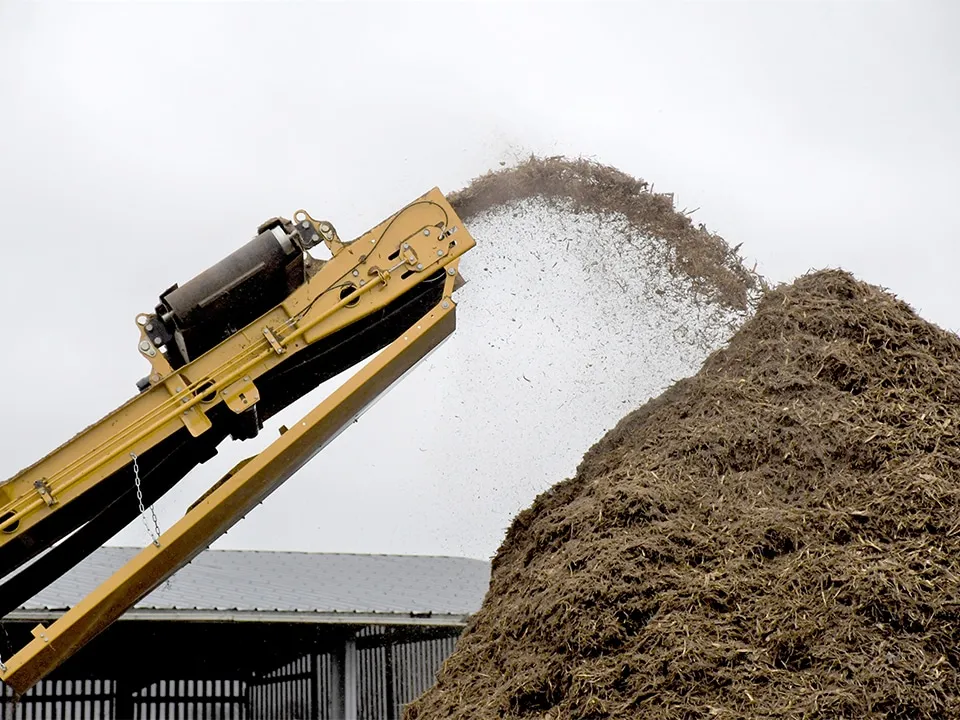
Those are not its only advantages. “The machine’s immediate availability played an important role in our decision, as we needed extra capacity quickly. Technically, the decisive factors were the infeed capacity and the accessibility of the screening surface. We were already familiar with Vermeer’s technology, and they have clearly not been standing still in recent years. A great many specifications have been improved. The hammers have been reinforced, for example, and the rotor is better protected. These are important features for continuous, reliable operation. That is also why we opted for the Damage Defense system. The machine has only been running for a week, but it has already stopped certain pieces of metal from reaching the rotor. It removes many potential obstructions before they can cause damage.” The machine will operate mainly at the site in Lochristi. “But it will also work at our second plant in Bernissart, which we are now setting up. We want to work locally, with local people. The new location also creates opportunities to expand our operations in northern France.”
Question about this story? Ask your question
Keep following this
Get an email when a new story is published. No account needed.
- SubjectBouwMat







