









New rainfall index: The Hague hardest hit by extreme rainfall
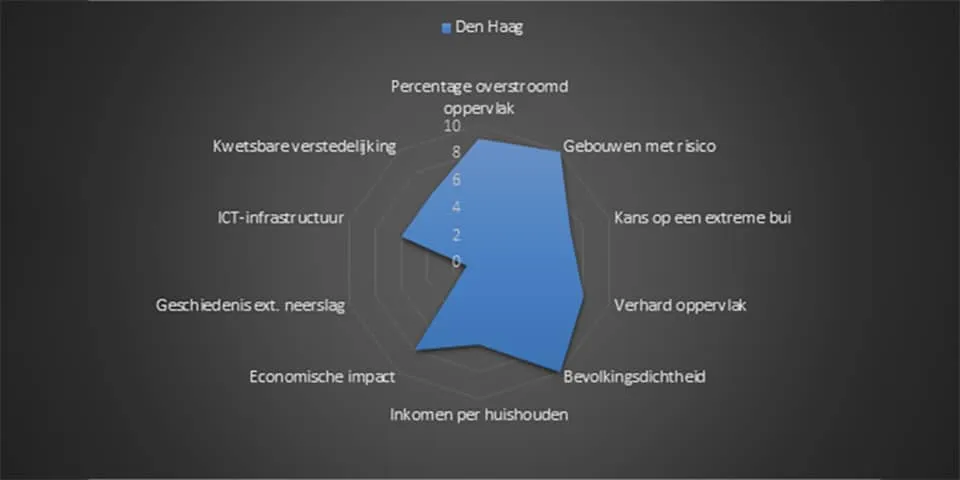
TU Delft and consultancy ‘HKV lijn in water’ have developed a rainfall index to compare the risks posed by extreme rainfall in different cities. The method has been applied to the provincial capitals in the Netherlands. The Hague fares worst.
Heavy downpours are increasingly causing flooding in urban areas. When excess rainwater cannot be drained quickly enough through sewers, ditches and canals, pluvial flooding occurs. Ongoing urbanisation means that an ever larger proportion of the ground is covered by impermeable surfaces. However, measures can reduce both the likelihood and the impact of this flooding.
Benchmark
TU Delft bachelor’s student Tjerk Krijger has developed a method for assessing and interpreting the risks posed by extreme rainfall, and comparing cities, under the supervision of dr.ir. Bas Kolen (TU Delft and consultancy ‘HKV lijn in water’) and dr.ir. Saskia van Vuren (TU Delft and Rijkswaterstaat). The method is based entirely on open data and quantitative analysis, making it reproducible. This makes it possible to compare cities effectively.
The latest rainfall statistics and models were used to determine the volume of water on the ground during peak rainfall events. The method was applied to the provincial capitals in the Netherlands. Various parameters were quantified to assess risk and define ambitions, including the number of properties that could be affected, the number of residents and the number of reports.
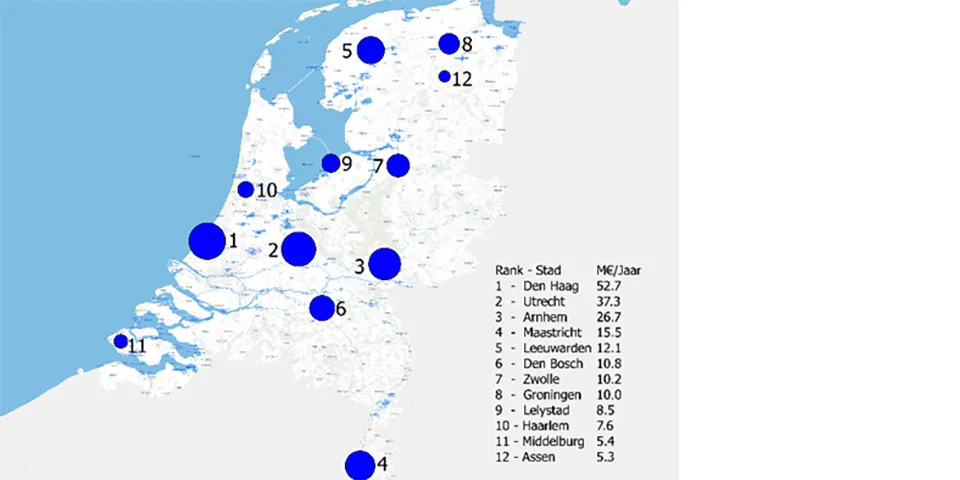
Flood risk associated with extreme rainfall in the provincial capitals of the Netherlands. The size of each circle indicates the scale of the risk.
Risk on the rise
For each city, the risk was calculated and the cities were then ranked according to their risk. This was done for the current situation (2018) and for the future (2050). Climate change (a greater likelihood of extreme rainfall) and socio-economic developments (urbanisation and economic growth) increase both the likelihood and impact of extreme rainfall. The study shows that this applies to all the cities examined.
The Hague
Of all the provincial capitals, The Hague has the highest rainfall risk in both 2018 and 2050. The rainfall index shows that The Hague has the largest number of buildings affected by extreme rainfall and faces the greatest economic impact from pluvial flooding. The index also confirms the high level of risk: The Hague has a relatively large proportion of impermeable surfaces and a high level of urbanisation.
However, expected economic growth (more than 80%) contributes more to the increase in risk by 2050 than the expected increase in rainfall (8%). Economic development also presents opportunities to reduce rainfall risk.
Reducing risks
The rainfall index shows that cities such as The Hague have clear options for reducing or better managing rainfall risk. For example, more green spaces could be created to reduce the area of impermeable surfaces. Parts of the city could also be renovated or raised, reducing the number of buildings that may be affected by extreme rainfall.
Encouraging climate adaptation
Using the rainfall index, cities can set specific ambitions for different parameters and translate them into practical objectives. Bas Kolen: ‘Our ambition is to further develop the method, adding new parameters and improving the relationships between risks. We believe that this approach, by comparing cities, offers an interesting way to encourage municipalities to take action on climate adaptation. We intend to publish an update to this list for all cities in the Netherlands every few years.’
Text and image: Land+Water trade journal
Question about this story? Ask your question
Keep following this
Get an email when a new story is published. No account needed.
- SubjectBouwMat







