









More intelligence in infrastructure
“The Netherlands’ infrastructure is becoming increasingly intelligent. Structures, railway points, … from now on, they will all be fitted with sensors that generate data.” So says Robert Voûte of CGI. The international automation company helps organisations with the digital transformation they need to make.
CGI is originally a Canadian ICT company and operates worldwide, with almost 80,000 employees across 400 offices in forty countries. CGI also has a strong presence in the Netherlands, with 2,500 employees in seven offices. “We operate in a wide range of sectors and offer a full portfolio of ICT services. In the infrastructure sector in particular, we do a lot of work for government bodies, the Kadaster, major infrastructure contractors, Rijkswaterstaat and ProRail.”
Contract partner
“In the infrastructure sector, we are not subject-matter experts, but we do know what is going on and how to build smart computer or automation systems on or around it,” Voûte continues. He gives an example: “For Rijkswaterstaat, for instance, we are a contract partner in the Areaal Informatie Rijkswaterstaat (AIR) programme.” ProRail has a similar programme, SIGMA, for managing its assets, particularly the location of the railway line. CGI is also closely involved in that. “The rails lie loose on the ballast bed,” says Voûte. “They shift from their original position and, after a while, need to be pushed back to their original designed location. We built the system that monitors the alignment of the rails. We do not carry out the measurements ourselves, but we process all the measurement data so that ProRail can see the condition of the track and what needs to be done to put the rails back in position.”
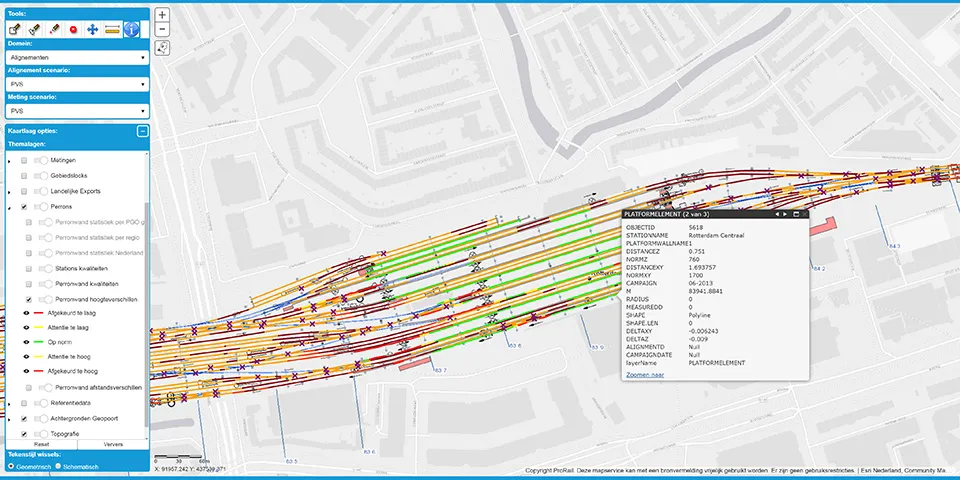
Platform edge height at Rotterdam CS.
Naiade
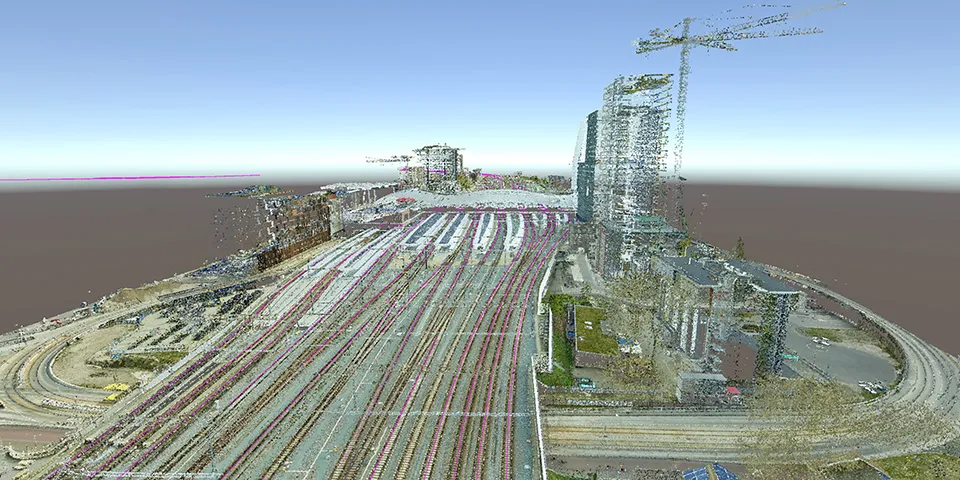
SIGMA is not the only project CGI is carrying out for ProRail. Voûte says: “We are also closely involved in Naiade, a programme that integrates the geographical and functional data for all spatial railway assets, such as buffer stops, points, level crossings and overhead lines. Using a standard software solution, we have built a bespoke suite for and with ProRail that is gradually being transformed into a 3D solution. The subsoil, the track bed and the area 50 metres to the left and right of the track are also surveyed digitally and visualised in Naiade. Contractors carrying out work on or alongside the railway also benefit from having a single source of integrated data.”
Digital transformation
Voûte believes the infrastructure sector still has a major digital transformation ahead of it. “Sensor data can help improve the maintenance of infrastructure and identify anomalies earlier. This requires a huge amount of ICT to process all the data, manage processes and so on. At CGI, we are seeing more and more operational processes in infrastructure being automated, which means the underlying software architecture has to be highly robust. Mission critical is a core value for us in infrastructure, as is cyber security. Extensive automation must not allow a malicious actor, for example, to take control of a pumping station.”
“Location- and time-specific data are already inextricably linked to infrastructure, and their importance will continue to grow,” Voûte concludes.
Question about this story? Ask your question
Keep following this
Get an email when a new story is published. No account needed.
- SubjectBouwMat







