









Making infrastructure smarter
“Dutch infrastructure is becoming increasingly intelligent. Civil engineering structures, railway points, … from now on, they will all be fitted with sensors that generate data.” So says Robert Voûte of CGI. The international technology and consulting company supports organisations in the digital transformation they need to undertake.
CGI is a Canadian IT company by origin and operates worldwide, with almost 80,000 employees across 400 offices in forty countries. CGI also has a strong presence in the Netherlands, with 2,500 employees in seven offices. “We work in a wide range of sectors and offer a comprehensive portfolio of IT services. In the infrastructure sector, we work extensively for government bodies, the Land Registry, major infrastructure contractors, Rijkswaterstaat and ProRail.”
Contract partner
“In the infrastructure sector, we are not subject-matter experts, but we do know what is going on and how to build smart computer or automation systems around it,” Voûte continues. He gives an example: “For Rijkswaterstaat, for instance, we are a contract partner in the Areaal Informatie Rijkswaterstaat (AIR) programme.” ProRail has a similar programme, SIGMA, to manage its assets, particularly the alignment of the railway line. CGI is also closely involved in that. “The rails rest loosely on the ballast bed,” says Voûte. “They shift from their original position and, after some time, need to be pushed back to their originally designed location. We built the system that monitors the alignment of the rails. We do not carry out the measurements ourselves, but we process all the measurement data so that ProRail can see the condition of the track and what needs to be done to return the rails to position.”
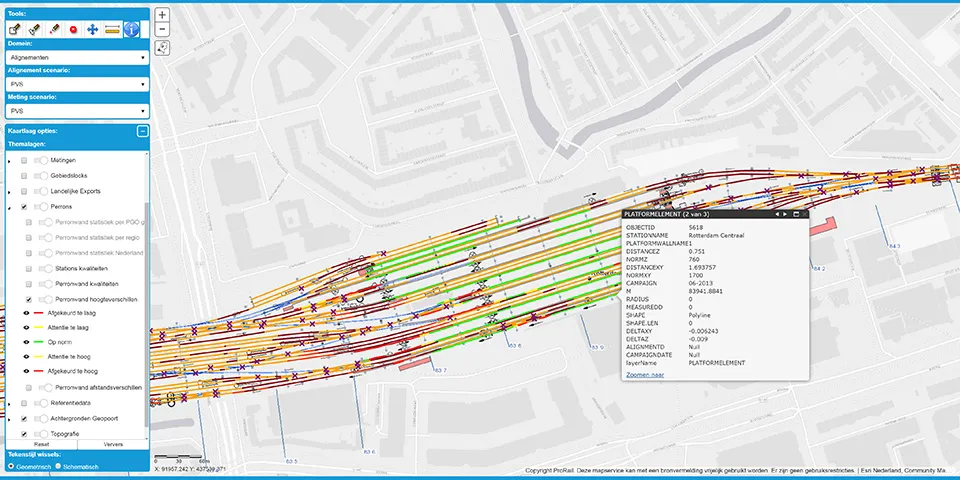
Platform edge height at Rotterdam CS.
Naiade
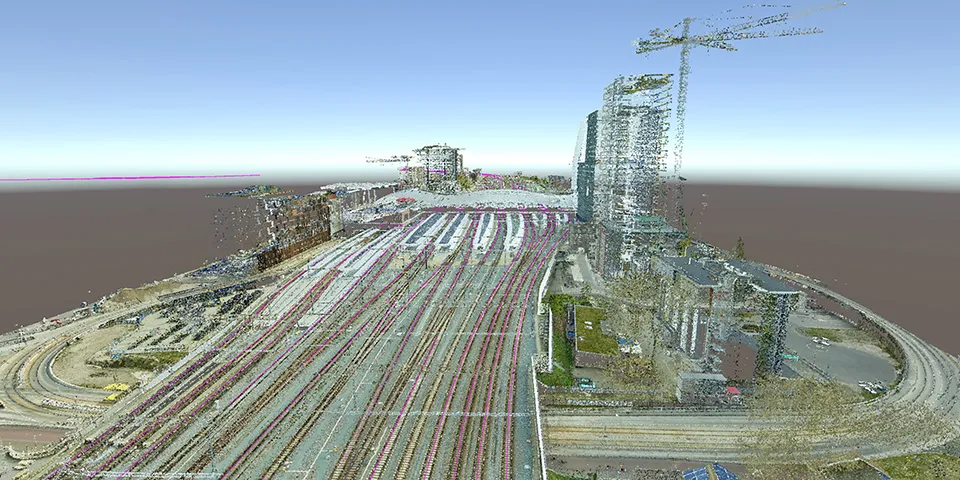
SIGMA is not the only project CGI is carrying out for ProRail. Voûte says: “We are also closely involved in Naiade, a programme that integrates the management of geographical and functional data for all spatial railway assets, such as buffer stops, points, level crossings and overhead lines. Using standard software, we have developed a bespoke suite with and for ProRail that is gradually evolving into a 3D solution. The subsoil, the track bed and the area 50 metres to the left and right of the railway are also digitally surveyed and visualised in Naiade. Contractors carrying out work on or alongside the railway also benefit from a single source of integrated data.”
Digital transformation
Voûte believes the infrastructure sector still has a major digital transformation ahead of it. “Sensor data can help improve the maintenance of infrastructure and detect anomalies earlier. This requires a huge amount of IT to process all the data, manage processes and so on. At CGI, we are seeing more and more operational processes in infrastructure being automated, and the underlying software architecture has to be highly robust. Mission-critical systems are a core value for us in infrastructure, as is cyber security. Extensive automation must not allow a malicious actor, for example, to take control of a pumping station.”
“Location- and time-based data are already inextricably linked to infrastructure, and their importance will grow,” Voûte concludes.
Question about this story? Ask your question
Keep following this
Get an email when a new story is published. No account needed.
- SubjectBouwMat







