









Investing in climate-resilient measures is hugely important
The Netherlands is now facing four climate trends: temperatures are rising, conditions are becoming drier,
heavy rainfall is becoming more extreme and sea levels are rising. The effects and consequences vary from sector to sector. But in every case, adaptive measures are needed to prevent major
problems and high costs.
Flooding on the one hand, drought on the other
Not only flooding but also drought causes problems in both the short and long term. We are seeing that persistently low groundwater levels can cause timber pile foundations to deteriorate through wood rot, or shallow foundations to subside. For roads, railways, cables and pipelines, this results in (differential) settlement, leading, among other things, to unplanned maintenance and speed restrictions. However, persistently high groundwater levels also affect buildings and infrastructure. This can lead to flooding and structural damage. To tackle these kinds of problems, we need to learn from the past and try to prevent future impacts by taking action NOW and investing in solutions.
But how? Fugro has an idea. Fugro is the world’s leading geo-data specialist, gathering extensive information about the Earth and everything people have built on it. “But our work goes beyond data collection,” says Leo Zwang,
Director Water Europe at Fugro. He notes that action is being taken to address the challenges posed by climate change, but geotechnical expertise remains underrepresented. “Current climate stress tests do not call for geotechnical experience, even though geotechnics plays a hugely important role in the problems we have just described. Fugro makes those connections, ensuring that opportunities are not missed. We are keen to get involved as early as possible and contribute to the design of the subsurface. This can save money on long-term management and maintenance.”
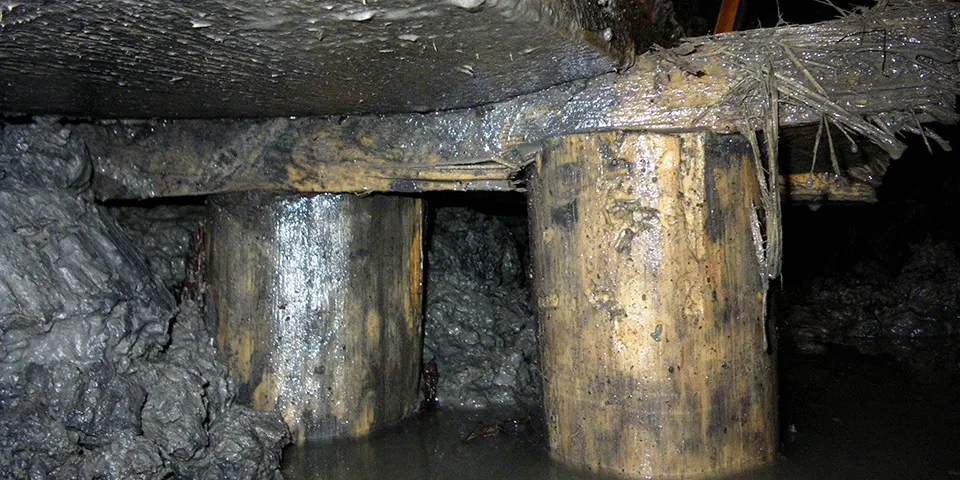
Damage to timber pile foundation caused by exposure to air.
Climate change in current designs
“We are currently seeing more and more circular roads being built. That is a positive development. However, this often only covers the road layout and the use of more sustainable materials above ground. Rainwater is still often drained in the traditional way, via roadside ditches into the water system. There are significant gains to be made here, particularly in areas affected by drought,” says Zwang.
“A good example of such a project is the provincial road Epe-Heerde (N-794), where Fugro developed a climate-resilient geohydrological design. The road runs along the edge of the Veluwe. From a geohydrological perspective, this is a challenging area. This is due to major groundwater fluctuations, variations in the road’s ground level and the presence of streams with high ecological value, into which no rainwater from the road surface may be discharged. Flooding had been experienced at several locations along the road. The drainage system was tailored to the site and designed to fit within the ‘limited’ space available. Various (new) techniques were used, including DSI rainwater infiltration wells, to meet the requirements. This made it possible to reconstruct the road in line with the requirements, providing sustainable drainage while also resolving the flooding experienced by local residents.”
Climate-resilient urban areas
“Creating climate-resilient urban areas is one of our goals,” adds Wouter Kooijman, Senior Advisor Hydrology at Fugro. “But we also look at climate resilience in agriculture, infrastructure and real estate. It is impossible to design climate-resilient areas without taking the soil and water management into account.” Kooijman believes new forms of contract will create opportunities in this respect. “When developing a climate-resilient design proposal, Fugro assesses at an early stage whether the soil and water conditions are suitable for a particular solution. If they are not, we then investigate whether the area can be made suitable. If that is not possible either, we ask whether other choices can be made for the design. Fugro advises throughout this process. We also look for ways to store surplus water in winter and draw on it during periods of drought.” Zwang concludes: “We are already seeing sustainability and climate adaptation above ground, but there is also much more that can be done proactively below ground. We are more than happy to help shape that. We also have unique technology, such as permeability cone penetration tests (HPT), to verify our designs reliably.”
A business enquiry for Fugro? Get in touch
Companies in this story
Keep following this
Get an email when a new story is published. No account needed.
- SubjectBouwMat
- CompanyFugro







