









‘InfraTech excels at addressing current issues, even now’
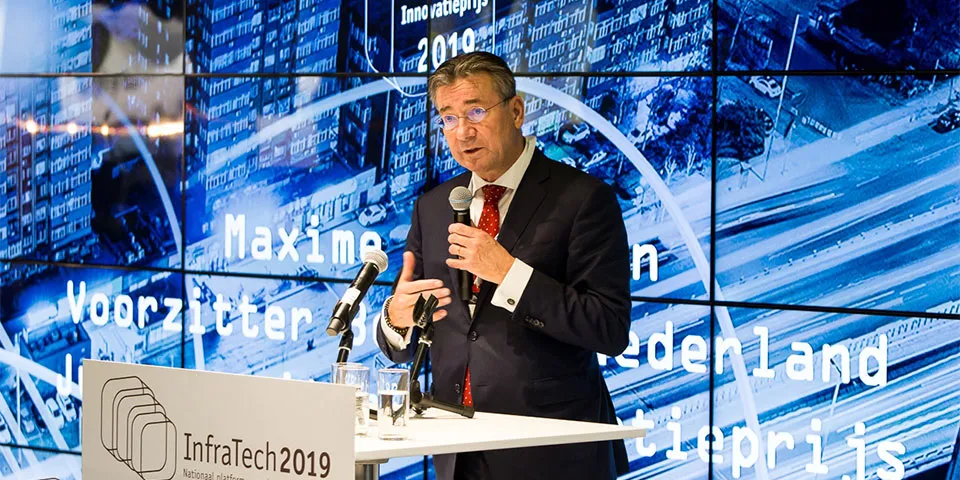
In the run-up to InfraTech 2021, InfraTech aims to be the platform where the various parties can meet and learn from one another. That is one reason why online talk shows are held every month, with discussions and debate on the various themes of the trade fair. Two episodes are already available online under the title ‘InfraTech Series’: one on mobility in a 1.5-metre society and one on digital infrastructure.
If the coronavirus crisis, which is still ongoing, has shown us anything, it is that unexpected situations can lead to radical change. The virus and its consequences have had a huge impact on almost all the topics covered at InfraTech. Coronavirus has shown that, as a society, we are capable of radically changing our mobility habits. Almost overnight, we were able to work from home en masse, leave the car at home and avoid public transport.
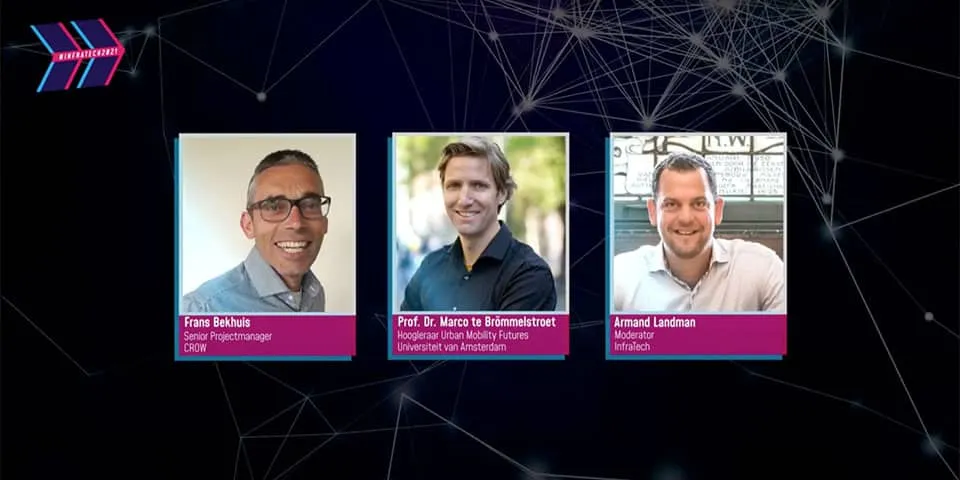
“The discussion about what kind of streets we want to live in has suddenly become more relevant than ever,” said Marco te Brömmelstroet, Professor of Urban Mobility Futures at the Faculty of Social and Behavioural Sciences of the University of Amsterdam (UvA), in the first episode of InfraTech Series. “And what role does mobility still play in our streets? We can now see that it no longer necessarily has to take centre stage. The Netherlands is an example to the world of how well you can organise different types of traffic.”
Room to move
But according to Te Brömmelstroet, the coronavirus crisis has also exposed how much space cars take up in the public realm, even when they are stationary. “People suddenly realised that the space available to pedestrians and cyclists is very limited compared with the area allocated to cars. And when you use your car much less, you suddenly start wondering why the pavement can’t be a bit wider, or why there is so little greenery in a residential area. These are issues that are suddenly up for discussion.”
Frans Bekhuis, Senior Project Manager for Mobility and Public Space at CROW, has noticed this too. “We are now receiving more requests to redesign streets with less space for motorised traffic. The coronavirus crisis has accelerated this trend.”
Both say that rethinking mobility and the design of public space also requires political courage. Bekhuis: “Mobility is a public and collective interest. That calls for government leadership. And things are indeed changing. Take the former infrastructure fund. It is now called the Mobility Fund, and its money is no longer automatically allocated to motorways, but also to facilities for cyclists. A broader perspective is being taken.”
Digital infrastructure
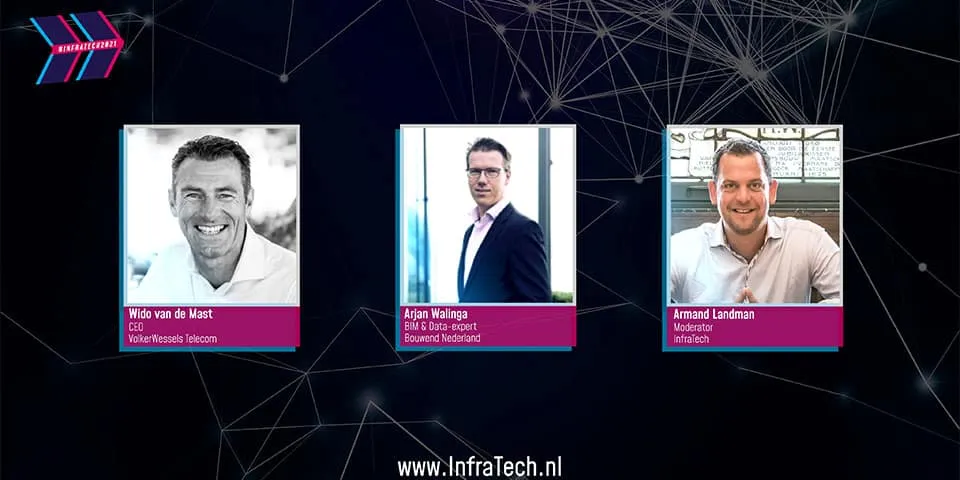
In 2020, the design of public space can no longer be considered without also taking digital infrastructure into account. That was the message from Arjan Walinga, BIM&Data expert at Bouwend Nederland, during the second episode of InfraTech Series. “With all the different users of public space, residents, pedestrians, cyclists, parcel delivery workers, businesses supplying shops and construction traffic, wouldn’t it be great if smart sensors and technologies could be used to predict how busy it will get and where? This could then help manage a great deal of traffic and make a city more liveable.”
Wido van de Mast, CEO at VolkerWessels Telecom, believes that this in turn calls for more coordination. “There is certainly room for improvement, particularly in the permitting process. We need to communicate better with each other about when disruption will occur and when a pavement or road needs to be dug up. There are still significant differences between municipalities. I think there is room for improvement there.” Van de Mast argues for a more integrated approach to installing digital infrastructure. “Telecom is often an afterthought in area development, as well as in the construction of homes and offices. Often, a building is completely finished before anyone realises that a fibre-optic cable should have been installed. Connectivity is forgotten. A major obstacle is the siloed way we have organised things. But if you see connectivity as a skewer running through everything, you can decide much earlier how and when to install things.”
Knowledge platform
These are the kinds of current issues at which InfraTech excels. The 14th edition will be no different. Together with hosts Rijkswaterstaat and the Municipality of Rotterdam, and partners such as Bouwend Nederland, CROW and Bouwcampus, preparations are under way for an engaging, content-rich programme. This programme will have a larger hybrid component than ever. But it will of course be just as innovative and informative, with ‘connecting and moving forward together’ taking centre stage more than ever.
Visit www.infratech.nl for the latest information and follow the LinkedIn page.
A business enquiry for InfraTech? Get in touch
Companies in this story
Keep following this
Get an email when a new story is published. No account needed.
- SubjectBouwMat
- CompanyInfraTech







