









Industrial listed building gets 7,000 m2 of coloured concrete roof slabs
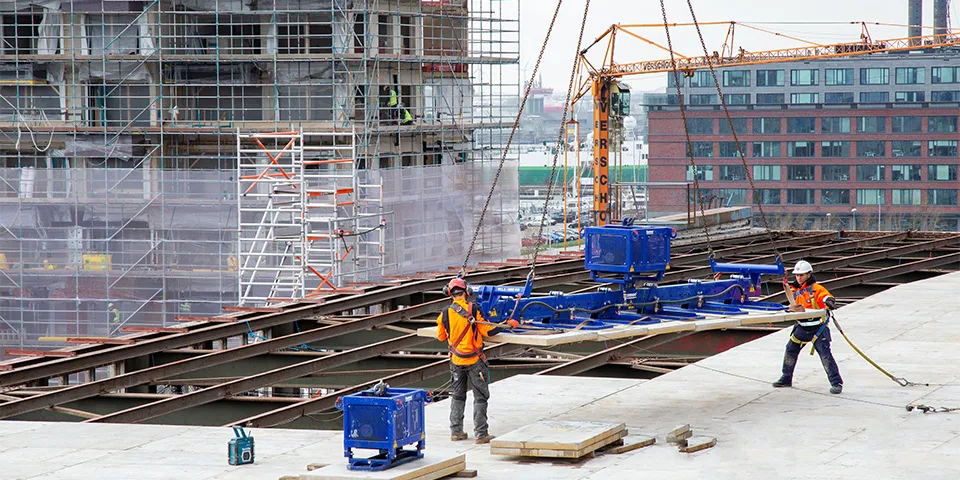
The former yard of the Nederlandsche Dok en Scheepsbouw Maatschappij (NDSM) lies directly on Amsterdam’s IJ. In this emerging urban district, the listed welding shed is currently being transformed into an international cultural hotspot, home to the world’s largest Street Art Museum (6,500 m²). The roof, in particular, needed extensive work.
The site was also known as the ‘cathedral of NDSM’. This was where enormous ship components were once welded together, before rolling out through the immense blue doors as ships or hulls. The building is a tall, rectangular industrial hall with solid brick façades, square cross windows and a flat roof, enlivened by four shallow pitched roofs running across its width and serving as rooflights.
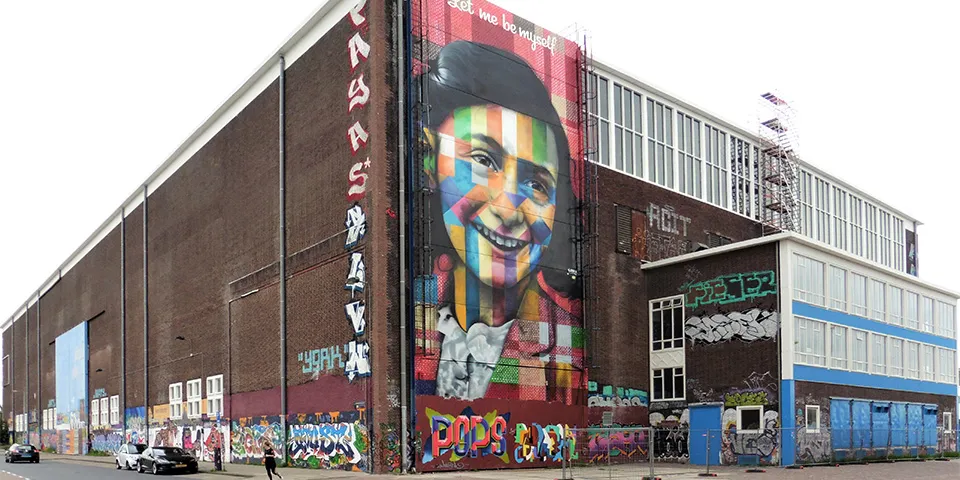
Listed industrial heritage to become the largest
Street Art Museum.
Before the ‘cathedral’ could become a museum, however, several changes were needed, particularly to the roof. The industrial heritage building’s pumice concrete roof, dating from 1952, was leaking and unsafe, so it had to be replaced. The new roof slabs needed to match the originals in appearance, dimensions and colour, while being as lightweight as possible. This is why, around three years ago, BMB ontwikkeling (Mediawharf bv) approached Betonfabriek Nigtevecht to produce replacement roof slabs measuring 2000 x 500 mm. The request was a perfect fit for the concrete factory, located between Amsterdam and Utrecht. For more than 60 years, the company has produced a wide range of concrete products using the ‘direct-stripping system’. This allows larger quantities to be produced each day, resulting in shorter production and delivery times and lower costs. The company works largely to customer specifications. Following several meetings and calculations, it was decided to install 1,000 mm-wide roof slabs with a dummy joint, preserving the appearance of the original dimensions while halving the number of installation operations.
Ochre yellow to preserve the original colour
Years of welding in the former welding hall had left the pumice concrete roof slabs with an ochre-yellow tint from the rising welding fumes. The request was therefore to preserve this colour and give the underside of the roof slabs the same pigmentation. Betonfabriek Nigtevecht’s production process allows concrete products to be pigmented throughout, as well as finished with polymer-modified cement mortar in various colours, including the required ochre yellow. Monumentenzorg opted for this solution. Bouwbedrijf Regiobouw Haarlemmermeer then expertly installed the roof slabs.
Question about this story? Ask your question
Keep following this
Get an email when a new story is published. No account needed.
- ThemeMaterials and techniques for infrastructure
- SubjectBouwMat







