









Earthworks are a Work of Art
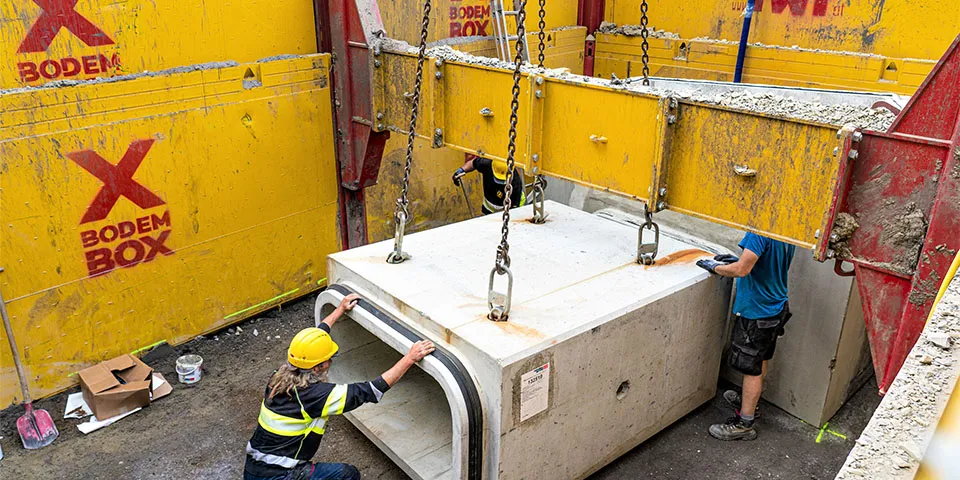
We can’t say it often enough: “Earthworks are a Work of Art”. Unfortunately, we still see unsafe excavations every day. In the Netherlands, we have developed the control of groundwater and the task of keeping our country dry, despite ever-rising sea levels, into a real specialism. So why aren’t we applying the same level of expertise to earthworks?
The success of a project often depends closely on how the earthworks are carried out. There is more to digging a hole or trench than meets the eye. Before starting to excavate, it is important to know what soil layers will be encountered and where the groundwater level is. Excavation with natural side slopes is only possible if the site conditions and soil layers are understood. After all, a slope in clay or loam is more likely to remain stable than one in loose sand. A natural slope is therefore not always the same steepness, nor can its angle be determined solely by the space available.
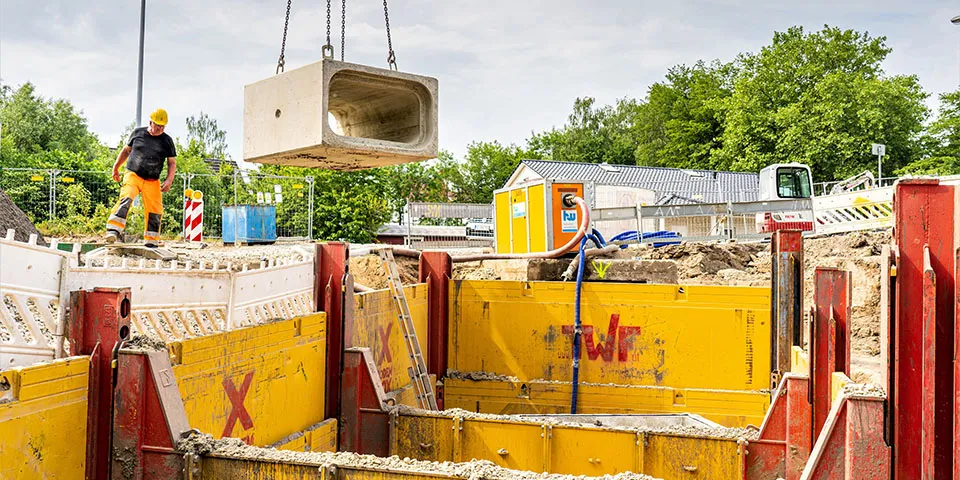
Hoisting a sewer chamber into a closed BodemBoX construction pit using a Dubbelgeleide BoX system.
An excessively steep slope may remain stable in some cases, but it can also fail badly. Factors such as rainfall, groundwater and the load behind the slope can cause it to collapse without warning and lead to settlement. The consequences may include subsidence of nearby buildings, sewers and/or cables and pipelines. The risks to workers in the trench are clear.
Of course, the consequences described above will not simply occur in every case, and there are plenty of situations where everything goes well. But if the consequences of settlement can be so serious, why would you even consider excavating without ground support in a questionable situation? It is like wearing PPE or using fall protection: the risks of the work are clear, and you protect yourself against the one time something goes wrong, because when it does, it can go very badly indeed.
On this basis, choosing to use a BoX system should be an easy decision. In reality, the opposite is true, because using a BoX system has implications for your project. But there are many other benefits to using a BoX system beyond safety. For example, less earth has to be excavated because there are no sloped sides to dig out and backfill afterwards. This means less working space is needed, and loads in the form of plant and materials can be placed right next to the pit or trench. This brings many logistical benefits that can help with planning and project duration. Other advantages include fall protection if the BoX system is allowed to extend above ground level, or the option of clamping a fence to it.
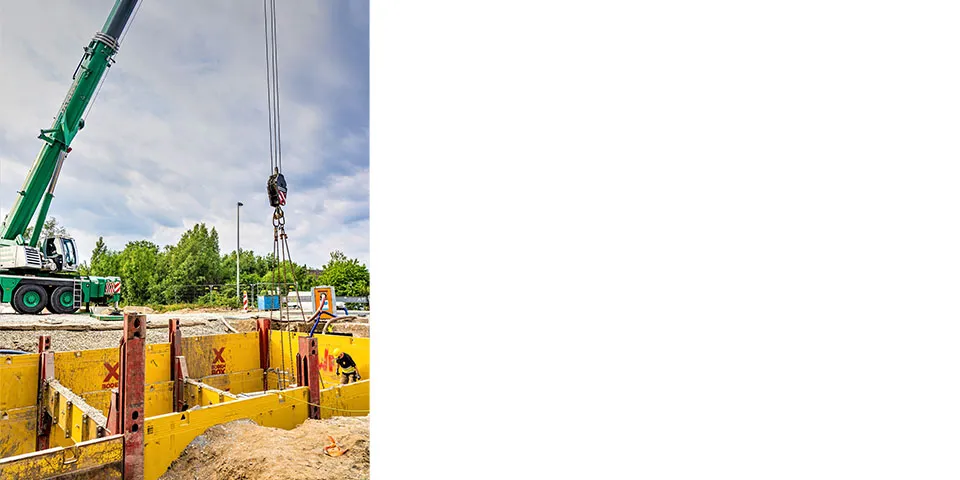
The use of trench support is often said to cause delays. Assembling the BoX systems takes time, and installation does not always go smoothly, which also takes extra time. Is that really the case? Fast assembly of a BoX system comes down to proper preparation and instruction. At BodemBoX, they ensure that site workers have the right knowledge to assemble a BoX system correctly first time. They do this by providing a detailed construction drawing tailored to your project. A manual is also provided with each BoX system delivery, but it is not a lengthy document, just one clear, easy-to-follow sheet. With every BoX system you hire, you can also receive free on-site instruction from one of their trained instructors. Last but not least, BodemBoX can provide extra hands to assemble the BoX system and help with installation. This way, you are guaranteed a safe pit or trench while also being sure of a fast, practical construction method. You handle the earthworks, and BodemBoX delivers the work of art!
Question about this story? Ask your question
Keep following this
Get an email when a new story is published. No account needed.
- SubjectBouwMat







