









Drinking water pipeline rehabilitated without excavation
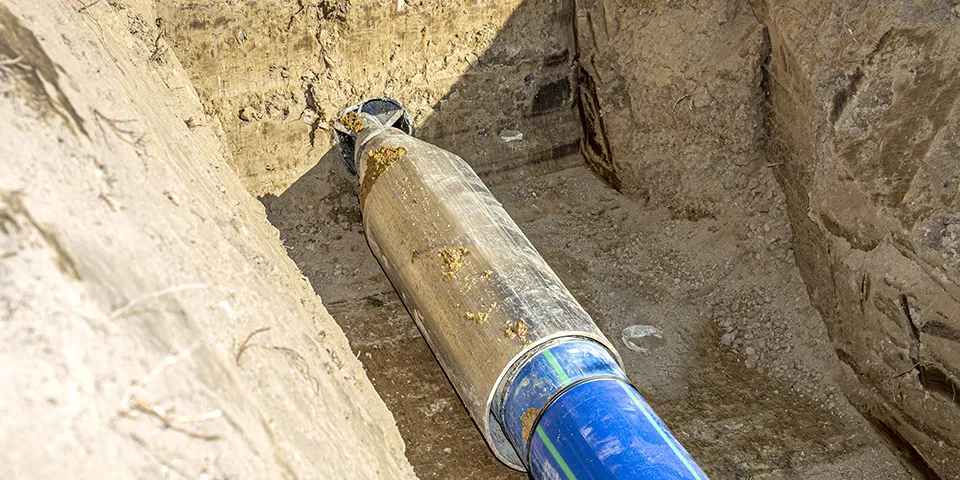
In Bad Hall, one of the oldest drinking water pipelines still in service is to be replaced. The old 250 mm da fibre-cement pipeline has been operating at full capacity for some time. In addition, several pipe bursts have had to be repaired over the years. AGRU protective-jacket pipes, 315 mm da and SDR 17, installed using the pipe-bursting method, are now being used as replacements. This soil-friendly rehabilitation method avoids having to remove the old pipeline and ensures that the new pipeline follows exactly the same route.
A 450 m-long 280 mm da pressure pipeline to the Voglhub elevated reservoir and a 1,800 m-long 315 mm da trunk main, with a branch from this elevated reservoir, are to be installed. On its way to the Pfaffenwimm elevated reservoir, the trunk main overcomes a height difference of 17 metres, and pressure in the pipeline system reaches 5.5 bar at the lowest point.
The last fibre-cement pipe was installed in 1979
“Unfortunately, there have been a few pipe bursts in this area in recent years,” says Anton Pöllabauer, managing director of the Bad Hall Kurbezirk Waterverband. As the person responsible for maintaining the new PE pipeline system, quality and service life are very important to him: “The last fibre-cement pipe was installed in 1979. For more than 20 years, however, we have installed only PE pipe systems from AGRU. We have rehabilitated older water pipelines with AGRU protective-jacket pipes using pipe bursting and ploughing methods, and have had very good experiences with them. We expect the newly installed pipes to have a service life of at least 50 years.”
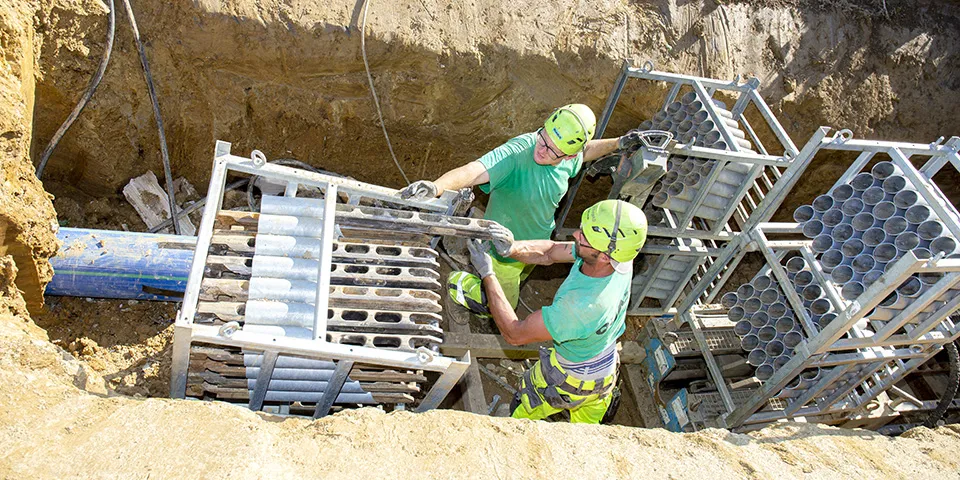
In the reception pit, the sections of the pulling rod are removed from the machine and stacked
Lower installation costs thanks to long pipe strings
To ensure the most economical installation possible, the pipe-burst lining method is being used again this time. The principle is that installation costs decrease as the length of the pipeline strings being pulled in increases. The contractor, WDS Bau GmbH, an Upper Austrian civil engineering specialist known for its careful pipeline installation, calculates the maximum pulling lengths between the launch and reception pits based on the ground conditions and the resulting pulling forces, which can reach pressures of up to 250 bar. Pipe strings up to 144 m long are made on site by butt-fusing 18 m-long protective-jacket pipes supplied by AGRU Kunststofftechnik GmbH. Sureline III pipes with a protective jacket provide double protection, as the stress-crack-resistant PE 100-RC core pipe is protected from fragments of the burst pipe by a scratch-resistant PP jacket when the pipe is clamped. A further advantage is the rapid butt fusion made possible by the factory-stripped ends. AGRU Kunststofftechnik supplied a CNC-controlled butt-fusion machine for the welding process. Thanks to the new technology, the temperature, pressure and time are pre-programmed, ensuring the quality of the welds. The parameters for each individual weld and the welder’s name are also documented. The completed pipe strings are then pulled into the old pipe using a burst-resistant lining. Pipe bursting is a cost-effective method for rehabilitating pipelines made of brittle materials without excavation. Breaking up the old pipe allows a new pipe with a considerably larger diameter to be pulled in. Some preparatory work is required.
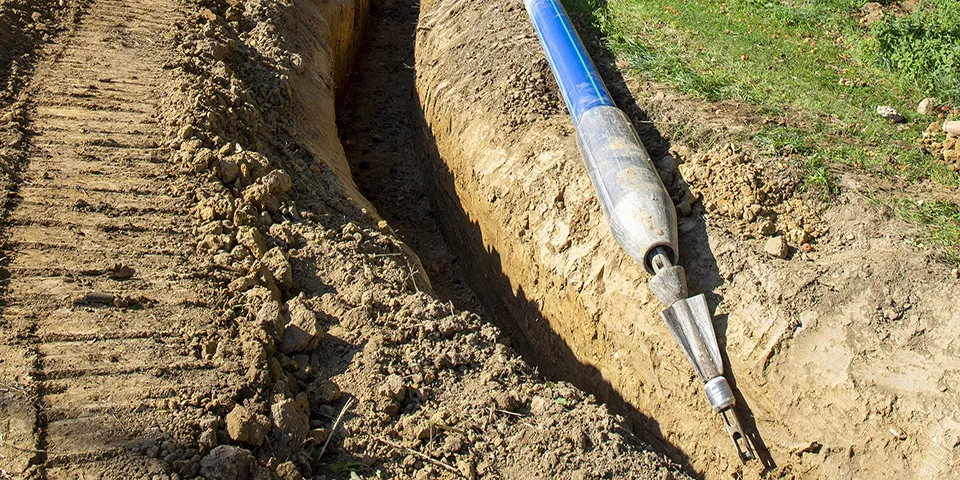
The breaking head and expansion cone are already mounted on the pipe
Pipe bursting: how it works
First, a camera is used to inspect the old pipeline. Metal fittings or cast concrete structures cannot be broken up and must therefore be removed using the open-cut method. The launch and reception pits are then excavated at precisely specified intervals. The breaking head with its expansion cone is located in the launch pit, with the pipe string to be pulled in attached to it. A hydraulic pulling device is located in the reception pit. The old pipe runs between the two pits, with a pulling rod made up of numerous sections inserted inside it. The stroke of the hydraulic cylinder on the traction unit corresponds exactly to the length of one section of the pulling rod. The breaking head is now attached to one end of the rod. The other end is connected to the traction unit. As the rod is pulled, the breaking head fractures the cement pipe into pieces. The expansion cone behind it pushes the resulting fragments into the surrounding soil, making way for the larger-diameter replacement pipe that follows. In this way, the old pipe can be broken up in a single operation, the bore enlarged and the new pipe pulled in. After each pull, the crew in the reception pit removes the new section of pulling rod from the pit. This process is repeated until the breaking head and the pipe behind it finally reach the reception pit. The pulling forces acting on the pipe are electronically recorded and documented throughout. Once installation is complete, the entire pipeline system is disinfected and pressure-tested.
Gerhard Dieringer is managing director of WDS Bau GmbH: “The welding machine supplied by AGRU worked perfectly. We divided the site into 12 sections for pipe-burst lining. We were able to burst and install 1 to 2 sections per day. We were very satisfied with AGRU Kunststofftechnik GmbH’s products and services, from preparation through to delivery and quality.”
Question about this story? Ask your question
Keep following this
Get an email when a new story is published. No account needed.
- SubjectBouwMat







