









Deepest point of Nieuwe Sluis construction reached!
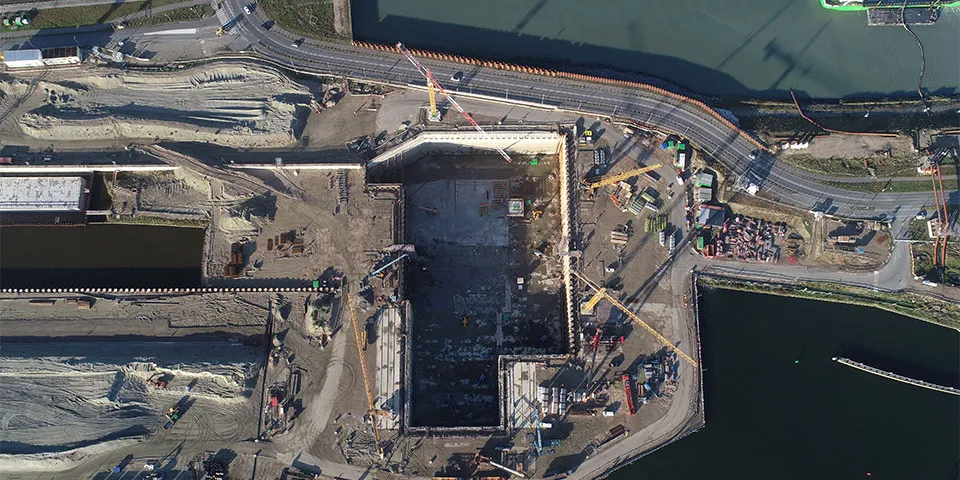
The outer head, the part of the lock where the gates and bridge will be located on the Westerschelde side, has reached its deepest point.
The bottom of this lock head is at -22 metres NAP. The outer head is now a dry construction pit around 25 metres deep. We marked this milestone in style. Today (Thursday 24 September 2020), the Nieuwe Sluis Terneuzen steering group and project directors were at the viewing point to see and celebrate the outer head’s deepest point.
- Eric Marteijn, project director, Nieuwe Sluis Terneuzen: “Reaching the deepest point of the construction is a high point in the building of Nieuwe Sluis. Together with contractor consortium Sassevaart, we work enthusiastically every day to achieve these great milestones.”
- Gerben Turkstra, project director, contractor consortium Sassevaart: “Hundreds of people from our design, construction and community relations teams are working purposefully and at pace on this lock. We are proud to have reached this milestone together.”
- Freddy Aerts, co-chair of the Nieuwe Sluis Terneuzen steering group: “We have reached the deepest point, and we are looking ahead with confidence to opening in 2023. This will boost economic development throughout the Canal Zone.”
- Theo van de Gazelle, co-chair of the Nieuwe Sluis Terneuzen steering group: “I am looking forward to the day when Rijkswaterstaat takes over this impressive Nieuwe Sluis for operation and maintenance. Nieuwe Sluis will then form part of a future-proof, sustainable and robust lock complex.”
Safe, watertight construction pit
Creating a dry construction pit for the outer head was no small undertaking. First, we excavated dry to -11 metres NAP. We then flooded the pit so that we could excavate under water to -22 metres NAP. Next, we laid a base of underwater concrete. After that, we dewatered the pit in stages, keeping a close eye on the walls and floor. We are now removing groundwater from beneath the base of the construction pit and discharging it back into the surrounding area. This recharge pumping is needed to reduce the pressure on the construction pit. Returning the water in this way keeps groundwater levels in the surrounding area stable. We are monitoring this closely. Now that we have a safe, watertight construction pit, we can start the complex concrete work required for the gate recesses, bridge chamber and levelling system. The inner head is expected to be a dry construction pit by early 2021.
Question about this story? Ask your question
Keep following this
Get an email when a new story is published. No account needed.
- SubjectBouwMat







