









Cycling was already healthy, now the cycle path itself is too!
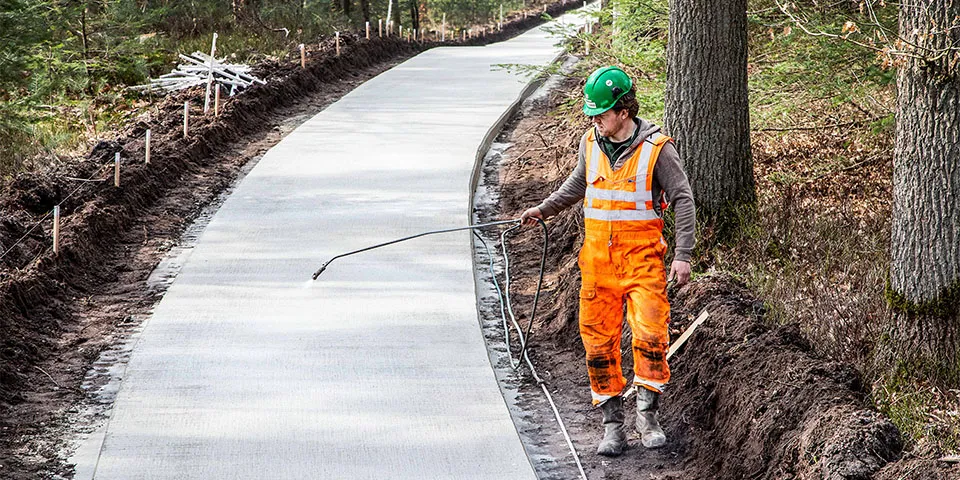
The Netherlands is known around the world as a cycling nation. The country is admired for the cycling infrastructure it has built. A new cycle path can now be added to its list of infrastructure achievements: the circular cycle path along Krimweg and Spoekweg in Hoenderloo.
We speak to Marc van der Weide, Technologist and Adviser at Schagen Infra, about this pioneering initiative by the municipality of Apeldoorn. “The municipality of Apeldoorn is keen to work sustainably. The key priorities for the new cycle path were therefore ‘durability’ and ‘sustainability’,” says Van der Weide, opening the conversation.
Waste materials become construction materials, sourced locally
Concrete was chosen for the cycle path. Schagen Infra joined Bruil Beton & Mix and the municipality of Apeldoorn in the project team as contractor. Van der Weide says: “We contributed to the development of the sustainable concrete mix. Concrete is a good fit for the requirements and wishes in terms of use, circularity and sustainability. Bruil designed a concrete mix incorporating recycled concrete aggregate from the De Parken neighbourhood in Apeldoorn, recovered from concrete rubble. Isn’t it a great idea, and a worthwhile ambition, to source some of the materials locally?”
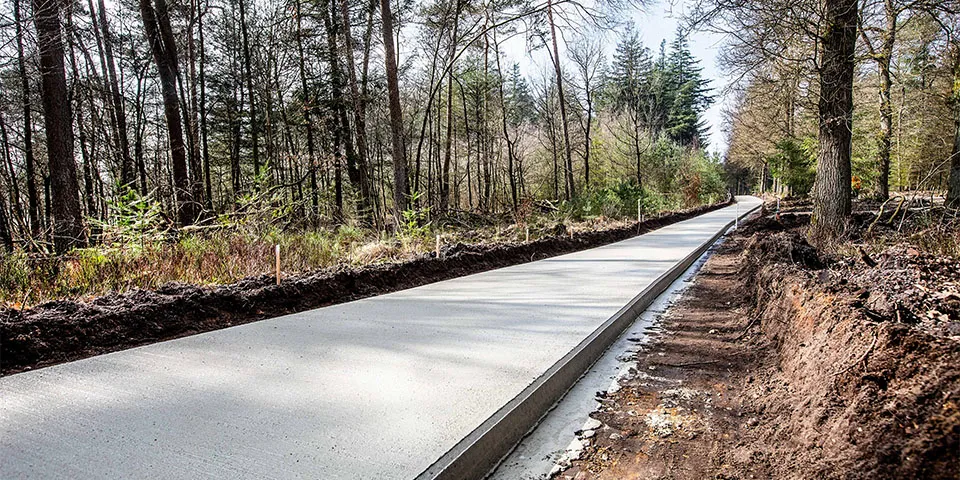
With this concrete mix, the curing time increased from an average of 10 days to around 3 weeks.
Sustainability was also improved in other areas, such as the use of binders. Careful choices were made about the type and composition of the binder used as a replacement for Portland cement. However, this brings new challenges. “Using less Portland cement automatically means a longer curing time and makes the concrete more vulnerable. We put up barriers along the cycle path to keep nearby wildlife off it and prevent unwanted imprints. Thermocouples were also cast into the concrete to measure temperature changes as the concrete pavement cured. The maturity index can then be used to establish when the concrete has reached sufficient strength,” explains Van der Weide. “With this concrete mix, the curing time increased from an average of 10 days to around 3 weeks. Once the concrete had cured, the verge could be finished neatly. To optimise the durability of the concrete pavement, a special treatment was applied after six months. The concrete mix used reduced CO2 emissions by 60%.”
Circularity is in the company’s DNA
Schagen Infra’s aim is to work as circularly as possible, and the company is a specialist in this area too. “We work circularly not only at production level, but also at project level. We always assess materials released during construction to see whether they can be reused,” says Van der Weide in conclusion.
Question about this story? Ask your question
Keep following this
Get an email when a new story is published. No account needed.
- SubjectBouwMat







