









Cycling was already good for your health, now the cycle path itself is too!
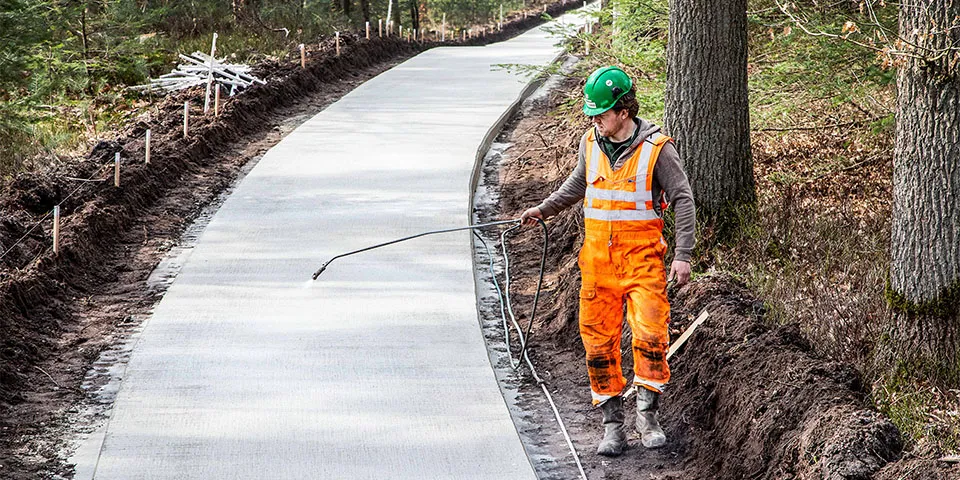
The Netherlands is known around the world as a cycling nation. People speak admiringly of the cycle infrastructure built here. A new cycle path can now be added to the list of infrastructure achievements: the circular cycle path along Krimweg and Spoekweg in Hoenderloo.
We speak to Marc van der Weide, Technology Adviser at Schagen Infra, about this pioneering initiative by the municipality of Apeldoorn. “The municipality of Apeldoorn is keen to work sustainably. The focus for the new cycle path was therefore on ‘durability’ and ‘sustainability’,” says Van der Weide as we begin our conversation.
Waste materials become building materials, sourced locally
Concrete was chosen for the cycle path. Schagen Infra joined Bruil Beton & Mix and the municipality of Apeldoorn in the project team as contractor. Van der Weide says: “We contributed ideas for the sustainable concrete mix. Concrete meets the requirements for use, circularity and sustainability in a good way. Bruil developed a concrete mix design incorporating recycled concrete aggregate from the De Parken district of Apeldoorn, recovered from concrete rubble. It is a great idea, and a worthwhile goal, to source some of the raw materials locally, isn’t it?”
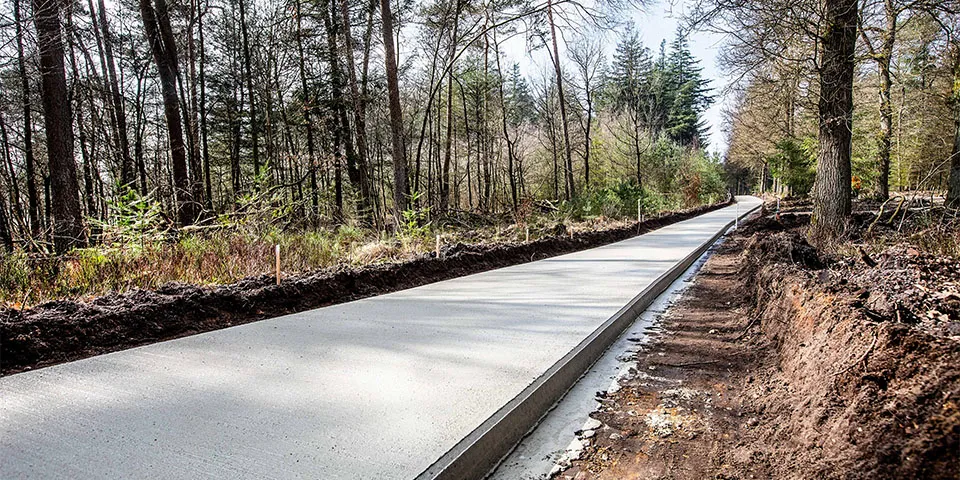
With this concrete mix, the curing time increased from an average of 10 days to around 3 weeks.
More sustainable choices were also made in other areas, such as the use of binders. The type and composition of the binder used as a replacement for Portland cement were carefully selected. However, this brings new challenges. “Using less Portland cement inevitably means a longer curing time and makes the concrete more vulnerable. We put up barriers along the cycle path to keep nearby wildlife off it and prevent unwanted imprints. Thermocouples were also cast into the concrete to measure temperature changes in the concrete pavement. The weighted maturity can then be used to determine when the concrete has reached sufficient strength,” explains Van der Weide. “With this concrete mix, the curing time increased from an average of 10 days to around 3 weeks. Once it had cured, the verge could be neatly finished. To optimise the durability of the concrete pavement, a special curing treatment was applied after six months. The concrete mix design used reduced CO2 emissions by 60%.”
Circularity is in the company’s DNA
Schagen Infra’s aim is to work as circularly as possible, and the company is a specialist in this area. “We apply circular principles not only in production, but also at project level. We always assess materials released during construction for their potential reuse,” says Van der Weide in conclusion.
Question about this story? Ask your question
Keep following this
Get an email when a new story is published. No account needed.
- SubjectBouwMat







