









‘Choosing sustainable timber protects forests’
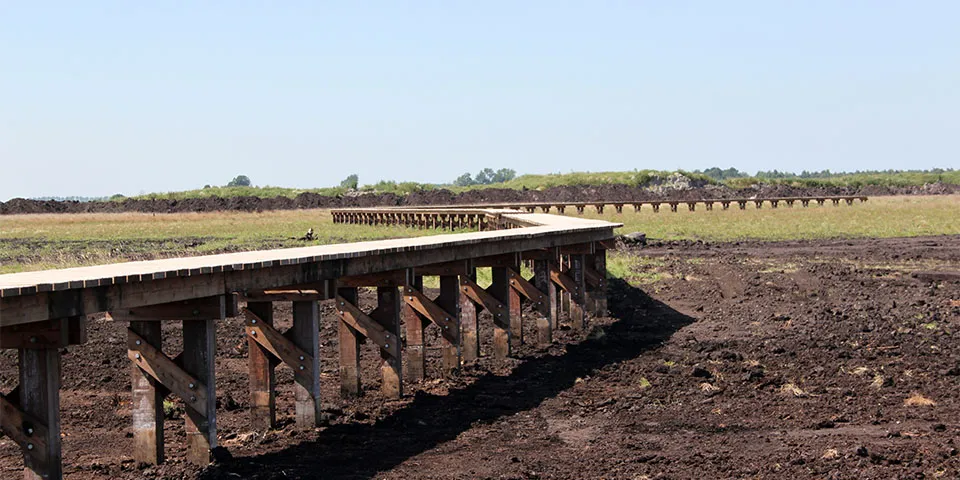
In Groningen, walkers cross a new wetland on a long footbridge. Certified timber is the foundation of this contemporary recreational project. A matter of course, according to the timber supplier, ‘because choosing verifiably sustainable timber protects the forest.’
Verifiably sustainable timber supports a footbridge across a new wetland
This is the Dannemeer footbridge in Schildwolde, Groningen. Dannemeer is a lake and peat wetland created between 2010 and 2014 in Groningen, covering a total area of 525 hectares as a nature reserve. In the interests of sustainability, farmland has been returned to nature, and in future a solar farm will form a buffer between the nature reserve and the agricultural hinterland. A sustainable cluster, then. A wooden footbridge has been built in the area, giving walkers a distinctive experience as they cross a wetland on verifiably sustainable timber.
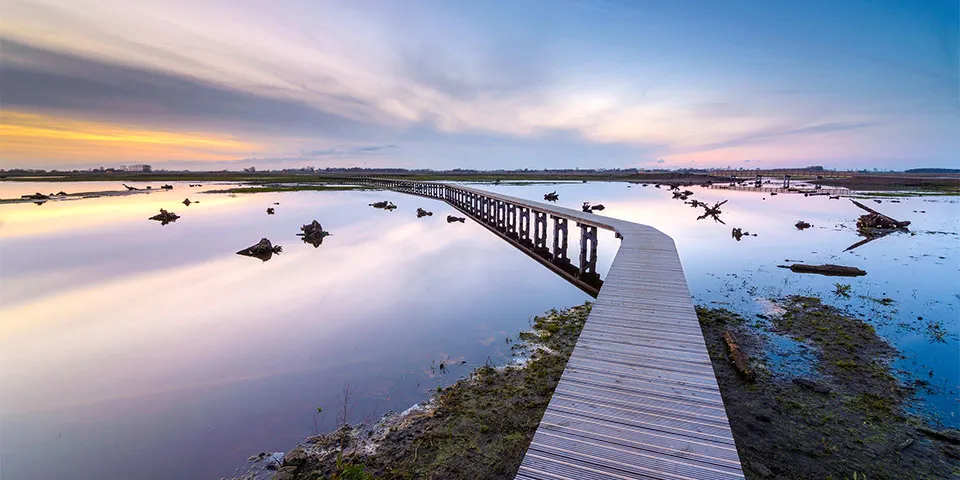
Dannemeer is a lake and peat wetland created between 2010 and 2014 in Groningen.
Klaas Jan Swager, the timber supplier for this project, explains: “The government is the client and the contractor carried out the project. The government requires the timber to be supplied in accordance with specific sustainability criteria.” This means that the timber must meet sustainability criteria regarding its origin. A certificate for sustainable sourcing makes this verifiable. Foreco goes a step further: “We want to help ensure that the right timber is used in the right place. In this case, we therefore opted for a composite product made from softwood and hardwood.”
The footbridge is made from composite piles: 40% certified tropical hardwood and 60% certified softwood. The softwood and hardwood are bonded with a finger joint using a durable adhesive. This guarantees a strong structure and a long service life. The upper section is hardwood, above the water, while softwood is used below the waterline. Is it more complicated to sell a composite product under the government’s current sustainable procurement requirements? Swager: “Together with the client, you look for a pragmatic solution that meets the sustainability criteria. We guarantee the timber’s origin.”
“Choosing verifiably sustainable timber should always be the obvious choice, everywhere,” Swager continues. “Timber performs very well in environmental assessments. And using certified timber protects forests.” It may sound contradictory to say that using timber protects forests, but it is not. Sustainable forest management ensures that forests are maintained. This is important from ecological, environmental and economic perspectives, because many people and animals around the world depend on forests and forest products. Under sustainable forest management, the amount of timber that can responsibly be harvested from a forest is assessed in advance. The forest is then left undisturbed for a set period, allowing its flora and fauna to remain intact and the remaining trees to continue growing.
An important aspect of sustainable forest management is to look beyond the timber itself. Forests provide vital ecosystem services, such as capturing CO2 and producing oxygen, and they also affect things like water management and air quality. Preventing erosion, for example, is another important function of forests.
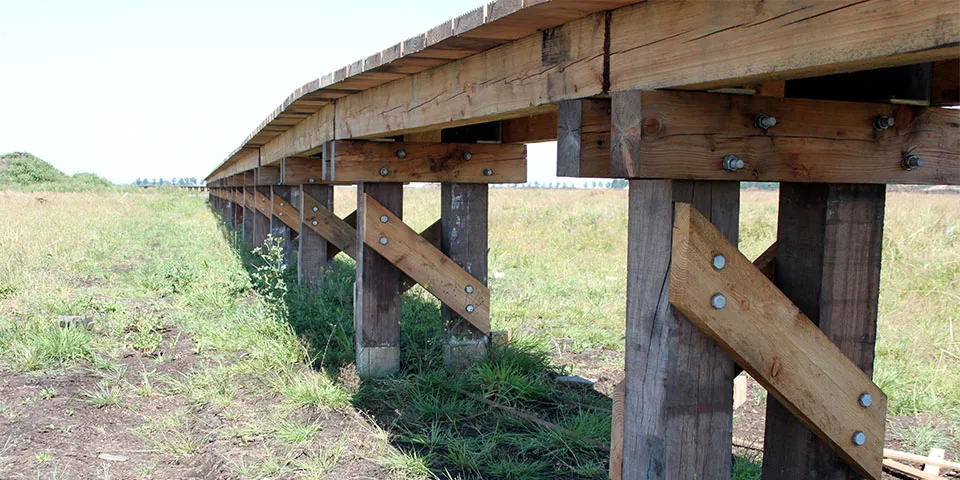
The footbridge is made from composite piles.
The United Nations estimates that 1.6 billion people worldwide depend on forests for some of their food supply, or for other products such as medicines and raw materials, ecosystem services or part of their livelihood. Under sustainable forest management, local people are closely involved in managing the forest. They retain a say in what happens to the forest, while timber production also provides them with employment.
The biggest threat to forests is their conversion to other forms of land use, often agriculture to meet rising demand for agricultural products such as palm oil, rubber, cocoa, soya and meat. By giving forests economic value through timber production, the risk of deforestation is greatly reduced. This benefits local people, wildlife and the environment.
Given the enormous construction task facing the Netherlands, with 75,000 new homes to be built each year between 2020 and 2025, there is a major opportunity to use more timber instead of other materials that contribute to climate change. This also reflects the growing importance attached to forests in general as a means of helping achieve climate targets. Demand for certified forest products is crucial to expanding sustainable forest management. Under the Convenant Bevorderen Duurzaam Bosbeheer, various parties, including the government, trade unions, civil society and trade associations, work together to promote sustainable forest management. They see stimulating demand for timber from sustainably managed forests as an important way to reduce the risk of deforestation. Would you also like to switch to verifiably sustainable timber for your project? Find out more at www.inkoopduurzaamhout.nl.
Question about this story? Ask your question
Keep following this
Get an email when a new story is published. No account needed.
- SubjectBouwMat







