









91% of vocational students want additional practical teaching from industry specialists
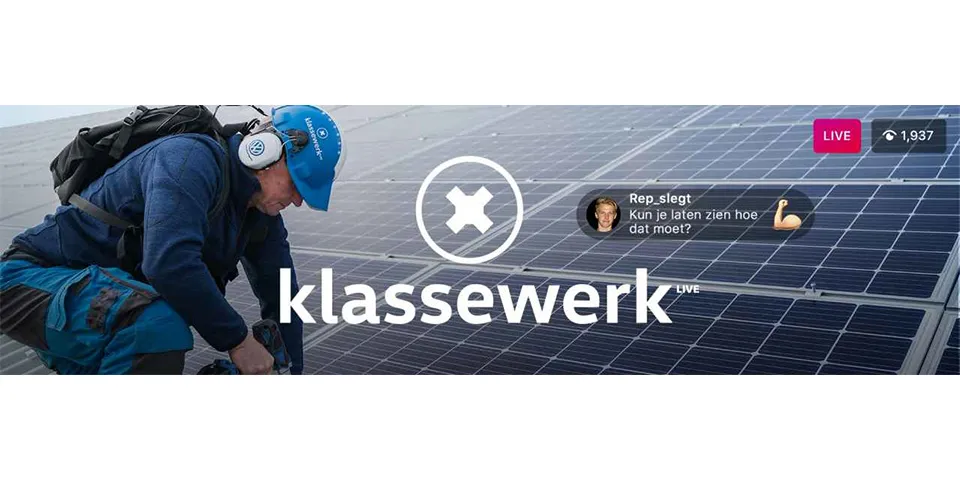
Volkswagen Bedrijfswagens launches pilot teaching method via Instagram Live at ROC
91 per cent of vocational students think it would be instructive to learn from industry specialists. This is according to research conducted among students at ROC Amsterdam and mboRijnland, who will take part in the ‘Klassewerk’ pilot. This initiative by Volkswagen Bedrijfswagens is a new teaching method in which students receive lessons via Instagram Live from various specialists working in the field. Using an interactive helmet, the specialists answer questions that students submit via chat in real time while they work. Klassewerk complements existing practical training, meets the growing demand in vocational education for up-to-date knowledge about innovation and sustainability, and improves students’ career prospects. The pilot’s first lesson takes place on Friday 10 May, with a focus on sustainable construction. Specialists and teachers from across the Netherlands, working in a range of disciplines, can now sign up for the next stage of the pilot.
Additional practical teaching
The research also shows that 86 per cent of students would like to see behind the scenes at specialists’ workplaces. In addition, the majority (61%) say they would like to learn more about professionals’ practical experience, alongside their current course programme.
Marjolein van Kooten, Head of Construction, Infrastructure & Maintenance Training at ROC Amsterdam, sees added value for vocational education in this new complementary teaching format: “Klassewerk helps bridge the gap between theory and practice. It introduces students to new ways of working without them having to leave the school. It brings the outside world in.” Badr Moustaïne, teacher and coordinator at ROC Amsterdam, agrees, noting that Klassewerk is more dynamic than his usual teaching method: “Students see the course material being put into practice right in front of them. That is quite rare and does not happen anywhere else in technical education.” Since students use Instagram every day, it is an accessible way to learn. More than half (55%) of students say they would like to be taught via Instagram.
Harry Buijs, a wind and solar energy specialist and one of the professionals teaching Klassewerk lessons, also believes that theoretical and practical knowledge could be better aligned: “I’m surprised that students often know quite a lot in theory, but their practical knowledge is rather limited.” That is why he believes it is important to pass on his knowledge to a new generation. This new way of teaching benefits more than just the participating students, Moustaïne explains: “Industry specialists contribute to the training of their future employees. In return, their practical knowledge helps teachers develop. It is a sustainable exchange.”
Sustainability and innovation
Van Kooten sees a growing need in vocational education to supplement the curriculum with lessons on sustainability and innovation: “Specialists working in the field have up-to-date knowledge that a school can never have to the same extent.” Moustaïne is also actively addressing this in his lessons: “I try to make my students aware that we are entering a new phase in which sustainability is no longer something exceptional, but is becoming the norm. An initiative such as Klassewerk can support the translation into practice that education still needs.”
Improved career prospects
66 per cent of students say they believe the knowledge they gain from Klassewerk will improve their chances in the labour market. 70 per cent therefore see Klassewerk as a valuable addition to their current course programme. Buijs also sees the benefits: “We have little time to train people in the field. It would be good if people had more practical knowledge. Klassewerk gives them a little more insight.”
The skilled professionals of the future
Klassewerk is an initiative by Volkswagen Bedrijfswagens. The first four live lessons will be delivered by specialists in sustainable construction who drive a Volkswagen Bedrijfswagen. Professionals from across the Netherlands and from a range of disciplines can sign up to deliver the fifth lesson, including those who do not drive a Volkswagen. Vocational teachers who would like to organise an Instagram Live lesson in their classroom can also sign up. After the pilot, applicants will be matched with one another so that more Klassewerk live lessons can be arranged. The number of lessons will depend on the number of applications.
Lukas Jeukens, Sr. Brand Communication Manager at Volkswagen Bedrijfswagens: “With Klassewerk, we contribute to the quality of vocational training and bring skilled professionals and students together. In this way, we make a difference for the skilled professionals of the future.”
Industry professionals and vocational teachers can sign up at www.vwbedrijfswagens.nl/nl/klassewerk.html
The Klassewerk schedule
- Friday 10 May: charging points for electric hybrid cars
- Friday 24 May: topic to be announced
- Friday 7 June: topic to be announced
- Friday 14 June: specialists from across the Netherlands can sign up for this date
The first Klassewerk lesson will be delivered by Maikel de Goede of Shupple and will cover charging points for electric hybrid cars. It takes place at 14:00. For the latest topics and times for the other lessons, visit www.vwbedrijfswagens.nl/nl/klassewerk.html
Question about this story? Ask your question
Keep following this
Get an email when a new story is published. No account needed.
- SubjectBouwMat







