









2021: a year of anniversaries for Daimler Trucks and Buses
Stuttgart: 2021 is a special year for Daimler Trucks and Buses, with no fewer than four anniversaries to celebrate.
In 1896, Gottlieb Daimler unveiled the first truck; in 1946, the first Unimog laboured across rough terrain as a prototype; five years later, in 1951, Otto Kässbohrer introduced the first bus with a self-supporting structure, the Setra; and finally, in 1996, the prototype of the modern truck, the Mercedes-Benz Actros, was unveiled.
1896: the first truck
When Gottlieb Daimler unveiled his first truck in 1896, it was still fitted with wooden wheels protected by steel bands. The world was not waiting for such a vehicle. There were no buyers to be found in Germany, and in England, where the vehicle eventually found a customer, an attendant still had to walk in front carrying a red flag to warn other road users. Yet this contraption, named Phoenix and powered through its rear wheels by a 1.06-litre, 4 hp twin-cylinder engine, marked the beginning of an unparalleled success story in goods transport.

The Phoenix, however, had little in common with a real truck: strictly speaking, it was a converted horse-drawn cart. The chassis was fitted with transversely mounted leaf springs at the front and coil springs at the rear. This suspension was absolutely essential, not only because the roads of the time were in poor condition, but also because the engine was particularly sensitive to shocks.
One modern feature, however, was the final part of the driveline: a belt transferred the engine’s power to a shaft mounted across the vehicle. A pinion, or reduction gear, was fitted at each end of the shaft. Each pinion tooth engaged with the internal teeth of a ring gear connected to the wheel being driven. Much later, this design principle became a defining feature of Mercedes-Benz trucks: the axle with planetary hub reduction, used in the ‘new generation’, the SK (Schwere Klasse, heavy class) and, today, in construction trucks.
1946: the first Unimog prototype
In 1946, Unimog ‘Prototype 1’ made its first test run. Chief designer Heinrich Rößler was at the wheel himself, putting the prototype through its paces on the difficult mountain roads near Schwäbisch Gmünd. The vehicle had no cab yet, but was already carrying a load of timber. The Unimog’s origins were closely linked to the difficult situation in the post-war years, when supplying the population was particularly challenging. In 1945 and 1946, food was in extremely short supply. This situation gave Albert Friedrich, who years later would head the aircraft engine development department at Daimler-Benz AG, the idea for an agricultural vehicle that could boost productivity in farming.
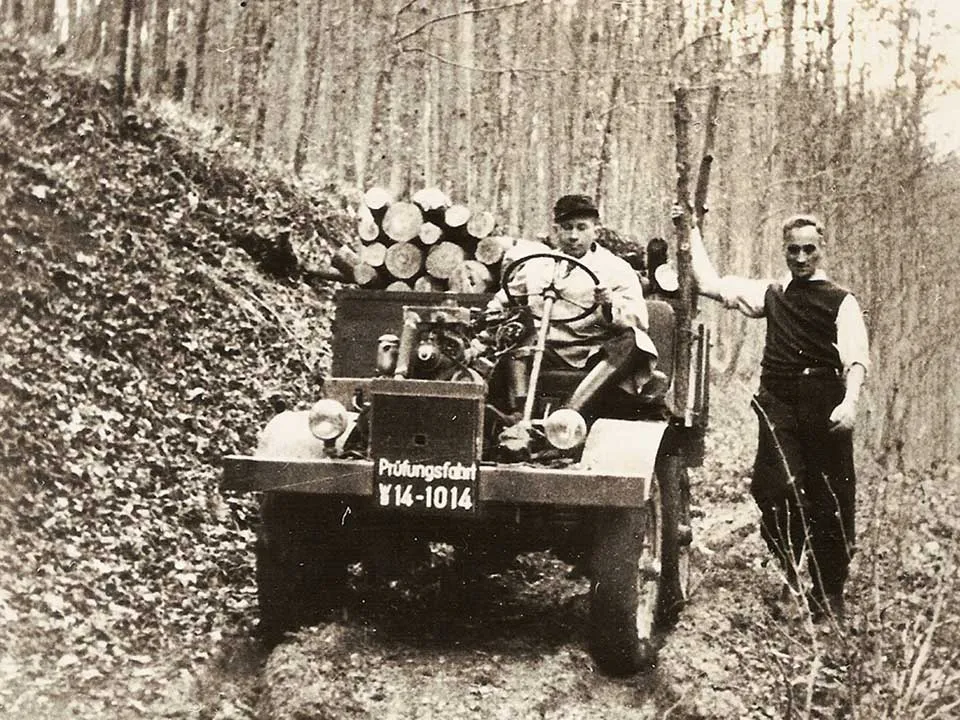
After the end of the war, Friedrich had re-established contact with Erhard & Söhne, a metalworking company in Schwäbisch Gmünd and a supplier to Daimler-Benz. As early as December 1945, the ‘L’ department (Landwirtschaft, agriculture) began work. Friedrich entrusted the project to his then colleague, technical designer Heinrich Rößler. He began work on 2 January 1946. Within a few weeks, an entirely new design had been developed, with the engine and gearbox positioned to the right of the vehicle’s centreline. This allowed the propeller shaft tubes, which protect the drive shafts, to be positioned at right angles to the axles, meaning that the chassis needed only four drive joints. This ingenious design is still used 75 years later in the Unimog U 4023/U 5023, part of the exceptional mobility series. In March 1946, Hans Zabel from Gaggenau, who had been involved in the project from the outset, came up with the name Unimog (Universal-Motor-Gerät, universally applicable motor vehicle), and the first test run followed in October 1946.
1951: the first Setra bus
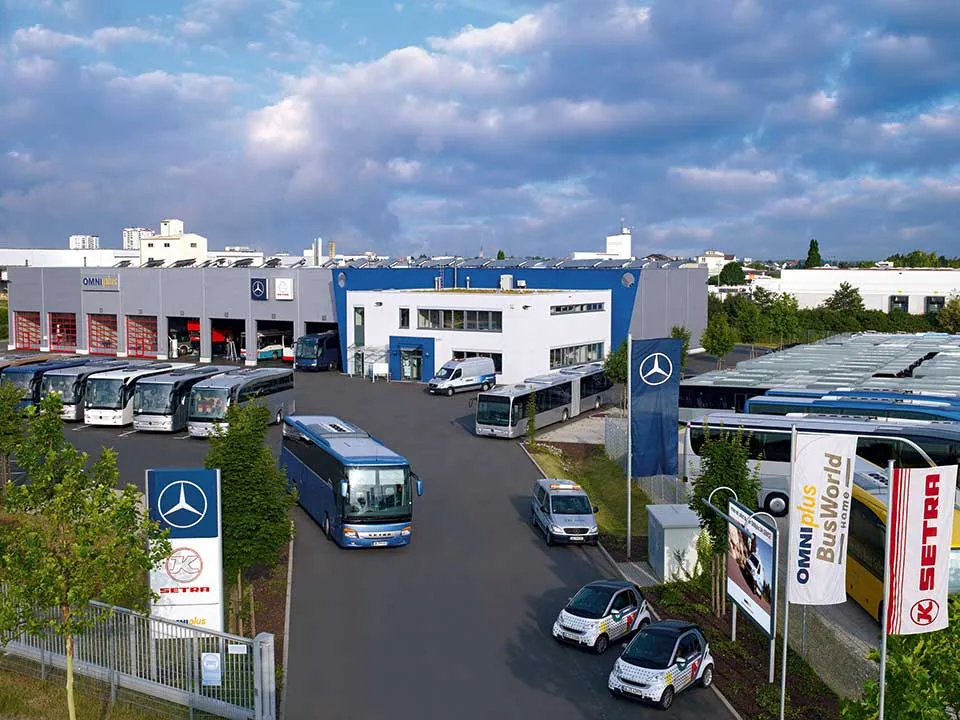
The Setra brand is proud of its roots. In 1951, Kässbohrer Fahrzeugwerke from Ulm unveiled the S 8, giving the brand its name: Setra, derived from ‘selbsttragend’ (self-supporting). The first series-produced bus with a self-supporting body, a rear-mounted engine and a directly driven rear axle was unveiled at the IAA (Internationale Automobil Ausstellung) in Frankfurt. Over the past 70 years, the brand’s six model ranges have not only set new standards in European bus manufacturing, but have also inspired, transformed and advanced the sector. The brand’s current flagship, which has always stood for maximum individuality, is the S 531 DT, a double-decker in the Setra TopClass 500 range.

As early as 1996, one year after Mercedes-Benz Omnibusse and Setra merged to form EvoBus GmbH, Omniplus was launched as the umbrella brand for the two marques’ after-sales activities. Omniplus was built on the successful customer services already offered by both brands. Today, Omniplus has a service network of more than 650 workshops in 42 European countries. It provides services tailored to buses and offers genuine parts, effective training and innovative digital services, all from a single source.
1996: the Mercedes-Benz Actros
At the end of September 1996, Mercedes-Benz made its debut at the IAA Nutzfahrzeuge with a new heavy-duty truck that would usher in a revolution for the sector: the Actros was the first truck to feature disc brakes on all wheels and the EBS electronic braking system. The combination of these two technologies made the Actros the safest vehicle in its class. Innovative technologies such as the ‘Telligent’ systems further boosted efficiency: service intervals more than doubled, fuel consumption was 3 to 7% lower depending on the application, and payload increased by 400 kg. All this came with significantly higher levels of safety and comfort. For example, at a speed of 85 km/h, the Actros’s braking distance could be shortened by the length of an articulated lorry thanks to the Telligent braking system with disc brakes. Considerable attention was also paid to a range of details: a new lining on the wheel arches, for example, effectively reduced spray in wet weather.
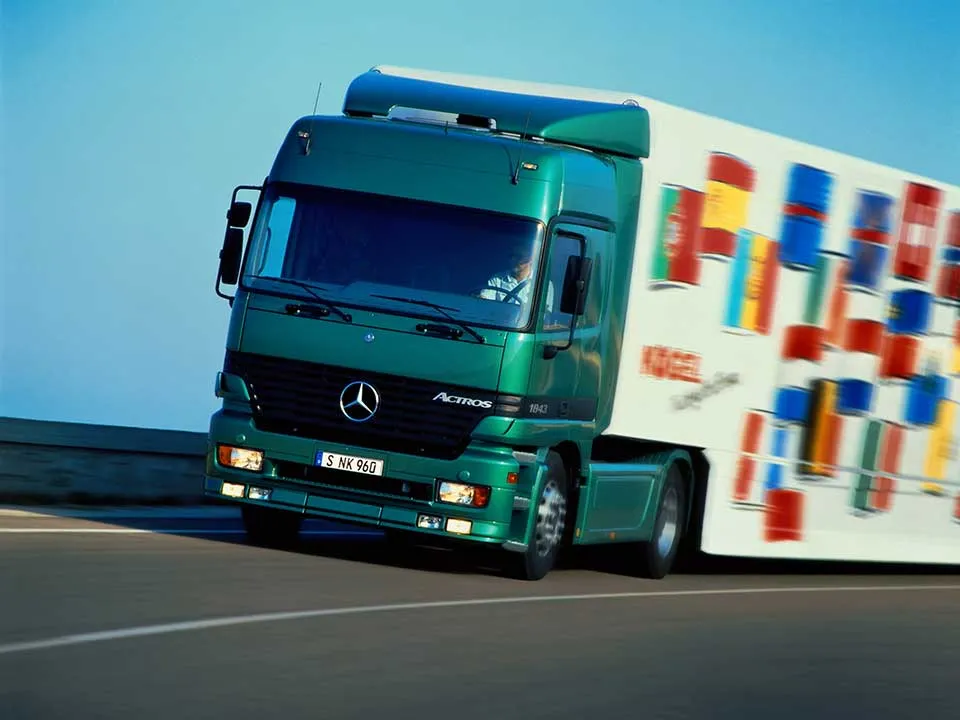
The newly developed, more fuel-efficient V-engines and improvements to vehicle assembly made the trucks more environmentally friendly: vehicle assembly required almost 50% less energy. The new cabs offered up to 47% more interior space and were designed entirely around drivers’ needs. They were also safer: they passed the full range of crash tests, both simulated and real-world, with flying colours. Other innovations included airbags and seats with integrated belt tensioners.
Every new Actros to be unveiled was named ‘Truck of the Year’, and even today the Actros continues to lead the way in safety.
Question about this story? Ask your question
Keep following this
Get an email when a new story is published. No account needed.
- SubjectBouwMat







