









The civil engineering sector in motion
Text Roel van Gils Image Rijkswaterstaat
The backbone of our economy is showing signs of strain
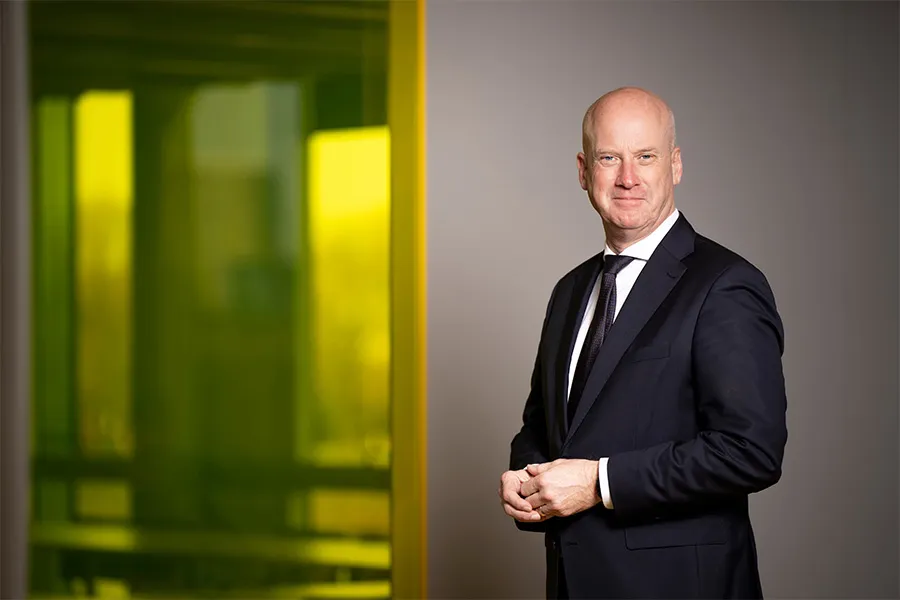
Maintaining before building was once Rijkswaterstaat’s guiding principle, and it is now more relevant than ever. It goes to the heart of the major challenge facing the Netherlands, and this enormous task of maintaining existing infrastructure has even featured in the King’s Speech. Infrastructure forms the backbone of our economy and society, but is now showing signs of strain. “You could say it has a serious slipped disc.” So says Martin Wijnen, Director-General of Rijkswaterstaat. In this anniversary edition, we look back with him at the key developments in the civil engineering sector over the past fifteen years, and above all look ahead. He also puts a pressing question to the sector.
“Many of our bridges, locks, tunnels and roads date from the post-war reconstruction period, shortly after the Second World War,” Wijnen begins. “The Netherlands of the future was built at speed. The 1953 North Sea flood disaster was followed by a huge wave of investment, particularly in the water sector. The major canals were built before the war, and people thought they would last for ever. The same was true of our road infrastructure. That assumption has proved to be wrong. What once symbolised progress now needs renewal. The pace at which our infrastructure is ageing is hard to keep up with. At the same time, this presents enormous opportunities for the civil engineering sector. Climate change, digitalisation and data-driven technologies are developing at speed and offer new possibilities. The question is not whether we need to act, but how.”
From project thinking to systems thinking
Looking back on 15 years in civil engineering, Wijnen says three developments have shaped the sector as it is today: “The growth in collaboration, digitalisation and the shift from project thinking to systems thinking. Market relations have changed, from the ‘market unless’ approach and rigid tender contracts to a more collaborative way of working. New players and international competition have also entered the picture. There is a growing recognition that the Netherlands is not just building more, but above all needs to maintain what it has. The Netherlands Court of Audit estimated deferred maintenance at 34.5 billion euros in 2024, a structural issue that calls for smart choices and the capacity to innovate. Looking fifteen years ahead, we can see that this period will be dominated by the major renewal challenge. Maintaining before building, then.”
Future-proof
“The Netherlands is expected to grow by two million people by 2040, and mobility per capita is also set to increase. This will place additional pressure on networks already heavily burdened by traffic and transport,” Wijnen continues. “New infrastructure must be future-proof: resilient to climate change, designed for circularity, and energy-efficient to build and operate. At the same time, working in existing environments (brownfields, ed.) is becoming more complex. When replacing a major network link, there is not always room to build something new alongside it. Examples include the widening of the Julianakanaal and the upgrade of the Galecopperbrug, where the cables and pylons were replaced while traffic continued to flow on the A12 with virtually no disruption. This calls for planning, expertise and high-level collaboration.”
Working together more effectively
According to Wijnen, the traditional client-contractor relationship is giving way to partnership. “Rijkswaterstaat and market parties are increasingly engaging with one another in the pre-contractual phase to develop solutions together. Other contract models, such as two-phase contracts, framework agreements for engineering services and portfolio approaches, create more scope for sharing knowledge and fostering innovation. In spring 2025, for example, we bundled the award of the renewal and renovation of five tunnels into a portfolio contract. We are now working on movable bridges, followed by concrete bridges and viaducts. This approach allows us to bring a larger volume to market in one go, retain knowledge and experience, and give market parties an incentive to innovate. It means projects can be delivered faster, better and more cheaply. What the market can ask and expect of us in return is a stable programme. One that provides calm, order and regularity, delivering results without friction, at a reasonable return and with a realistic level of risk for all parties.”
Resilience in an uncertain world
Society talks about vital processes that are essential to keeping the economy running. For Rijkswaterstaat, that means ensuring the smooth flow of traffic on roads and waterways, and safeguarding water safety. “We live in a very vulnerable delta, crossed by two enormous rivers. We face rising sea levels, and our land is still subsiding,” Wijnen says, listing the critical factors. “Our task is to keep the system robust. And one important consideration comes first: vulnerability.” Wijnen means natural vulnerabilities such as storm surges, spring tides, clusters of heavy rainfall, or extreme heat and drought, but also man-made vulnerabilities such as cybercrime and sabotage, and finally vulnerabilities resulting from ageing infrastructure. “All these factors affect our ability to deliver a robust maintenance programme, with the added requirement of keeping the corridors open for military transport. In short, there is work to do, a lot of work!”
The times call for leadership that brings people together, stays the course and takes people along with it. “The challenges are significant: staff shortages, limited nitrogen emissions headroom, permits and raw materials. Yet there is also an enormous opportunity to make a step change as a system,” Wijnen says. “In fifteen years’ time, I hope to look back on a period in which the Netherlands not only maintained its infrastructure, but raised it to a higher level. A resilient and sustainable sector that is second to none, proud of what it maintains together, and whose world-class infrastructure makes the Netherlands a showcase for civil engineering innovation. So I would like to ask the sector: what more can Rijkswaterstaat do to help achieve that goal of a resilient and sustainable sector?”
Question about this story? Ask your question
Keep following this
Get an email when a new story is published. No account needed.
- SubjectYearbook







