Specialist in the construction of emergency water storage areas
Text Roel van GilsImage Gebr. Olieman
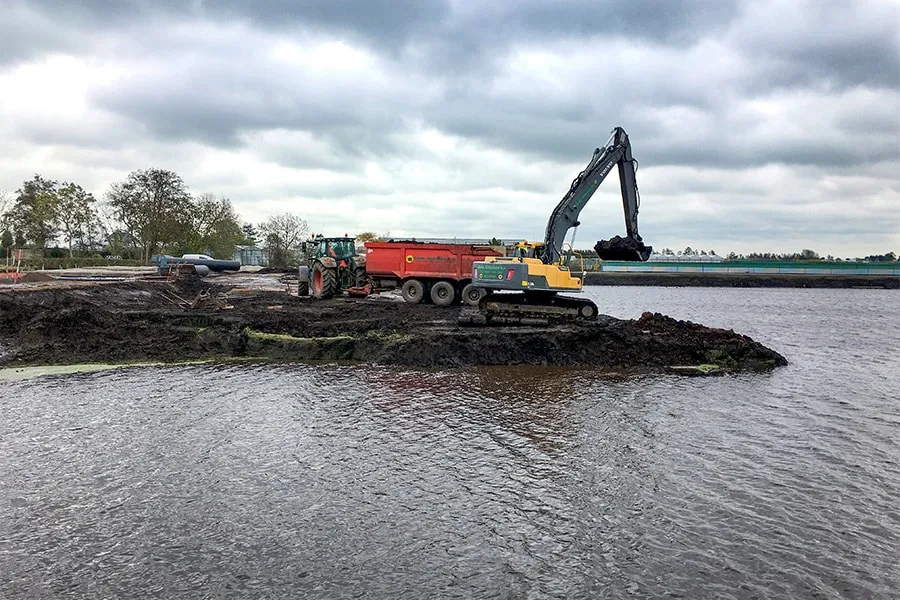
Water is becoming a global problem. We are acutely aware of this in the Netherlands and are taking action. In peatland areas, for example, any increase in impermeable surface must be offset by 15% within the relevant water-level area. Gebr. Olieman, an earthmoving contractor and trading company specialising in high-quality peat soil, has made a name for itself in the construction of so-called emergency water storage areas that maintain the balance within the water-level area.
The Netherlands is sinking, and raising dikes is part of everyday life. “It’s an exercise you have to keep repeating endlessly,” says Hans Olieman, one of the brothers. Gebr. Olieman knows the polder like the back of its hand. In the summer of 2021, the company made national news by building an emergency dam in the early hours of the morning after a dike breach in its own backyard, in Reeuwijk. The waterschap, the dike reeve and the municipality greatly appreciated the company’s swift response. “We know the area and have a stock of soil types from the area. That’s why we’re now also frequently involved in building emergency water storage areas.”
Maintaining the balance
Gebr. Olieman operates mainly around the Reeuwijkse Plassen, an area of more than 1,000 hectares stretching from Gouda to Zoeterwoude. “It’s a very watery area, but in dry periods as much as half a centimetre of water can evaporate in a single day,” Hans explains. “That means water has to be let in every day during those periods to maintain the level. A water level that is too high is undesirable, because people end up with wet feet, while a level that is too low causes desiccation, with all the consequences that entails. Hoogheemraadschap van Rijnland has digitally mapped its management area as a grid divided into dozens of polder water-level areas, some as small as just a few hundred hectares. The water in each of these areas must remain in balance. There is also an obligation to compensate for the loss of waterways and any increase in impermeable surface.”
Storing clean rainwater
Gebr. Olieman has already built several water storage areas, including one on its own land. “We have hectares of land used for storing soil, which is classified as impermeable surface,” says Hans. “To compensate for this, we’re lowering 1 hectare of land and will keep it at a controlled lower level in future. Cows graze here in summer, and when it rains, the overflow function comes into play and the area fills up. We’re also building an emergency water storage area covering 8 hectares. We’re going to lower the land there by 50 centimetres. A 5-metre-wide embankment will surround the area, with overflow points set 5 centimetres above the established polder level. Heavy rainfall causes the polder level to rise. If it rises by more than 5 centimetres, the overflow points come into operation, allowing the entire 8-hectare area, which also has a network of ditches, to fill up. The advantage is that you can temporarily store clean rainwater until the level outside the area returns to normal. That means you don’t have to pump it out, and it stays in the area. Because anything you pump out has to be let back in a week later, which increases salinity.”
Gebr. Olieman currently has several such water storage projects under way, ranging in size from a quarter of a hectare to the 8-hectare storage area mentioned above. “We don’t just build them; we also play an active role in the preliminary stages, contributing ideas, drawing up a plan and presenting it to the waterschap. All in all, it’s a fascinating challenge at the intersection of water, nature, the environment, legislation and regulations.”
Question about this story? Ask your question
Keep following this
Get an email when a new story is published. No account needed.
- SubjectYearbook