









A range of metal testing methods for SMEs
Text Chris Elbers/NDO-Nederland Beeld NDO-Nederland
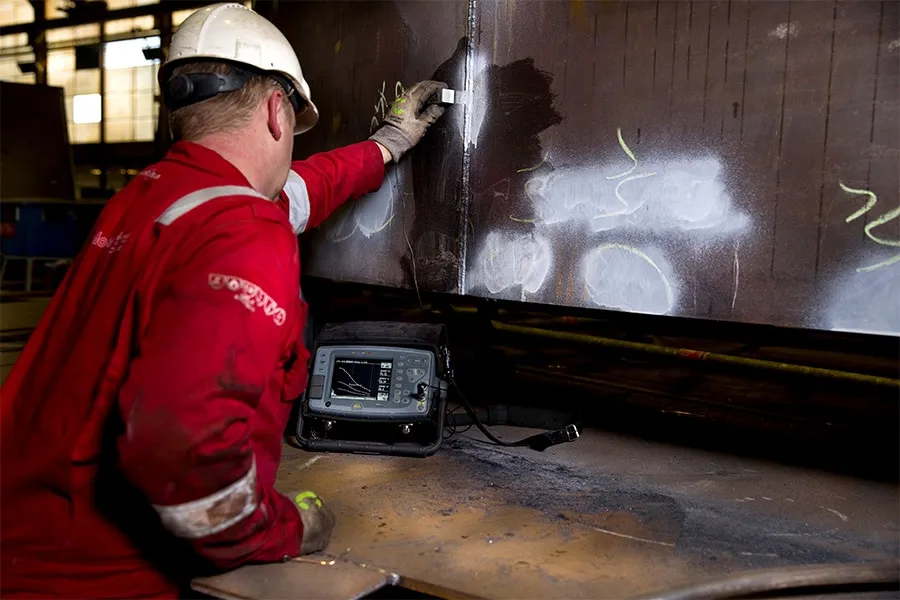
Working with metal often involves a lot at stake. A poor weld, for example, can lead to enormous repair costs. And if problems are discovered too late, project handover is often put at risk too. To prevent these kinds of problems, NDO-Nederland provides SMEs with various forms of non-destructive testing (NDT).
Whenever someone works with metal, NDO-Nederland can help and make a difference. This applies whether a customer wants to know more about the exact composition of their stainless steel, check the hardness of carbon steel, or detect any imperfections, defects or damage in a weld. “We help everyone quickly and carry out our tests on site,” says owner Wolter van der Zee. “This keeps project delays to a minimum and avoids costly repairs. We also understand the importance of deadlines, so we are always quick to get on site. For some NDT methods, we provide the results immediately; in other cases, we do so after an analysis. Customers also always receive an advisory report to help prevent the same problems arising again.”

Ultrasonic testing
A structure is only as strong as its weakest connection. Ultrasonic testing quickly provides certainty about a range of joints, from welds and castings to bonded joints. NDO can thus immediately reveal any defects, so customers know whether a joint is sound or needs repair. An advisory report is also provided free of charge.
Penetrant testing
Penetrant testing is highly accurate and versatile, while offering a number of advantages. One is that materials can easily be screened in their entirety by immersion. It can also be used to test any metal surface, provided it is smooth. This brings surface defects to light even in non-magnetisable metals. “By using a liquid that fluoresces under UV light, we can detect defects as small as 0.1 millimetres,” explains Wolter.
Process
Penetrant testing is used mainly on non-ferrous metal alloys, but also on magnetisable materials where magnetic testing is too complex. “During penetrant testing, a low-viscosity liquid is applied to the material being tested,” Wolter explains. “The material can also be fully immersed. The liquid seeps into defects that are directly connected to the surface. Any excess liquid is removed. After the dwell time, we use what is known as a developer. This draws the liquid out of any defects and makes them clearly visible.”
Question about this story? Ask your question
Keep following this
Get an email when a new story is published. No account needed.
- SubjectYearbook







