Erik Scholten on the Dutch CAD Standard: “With the NLCS, you know exactly where you stand”
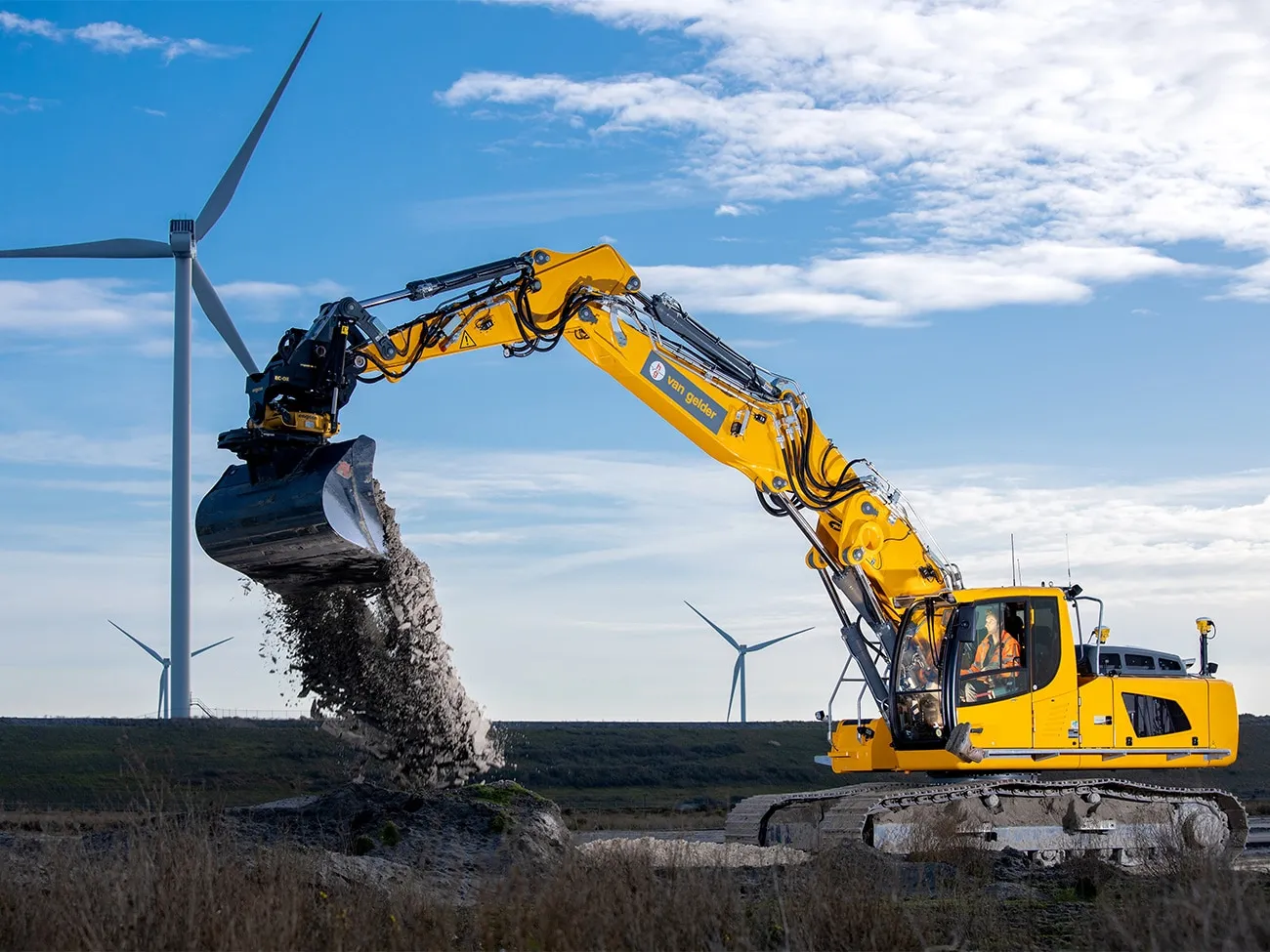
Uniformity, and the resulting ease of transferring information. These are the NLCS’s main advantages, according to Erik Scholten. The designer at Van Gelder sees the Dutch CAD Standard as an opportunity to further strengthen the civil engineering sector. “With an NLCS drawing, everyone understands each other: you know exactly what you’re getting.”
Alongside his design work, Scholten is a work planner and creates 3D crane models for colleagues in the field. What he enjoys about his job is that the projects he designs add value for so many people. “Building a roundabout, renovating a sewer system, preparing a residential area for construction… it’s all very rewarding work. It’s great to drive along a new road and realise: we built that. The fact that I work across different disciplines is useful too. Although I spend a lot of time at the drawing board, I know what challenges arise during construction. That means we work together as a close-knit team from the outset of a project.”

NLCS as standard practice
By the time Scholten joined Van Gelder in 2018, the NLCS was already standard practice among the designers. “However, many external clients still used their own drawing standards, and often expected us to comply with them too. It could be difficult to interpret those drawings, especially when the layer structure was unclear or the drafter used abbreviations we weren’t familiar with. In such cases, it could take quite a while to piece everything together. The NLCS has now eliminated that problem.”
According to Scholten, adoption of the NLCS took off particularly when public authorities made it a mandatory standard, for example in tendering processes. “Has half the market made the switch? I think it’s much more than that. Judging by the drawings we receive from third parties, I estimate that at least 80 per cent are now using the NLCS. And in a few years’ time, that figure will have risen further, without a doubt. Who wouldn’t want to work with a clear, consistent structure, with clarity on layer names, line types and symbols? With the NLCS, you know exactly where you stand. From the initial programme of requirements right through to final handover, you have one consistent, uniform standard.”
The right software
To work in accordance with the NLCS, Scholten and his colleagues use InfraCAD, often through AutoCAD or Civil 3D. They are even using the latest version, version 7.0, which includes several new features. “InfraCAD is ideal for us, enabling us to work accurately and quickly in accordance with the NLCS. The software offers a wide range of options, as well as plenty of scope for customisation. However comprehensive the standard library may be, you can always add your own symbols, naturally in full compliance with the NLCS guidelines. Another advantage is that InfraCAD’s developer keeps the software up to date, adapts it to new developments and works closely with end users. I played a small part in the development of InfraCAD 7.0 myself. Take something as simple as a button for rotating a symbol: it’s a straightforward task, but one I perform very often. That function wasn’t available before, but now it is. I also really like the option for processing revisions. We’ve created our own measurement code lists for our surveyors, linked to the NLCS. Using these, they create a points file containing their measurement data, which we load directly into InfraCAD CE. That cuts the drawing work by almost three-quarters! It saves a huge amount of time, and with less manual work, there’s also less chance of errors.”

Calculating quantities
Scholten also sees significant benefits in importing KLIC notifications, loading cadastral maps and checking elevations using InfraCAD Map. “Or take quantity calculations, using the NLCS object viewer. For example, filter by the ‘sewer’ layer and you’ll see only the associated quantities, ready to export as an Excel file for work preparation. It’s clear that a lot of thought has gone into InfraCAD. We tell all new drafters to take the time to learn how to use it properly. The hours you put in are an investment at first, but they quickly pay off in time saved.”
Improving the sector
Scholten has high hopes for the NLCS in the future, although he doesn’t know exactly how its adoption will continue. “It’s difficult to say whether the NLCS will be the standard everything revolves around in X years’ time. But given the progress already being made in adapting it for housebuilding, the NLCS offers great opportunities to connect the different construction sectors.”
Scholten advises companies unsure about adopting the NLCS to talk to their peers. “The NLCS wasn’t developed by one person either; it was thought through collectively. Nor is it an immutable law everyone has to follow. It’s much more an opportunity to improve our sector. Talk to colleagues and ask about their experiences. I’d bet you’ll soon discover benefits you could never achieve without the NLCS.”
NLCS
The NLCS (Dutch CAD Standard) is a uniform drawing standard for civil engineering. Information in an NLCS drawing is unambiguous, complete and clearly structured. This makes drawings easy to exchange, reduces the risk of errors and enables the entire civil engineering supply chain to save costs. The NLCS is a BIM Level 1 standard and is managed by BIM Loket.
About CAD Accent | Arkance Systems
CAD Accent | Arkance Systems is an Autodesk specialist with a strong focus on construction and infrastructure. The company helps clients implement BIM, optimise workflows and working methods, and standardise CAD environments. CAD Accent is part of Arkance Systems, a European organisation of specialists that supports organisations with the digital transformation to BIM and Industry 4.0 through a comprehensive portfolio of hardware, software and services.
About Van Gelder
Van Gelder, headquartered in Elburg, specialises in the delivery of above- and below-ground infrastructure. Its 1,100 employees work throughout the Netherlands and beyond. Through several specialist operating companies, Van Gelder covers the full range of infrastructure construction. Increasingly, these companies pool their expertise in an integrated project organisation. This all supports the company’s mission: to deliver projects through drive and commitment, based on reliability and mutual respect
Question about this story? Ask your question
Keep following this
Get an email when a new story is published. No account needed.
- SubjectDigitalisation & software