









Wegenwijs
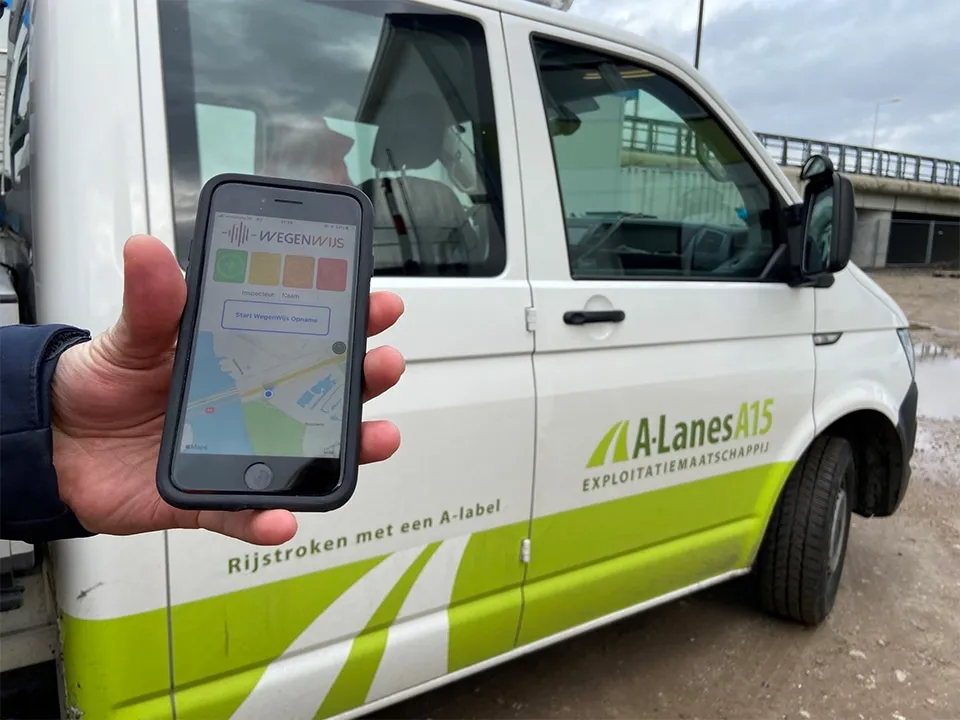
Sensors in cars monitor road surface quality, giving road authorities greater insight and control while causing less disruption to road users.
An idea from a project manager still sounded like a pipe dream in the summer of 2019, but six months later the innovation had become a reality. Its name: Wegenwijs. Following a pilot in North Holland, it has its first customer: A-Lanes A15 has deployed Wegenwijs to monitor its road network.
How much longer will a road surface last? When should maintenance or renewal take place? Road inspections are needed to answer these questions. During an inspection, the inspector looks at the extent of ravelling, among other things. This is done largely using images, and road closures are often unavoidable.
Coen Smits, project manager at Unihorn / Strukton Civiel: ‘‘Ravelling can sometimes be difficult to assess when carrying out inspections using images. We experienced this in 2019 during an inspection of a two-layer porous asphalt surface. The images showed no signs of ravelling, but when I drove over it, I could clearly hear a different tyre noise from that on the adjacent lanes. This was the main indication for me that something was indeed wrong.”
Smits developed an idea for measuring ravelling using sensors and applying algorithms to turn the data into information. With a proof of concept, he demonstrated that the different ravelling categories could be identified from sound recordings. In the summer of 2019, he was given the opportunity to pitch his idea within Strukton Civiel. It was a success: together with the project team, he secured a budget to develop and train the algorithm. “After that, everything gathered pace and the Wegenwijs innovation was born,” says Smits.
How does it work?
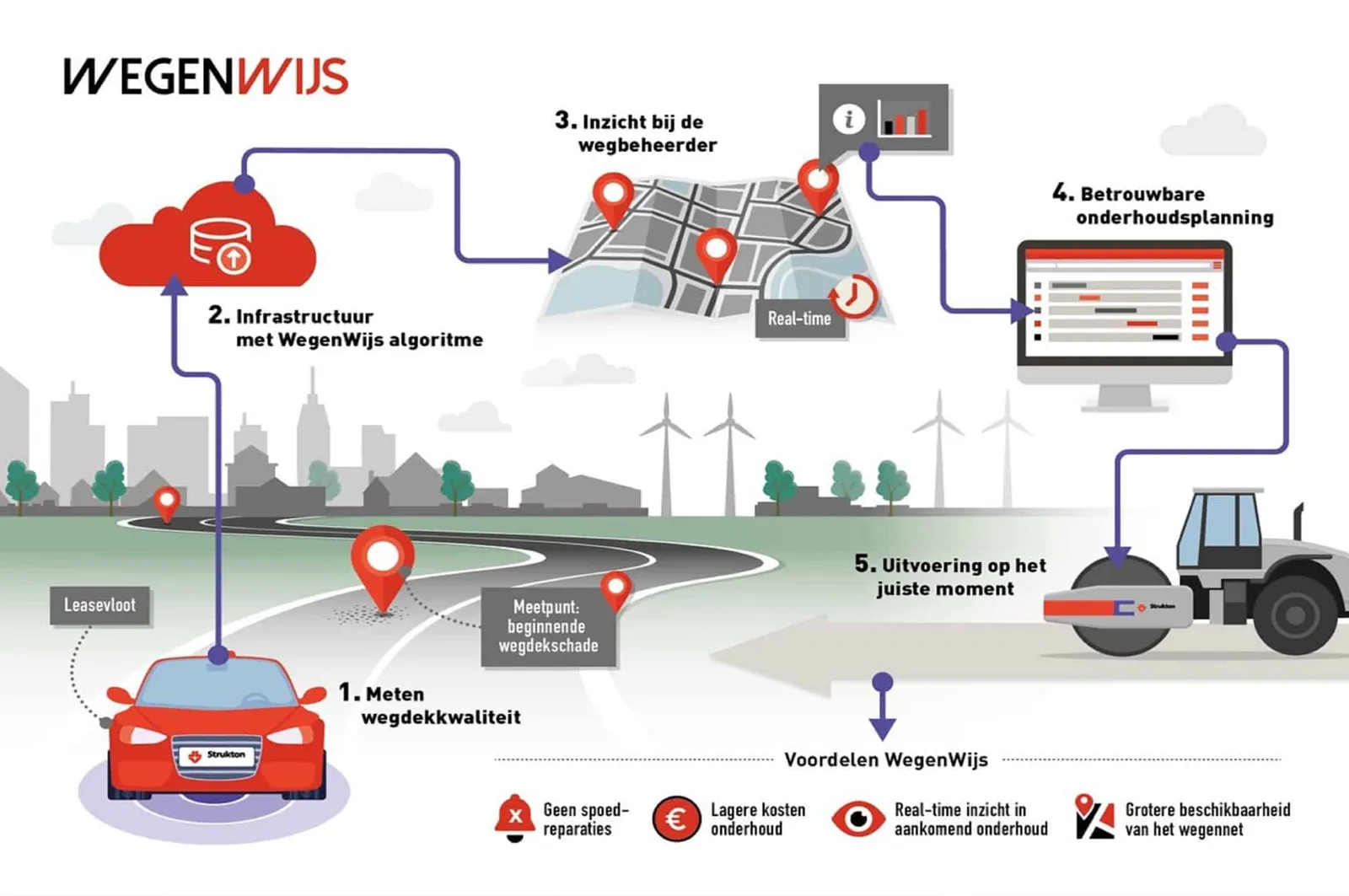
Wegenwijs uses vibration sensors in vehicles and smartphones to continuously measure road quality on every road. The measurement data is uploaded to the cloud, processed and displayed on an online platform. Road authorities can consult the platform and use the information it provides to draw up and update their maintenance plans and budgets.
Benefits
• Road quality is monitored continuously, and changes in quality are immediately visible by comparing data over time
• Strukton Civiel and its sister and subsidiary companies have thousands of vehicles travelling throughout the Netherlands, providing the basis for quality monitoring
• Road authorities and private individuals can use their vehicles to contribute directly to quality monitoring via the Wegenwijs app
Current status
Ravelling is usually the most critical and least predictable form of damage. The technology is therefore being developed initially to detect ravelling. A proof of concept has confirmed that the principle works. In 2020, the system will be able to determine the type and extent of ravelling. The technology will then be used to identify other types of damage. Additional damage-assessment methods and other relevant features will be incorporated into Wegenwijs in the near future. The result: Wegenwijs continuously monitors road quality. Road authorities receive all the information they need in good time to manage their roads optimally. Everyone can contribute to data collection. Expensive inspections and measurements are no longer necessary.
Want to find out more about Wegenwijs?
A business enquiry for Strukton Civiel? Get in touch
Companies in this story

Keep following this
Get an email when a new story is published. No account needed.
- SubjectNews
- CompanyStrukton Civiel
- CompanyUnihorn







