









Unique longitudinal prestressing with tendon anchorage on the Emmen-West flyover
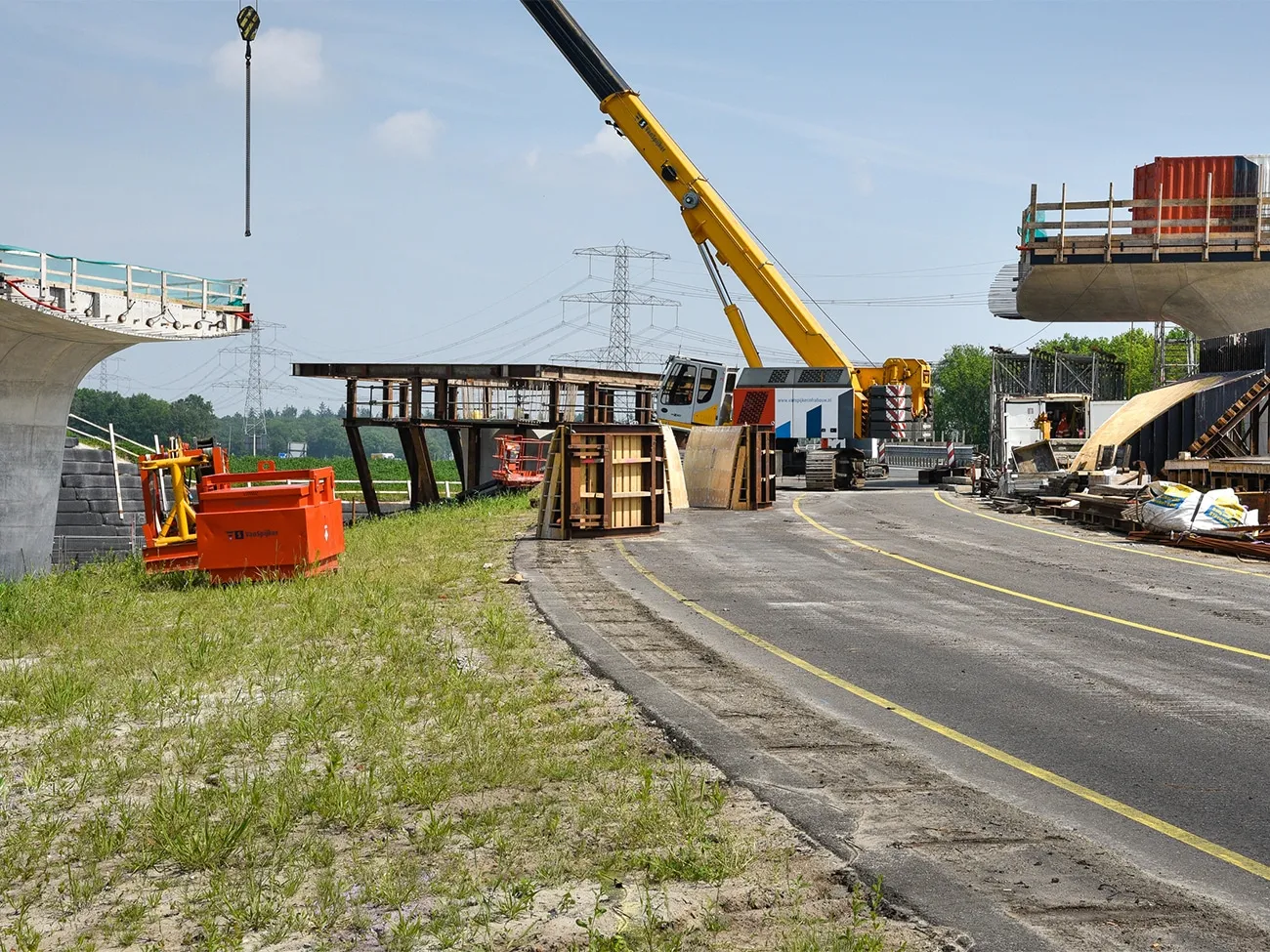
On behalf of the province of Drenthe, Van Spijker Infrabouw B.V. is reconstructing the Emmen-West interchange. This is part of the widening of the N34 between Coevorden and Emmen and the connection at Emmen-West with the Rondweg Emmen (N391).
A new flyover is being built as part of the project. Because of the unusual construction sequence, Dywidag was brought in to devise a unique solution for prestressing the deck.
In the existing situation, the slip roads join the Rondweg N391 at the same level. To improve safety and traffic flow, the new road layout will include grade-separated slip roads. The junction is therefore being reconstructed as an interchange with grade-separated crossings. To minimise disruption to traffic, the 93-metre-long flyover is being built in phases. “Normally, a deck is built from left to right or outwards from the middle, but different ‘rules’ apply here,” says Robert Jansen of Dywidag. “Because of the schedule and planned road diversions, the left-hand section of the deck had to be built first, followed by the right-hand section and, finally, the middle section. That is not logical from a prestressing perspective.”
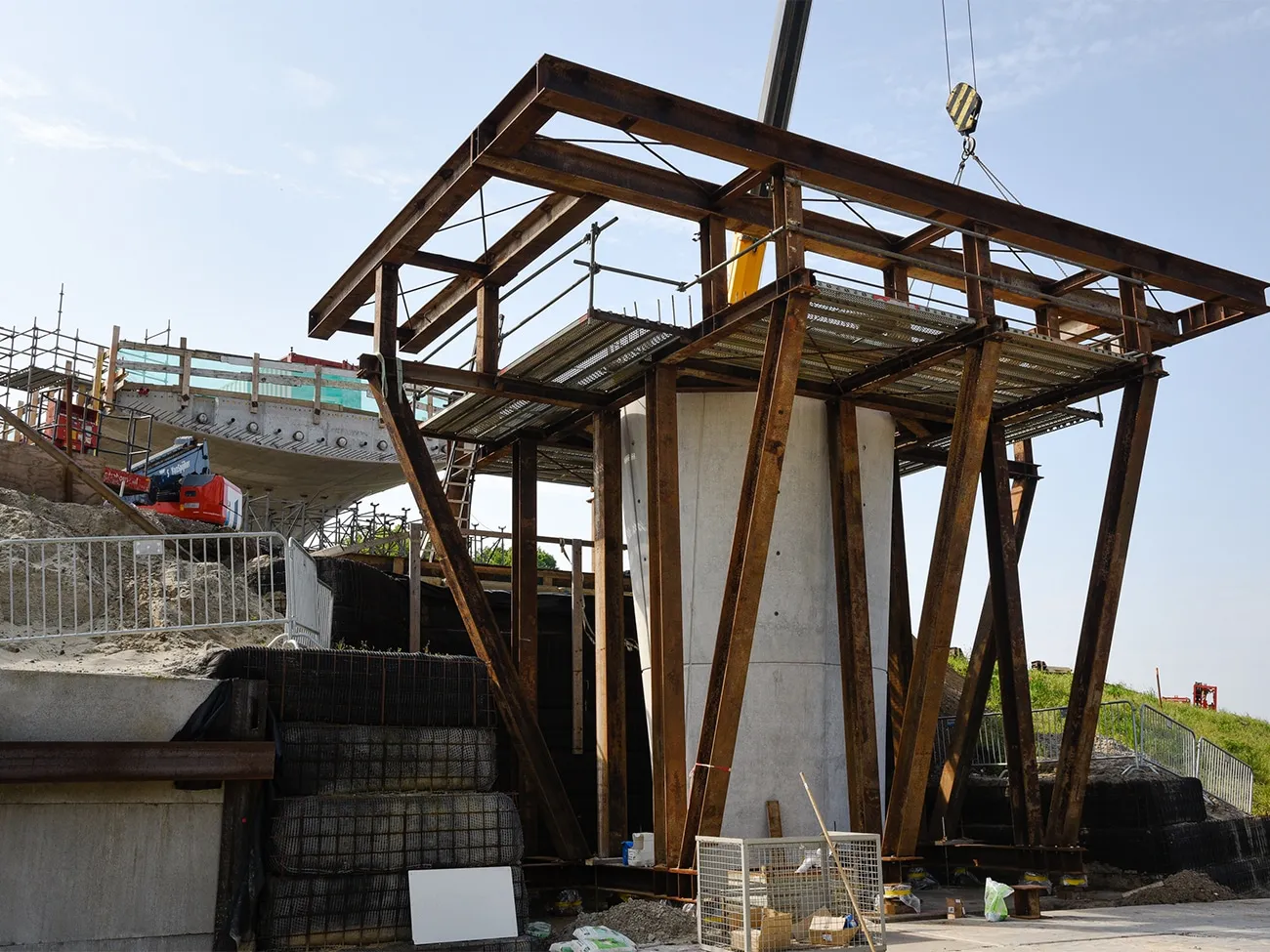
Laced connection
Dywidag’s task was to make the seemingly impossible possible. “We made use of the fact that 50% of the final prestressing force is enough to carry the deck’s self-weight. Fourteen ducts were therefore installed in the first deck section. Seven of them are left empty, while the other seven are filled and stressed using couplers. This means the deck section can carry its own weight. The formwork can be removed and the road network below can be diverted. The same process was repeated for the other deck section, with the longitudinal prestressing shifted by exactly one duct. This means the middle section, which is now under construction, can be built last. The tendon in deck 1 is connected through the middle section to the empty duct in deck 3. In this way, the decks are joined together like laces. The entire deck is thus brought up to 100% prestressing. There are no expansion joints, as these are fully compressed. The deck can ultimately be regarded as one continuous prestressed structure. This phasing is fairly unique and is rarely, if ever, used. But it is possible,” Jansen concludes.
Question about this story? Ask your question
Keep following this
Get an email when a new story is published. No account needed.
- SubjectNews







