









TenneT works together to build the future of Brabant’s electricity grid
Text Susan Peek Beeld Evert van Moort, Koen van Rens
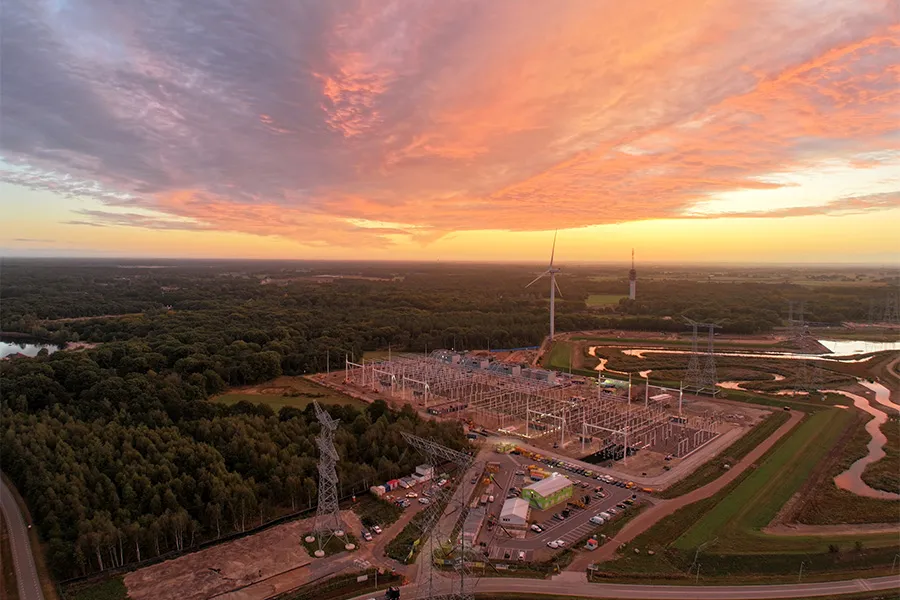
A new 380 kV substation is taking shape at De Spinder near Tilburg to ease pressure on Brabant’s electricity grid. The project brings together civil engineering, construction and electrical engineering, alongside water management, ecology and community engagement. “We’re working with many different parties here, but as one team,” says TenneT project manager Roel Jannink. “That’s exactly what makes this project so special.”
As the national high-voltage grid operator, TenneT is responsible for transporting electricity through the high-voltage grid, the ‘motorways’ of our energy system.
Putting the pieces together
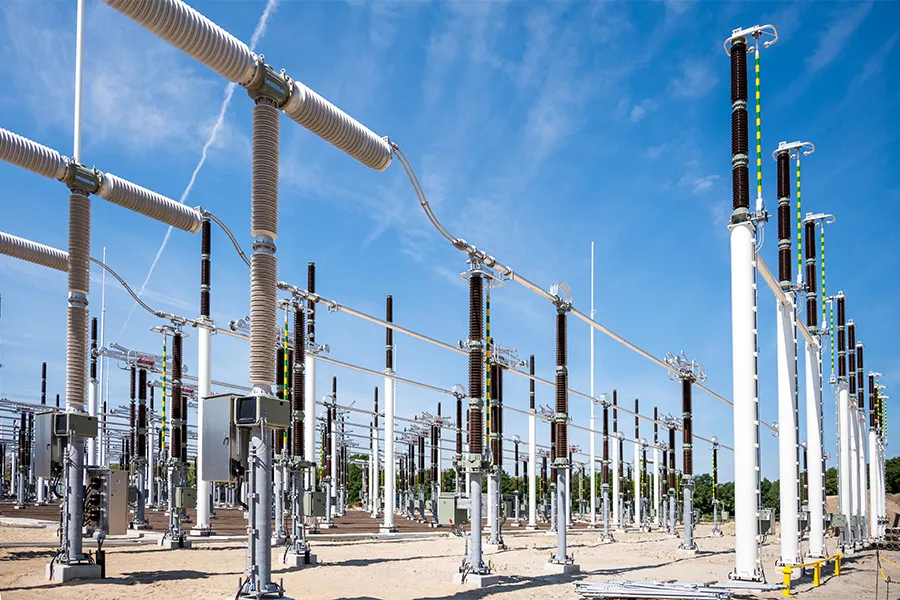
TenneT oversees the entire process on this project, from preliminary design through to delivery. The organisation monitors safety, scheduling and progress, and coordinates the work of the many parties involved. Four main contractors are working with numerous subcontractors, consultancies and suppliers, some at the same time, on the various work packages: preparing the site for construction, building the substation, installing the cable connection to Tilburg-Noord and constructing the overhead lines. “Our role is to put the pieces of the puzzle together,” says Jannink. “Everything has to dovetail, with safety, quality and collaboration in mind. That can only be achieved through close coordination and a great deal of trust.”
On site, safety experts oversee the safe delivery of the work, while construction managers coordinate daily with contractors on schedules, agreements and execution. TenneT also looks beyond this project, considering other work in the region, interfaces and the right sequence for delivery. “That constant coordination, between technical requirements and stakeholder interests, keeps the whole project manageable.”
Environment and ecology
The 35-hectare site, of which 6.5 hectares is occupied by the substation itself, lies partly on former settling ponds, making construction complex. The work is being carried out in close coordination with the Municipality of Tilburg, the Province of North Brabant, the De Dommel and Brabantse Delta water authorities, and nature organisations such as Natuurmonumenten. The substation forms part of Landschapspark Pauwels, where nature restoration and landscape integration go hand in hand. “Ecological measures are an integral part of the plan,” says Jannink. “We consider the engineering alongside the environment in which we’re building.” According to Jannink, the biggest challenge is bringing all these disciplines, engineering, ecology and the environment, together as one.
Innovation above ground
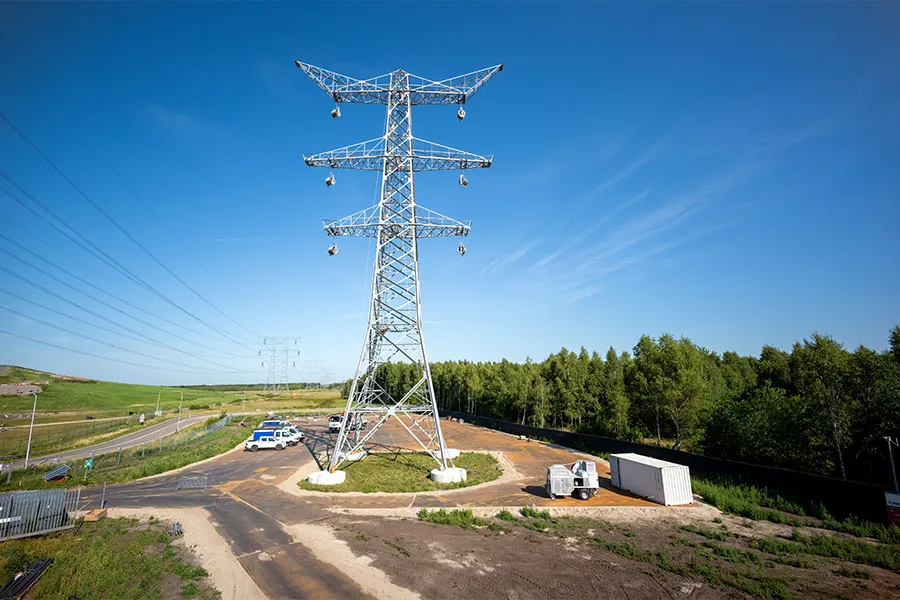
Four new high-voltage pylons are being built as part of the project, including three-circuit pylons with greater capacity, a first for the connection between Geertruidenberg and Eindhoven. One of the most striking elements, however, is the construction of the Netherlands’ first Moldau pylon. This new generation of lattice pylons will become the standard for future 380 kV connections and marks a major step forward in design, sustainability and construction. “It’s a first,” says Jannink. “Over the coming years, we’ll build more than 1,200 of them in the Netherlands. They are the new standard and will form the backbone of the expansion of the national electricity grid.”
Thanks to its standardised, modular design, the pylon can be manufactured, transported and assembled more efficiently, using less concrete and therefore generating less CO2. The steel is also fully recyclable, and the uniform design creates a more harmonious landscape. “The Moldau pylon symbolises how we want to build for the future in the Netherlands,” says Jannink. “Affordably, sustainably and in harmony with the surroundings.”
A proud moment
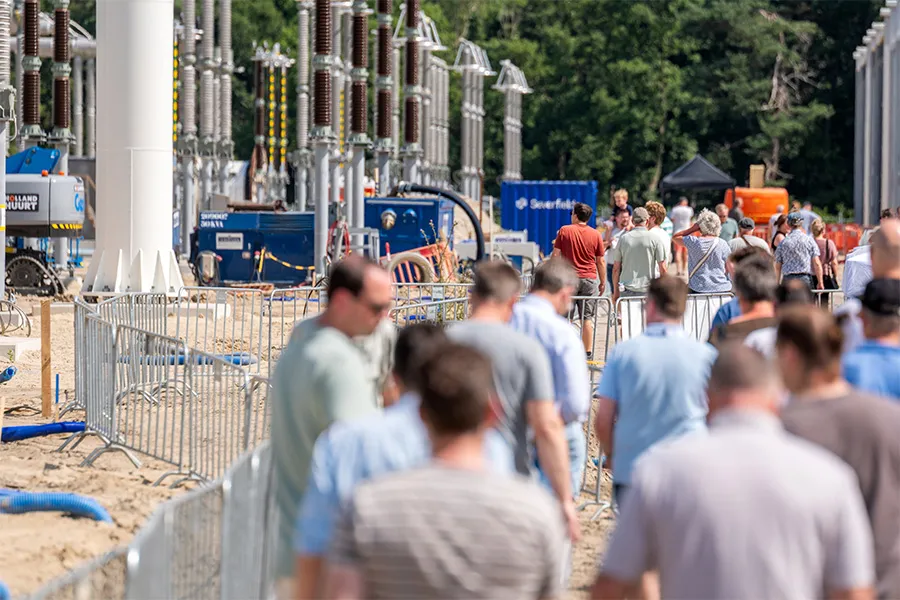
Alongside that first, Jannink is particularly proud of the collaboration between the parties, which was clearly on display at Construction Day. “We were there with all the contractors and colleagues, each of them proud to show what we’re building together. For me, it was a miniature version of the whole project: even when something goes wrong, we sort it out together. It’s about give and take, adapting flexibly so the work can keep moving forward. Always with our shared goal in mind.”
Looking ahead
In the coming months, the civil engineering work on the water storage facility will be completed, and the cable connection to Tilburg-Noord will be extended. In summer 2026, the overhead connection to Eindhoven and Geertruidenberg will be connected into the grid. The major milestone comes next: the substation is due to be commissioned in autumn 2026.
“We’re doing this because it’s needed for the Netherlands and the energy transition,” says Jannink. “But the success of this project lies in how we do it: safely, openly and together. That’s the only way to put together a complex puzzle like this.”
Question about this story? Ask your question
Keep following this
Get an email when a new story is published. No account needed.
- SubjectNews







