









Sustainable rubber level crossings at Amstelveen Line stabling yard
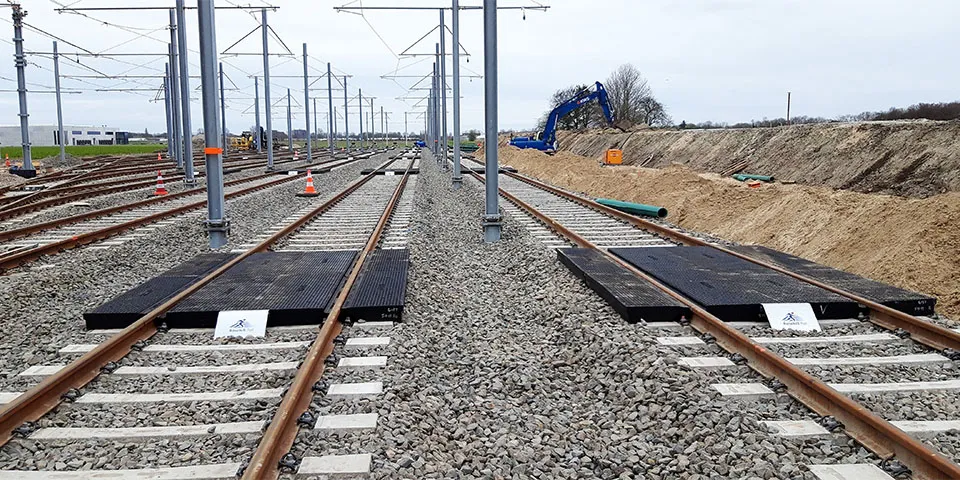
The revamped Amstelveen Line is getting a completely new stabling yard for its trams in the Legmeerpolder. Alongside stabling positions for the rolling stock, there will also be facilities for activities including minor tram maintenance. Staff will be able to reach the stabling positions via a large number of level crossing paths made from solid rubber, sustainably manufactured from 100 per cent recycled car tyres.
A bespoke solution for every railway structure
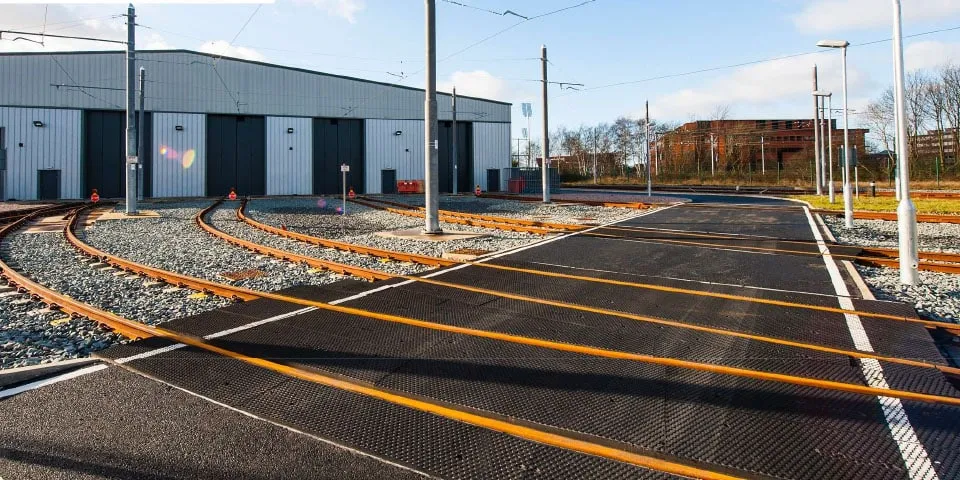
Depot reference, United Kingdom.
The complete rubber level crossings are supplied by Alom, a railway materials engineer and supplier. The crossing system, manufactured by British company Rosehill Rail, offers many benefits, says Alom director Mark van den Rijen. ‘’The solid rubber crossing panels can be installed quickly and efficiently. Installing the 1.80-metre-long panels, each weighing around 200-250 kilos, does not require large cranes. Thanks to what are known as lifting pins, two panels can be lowered simultaneously into a trough profile between the rails. The lifting pins also make it easy to remove individual panels for track maintenance and inspection, without having to dismantle the entire crossing.’’
Crossings are available in different strengths, depending on how they will be used. The ‘baseplate’ is intended for lighter use, for example by pedestrians and cyclists. These panels rest on the sleepers and are connected underneath by steel plates. Where heavy traffic uses the crossing, the Rosehill Rail ‘Rodded’ system is used. These panels feature an integrated steel frame and are connected by bolts protected by rubber cover plates
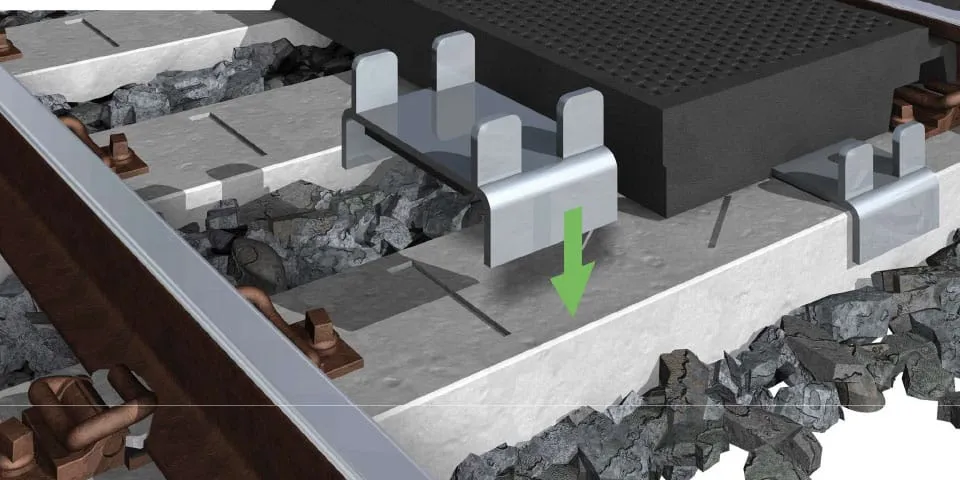
The baseplate for lighter traffic is connected to a steel frame underneath.
The crossing panels are manufactured in a press using an innovative, environmentally friendly “Cold Curing” method to ensure a long service life. Van den Rijen says: ‘’These crossings are wear-resistant, extremely easy to maintain and able to withstand many years of heavy traffic and all weather conditions.’’
Crossings can be custom-made for points or cut to fit other specialist rail infrastructure. For such specific situations, Alom prepares a laying plan. ‘’Rosehill crossings can also be laid on curves. We design a bespoke solution for each railway structure,’’ says Van den Rijen. ‘’At the Amstelveen Line stabling yard, the panels are also used around the sand-filling installation and the quick service point.’’
Van den Rijen says the Rosehill system offers a solution as rail traffic in the Netherlands is set to increase in the coming years. ‘’It is therefore important to increase track availability too. The Netherlands has around 2,500 level crossings in total. 1,800 of these are on public roads and are public crossings. Reducing the time that tracks are out of service for maintenance is an important factor in this.’’
‘’You could think of Alom as the one-stop shop for the railway industry,’’ says Van den Rijen. ‘’To continue the analogy, you can come to us for anything from a crate of Heineken to delicacies and all kinds of specialist ingredients. But we are also very happy to work things through with our customers, and add value for them. We can provide bespoke solutions to meet their specific requirements. We co-engineer our own rail systems, and we can supply what we design. For example, we developed our own rail system for the North-South Line in Amsterdam. We are incredibly proud of that.’’
Question about this story? Ask your question
Keep following this
Get an email when a new story is published. No account needed.
- SubjectNews







