









Surprising findings from Bomenwacht study into cycle paths
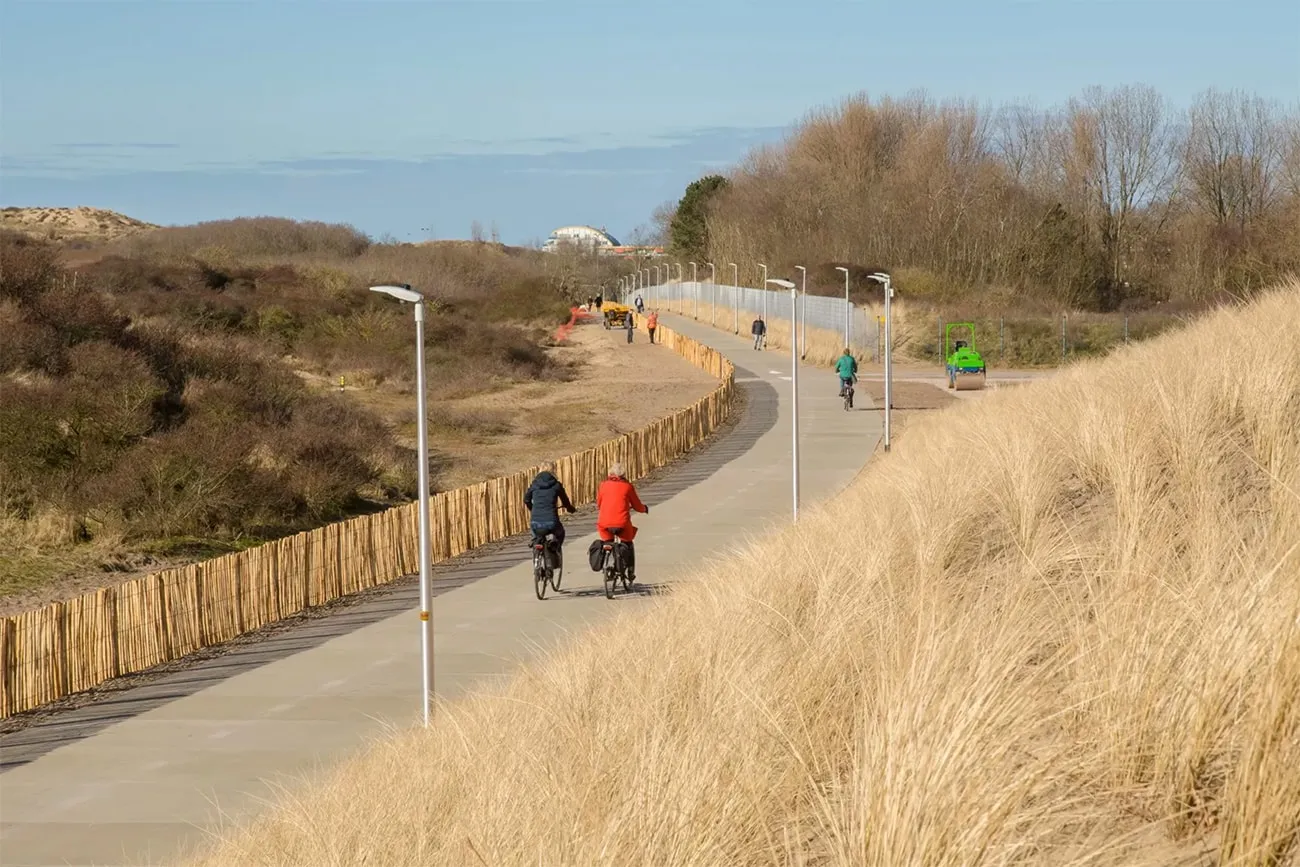
Trees and cycle paths can sometimes get in each other’s way. Root heave can turn a smooth surface into a bumpy cycle path full of cracks. Repairing cracks is an annual expense. To address this, attention often focuses on the impact trees have on cycle paths. Easypath turned the question around and approached Bomenwacht Nederland to carry out a study asking: “What impact can a cycle path have on tree development”. The study reached a surprising conclusion.
Limited space for trees in cities
Trees play a major role in tackling climate change, helping to provide clean air and a healthy living environment. In urban areas, where space is limited, trees cannot be taken for granted. “A city tree lives for 40 years on average,” says tree specialist Ronald van den Brink of Bomenwacht Nederland. “That is far too short, because a tree only starts delivering its benefits after those 40 years.” With many city centres becoming increasingly paved over, space for trees is limited. Even when a tree is included in a design, its growing space is often too small. ”When it comes to climate adaptation, we want to preserve those trees as much as possible,” says Jim Brouwer, commercial director at Easypath®. Brouwer wanted to find out whether the concrete elements used to construct cycle paths hindered tree development. He asked Bomenwacht Nederland to investigate.
Bomenwacht Nederland carried out research in four municipalities
Bomenwacht Nederland investigated cycle paths in four municipalities and was given three questions to answer:
- What impact do the interlocking concrete elements have on the development of tree roots?
- Can a difference be demonstrated compared with traditional asphalt or tiled cycle paths?
- What can be done when constructing cycle paths to reduce their negative effects on trees and increase the opportunities for tree development?
Bomenwacht began its work in 2021, selecting two existing cycle paths made of interlocking concrete slabs: one laid in Wageningen in 2006 and one in Teylingen in 2013. A traditionally constructed cycle path in Haarlem was also investigated. The researchers also visited a site in Amstelveen where a traditional cycle path was due to be replaced with a structure made of interlocking concrete elements. They carried out a growing-site survey, assessing a number of trees and examining the soil directly next to and beneath the cycle paths. “What condition are the cycle paths in now, with the trees alongside them? Are there problems with roots? Do the roots grow underneath? How thick are they? What is the quality of the growing site, and so on?” explains Van den Brink. “And how does that differ between concrete elements and asphalt or tiles?” Bomenwacht also asked the municipalities to complete a questionnaire.
Combination of reduced compaction and extra space proves crucial
Easypath®’s interlocking concrete elements performed well in the study, benefiting both the cycle paths and the trees. Van den Brink explains why. “It is the combination of less compaction and extra space. With traditional cycle paths, the subsoil is heavily compacted and allows less water and oxygen through. The roots seek higher ground and then grow through the foundation layer. With interlocking concrete elements, the foundation is barely compacted, because the load is distributed over a larger area and less compaction is needed, allowing water and oxygen through.” Bomenwacht found that there was more than enough oxygen for the trees beneath the concrete structure. Using tree soil improves growing conditions further. Because the soil is not compacted and there is enough oxygen and water, roots can grow downwards when concrete elements are used, where there is sufficient room for them to continue growing. This offers a major advantage in cities. It almost doubles the growing space beneath the concrete slabs and extends the life of the tree. “The greater the rooting space, the larger a tree can grow and the longer it will live,” says Van den Brink.
Easypath cycle paths are future-proof
Brouwer was surprised by the findings. “We knew that we offered an integrated solution that prevents root damage and heave. This is obviously a welcome confirmation. But above all, we are pleased that our system can provide an optimal growing site for trees, both in new and existing settings. Because our concrete elements are laid in a modular way, they can be removed to improve the growing site or add tree soil. And this matters, now that we are facing drought and heat stress.”
Question about this story? Ask your question
Keep following this
Get an email when a new story is published. No account needed.
- SubjectNews







