









‘Reversing the build is harder than building’
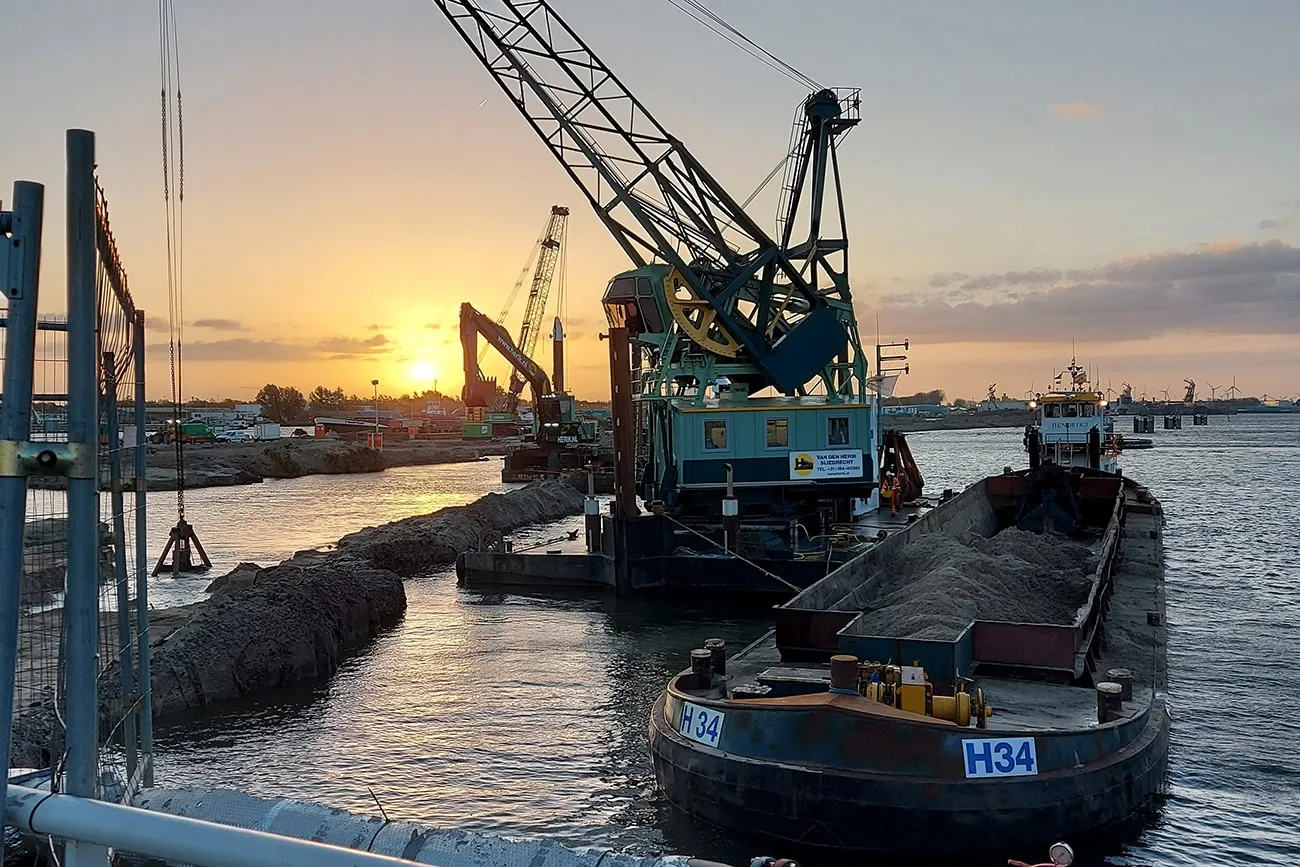
A temporary structure was built at the Frontmuur Zuidwest for the construction of the Nieuwe Sluis. And, as the name suggests, it was temporary, so it had to be removed. No easy task, because dismantling, or reversing the build, is harder than building. This is especially true when working towards circularity, as the materials must be dismantled separately to enable reuse. Water engineering contractor Van den Herik Sliedrecht took on the challenge of managing the work successfully.
Separating materials for reuse
“Removing the embankment in one go with large buckets isn’t difficult,” says Leo Kruidenier, Construction Manager at Van den Herik. “But then you’ve created a problem for yourself. The challenge was to reuse as much of the recovered material as possible.” To give an idea of the scale of the work, it involved removing (reversing the build) the steel slag, bentonite mats and sand from the temporary land reclamation around the Frontmuur Zuidwest. In terms of quantities, this amounted to 45,000 tonnes of 45/180 mm steel slag, 3,000 m² of bentonite mats, 2,500 tonnes of 5/40 kg rubble stone penetrated with colloidal concrete, 15,000 m³ of sand and 1,600 tonnes of clay. Wherever possible, all these materials were reused elsewhere on site or processed for reuse at other construction sites.
Sequence was key to reuse
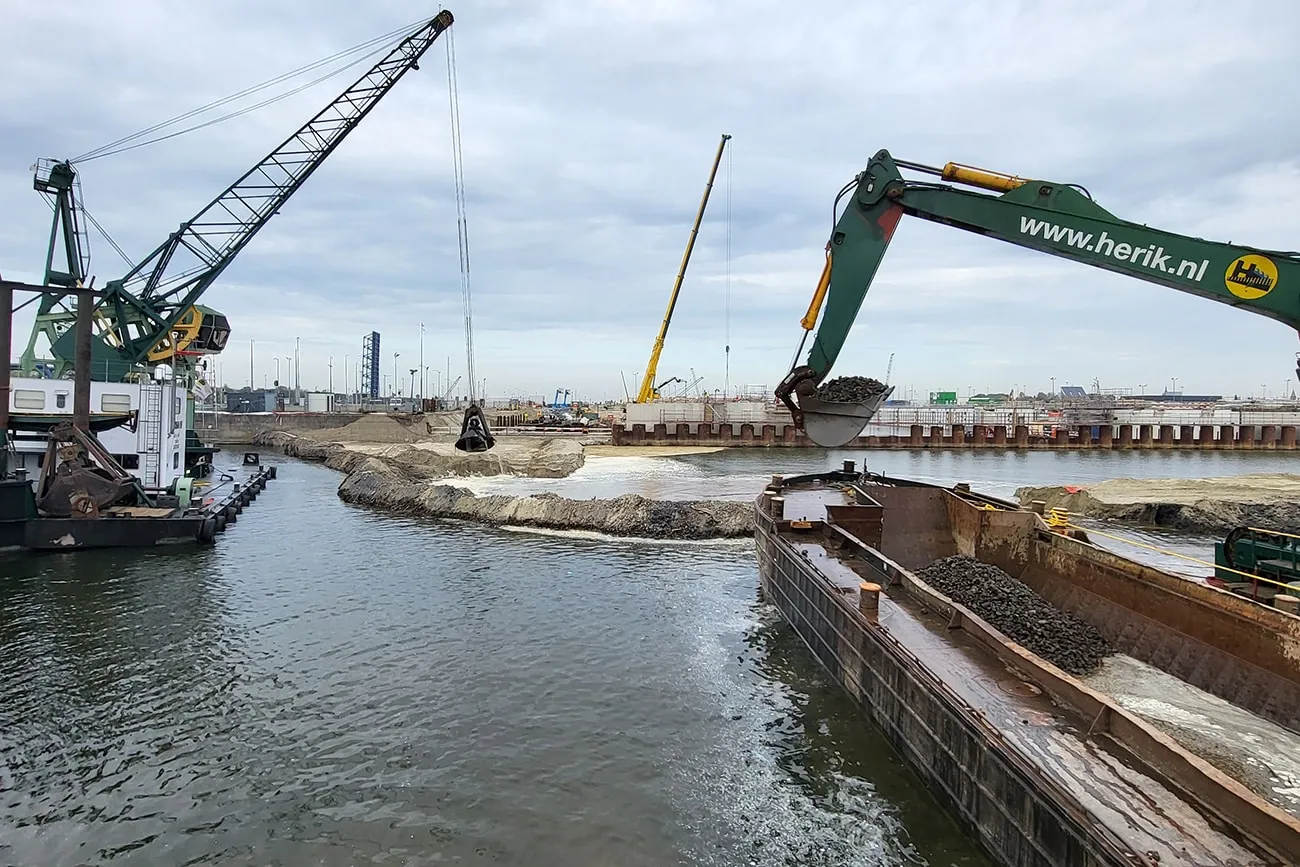
Van den Herik worked carefully, step by step. First, the sand was excavated, transported and used in a new application. It had to be removed carefully down to the steel slag, on which the bentonite mats had been laid, to prevent the steel slag from mixing with the sand. Next, the mattresses on the inside of the embankment, which had been sunk using steel slag, were removed. Kruidenier says: “Working in this sequence allowed us to separate the materials. The biggest challenge was separating the steel slag, fascine bundles and geotextile.”
Using large crane pontoons
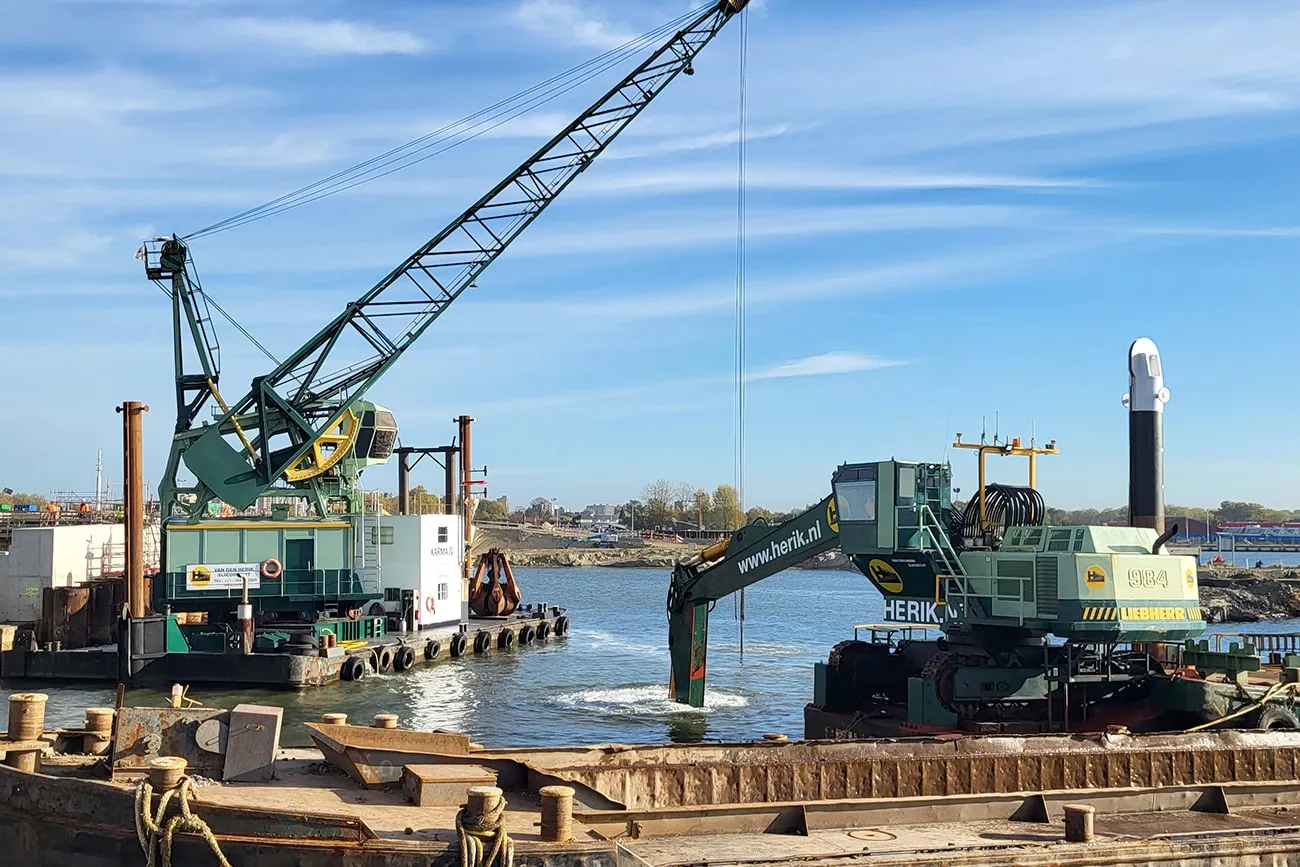
On the outer side of the embankment, the concrete-penetrated rubble stone was broken up to a depth of 12 metres, with as much of the colloidal concrete as possible separated from the rubble stone. This work required considerable force at great depth. Van den Herik adapted its crane pontoon Prins 5 for the task and put it to work. The recovered materials were transported by split-hopper barges to a stockpile, where the remaining materials were separated. This means the rubble stone can also be used elsewhere. “Once the sand, rubble stone and mattresses had been removed separately, we were able to remove the 45,000 tonnes of steel slag. Our crane pontoons Karma IV and Prins 5 did a great job handling this quantity at greater depths.”
Logistical challenge
Thanks to the two large crane pontoons, Karma IV and Prins 5, together with the necessary split-hopper barges and push boats, the work was completed in a short time. Logistics presented an additional challenge, as the work was carried out close to the busy Westsluis. Careful preparation, a clear working method and close coordination were essential. “One wrong decision could have had consequences. But under the day-to-day management of site supervisor Gerco Grootenboer, with the right equipment operated by skilled specialists, and thanks to the team’s commitment and dedication, the work was completed successfully. We are proud of the people who make it happen and look back with satisfaction on a challenging project completed to everyone’s satisfaction and within the agreed timeframe.”
Question about this story? Ask your question
Who worked on it
Southwest headwall
- hydraulic engineering companyVan den Herik Sliedrecht
Keep following this
Get an email when a new story is published. No account needed.
- ProjectSouthwest headwall
- SubjectNews
- CompanyVan den Herik Sliedrecht







