









Panheel’s smart treatment plant bubbles and fizzes its way to clean water
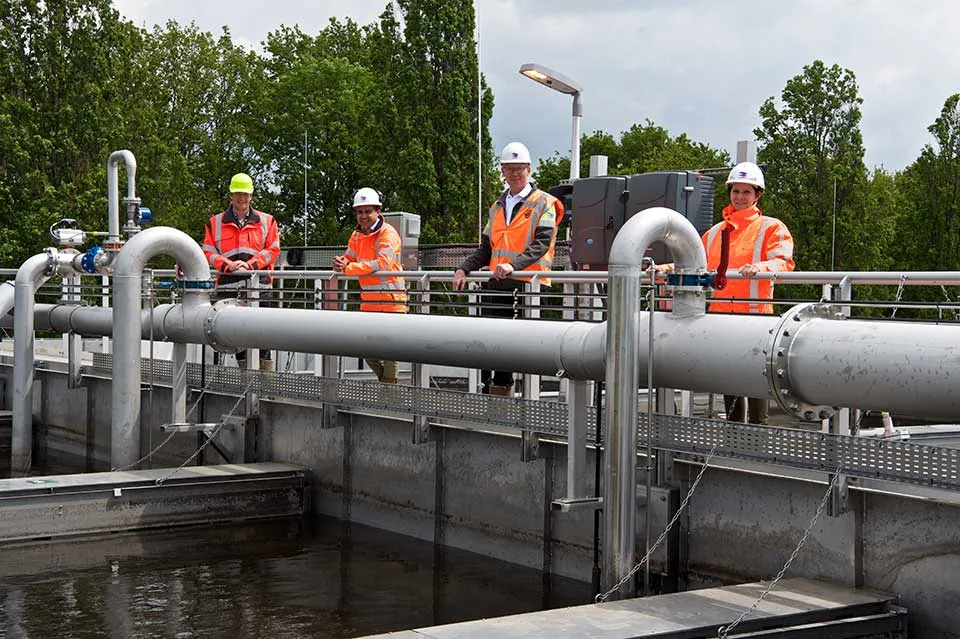
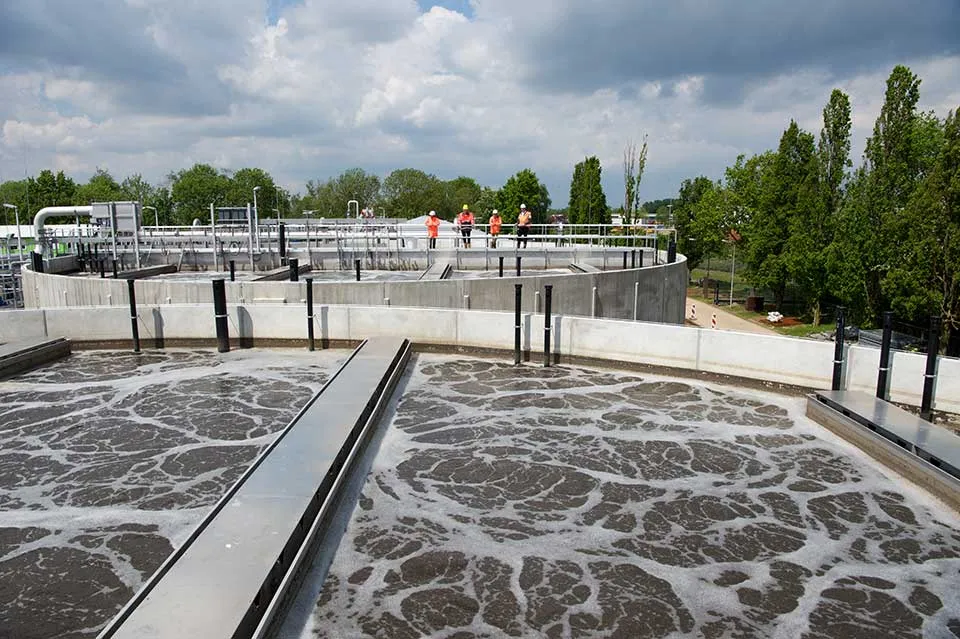
In Panheel, Limburg, water bubbles and fizzes in the circular basin. Dirty sewage flows through various parts of the treatment plant and comes out clean.
Treatment sounds relatively simple, but there is a whole world behind it of modular construction, smart technology and collaboration. ‘You never get used to the smell.’
The good news is that the odour will also diminish once the construction phase is over and the treatment plant has been fully commissioned. By then, project manager Jochem Seghers will be ready to move on from the project he is leading on behalf of Mobilis and Croonwolters&dros. When he started the job, he was far from confident; now he is brimming with confidence. The wastewater treatment plant (WWTP) will operate independently from 1 June: ‘I was told, “You’re going to build a treatment plant in a year.” I thought, yeah, right. But we did it. This is truly spectacular.’
What makes the project special is the use of a construction team during the delivery phase, the application of Nereda biological treatment technology and the Verdygo principle, which makes the construction and plant almost entirely modular and sustainable. Environmental considerations have also been given plenty of attention. For example, the concrete floors of the water basins have been given a seaweed-based post-treatment (Delft Green) .
Ruud Paridaans, technical manager at Waterschapsbedrijf Limburg (WBL), is delighted with the result and predicts that other water authorities will adopt this concept. ‘The treatment plant is more flexible, quicker to build and easier and smarter to maintain. What’s more, the treatment process itself is highly efficient thanks to Nereda technology. The benefits quickly add up.’
Waterschapsbedrijf Limburg worked with Mobilis, Croonwolters&dros and Tauw on the design phase. ‘We are convinced that you need to draw on the expertise available in the market. We have expertise in-house, but the contractors also bring a wealth of experience and ideas. Combining them gives you a smarter, better design,’ Paridaans explains.
The water authority selected three joint ventures under a framework contract to deliver several projects in Weert, Stein and Panheel. Mobilis is building two treatment plants in Panheel and Stein. In Panheel, Mobilis is working with Croonwolter&dros (CMC Waterprojecten Limburg) and Eliquo. In Stein, CMC is working with Engie and Eliquo. A completely new treatment plant is now in place at Panheel, as at Stein.
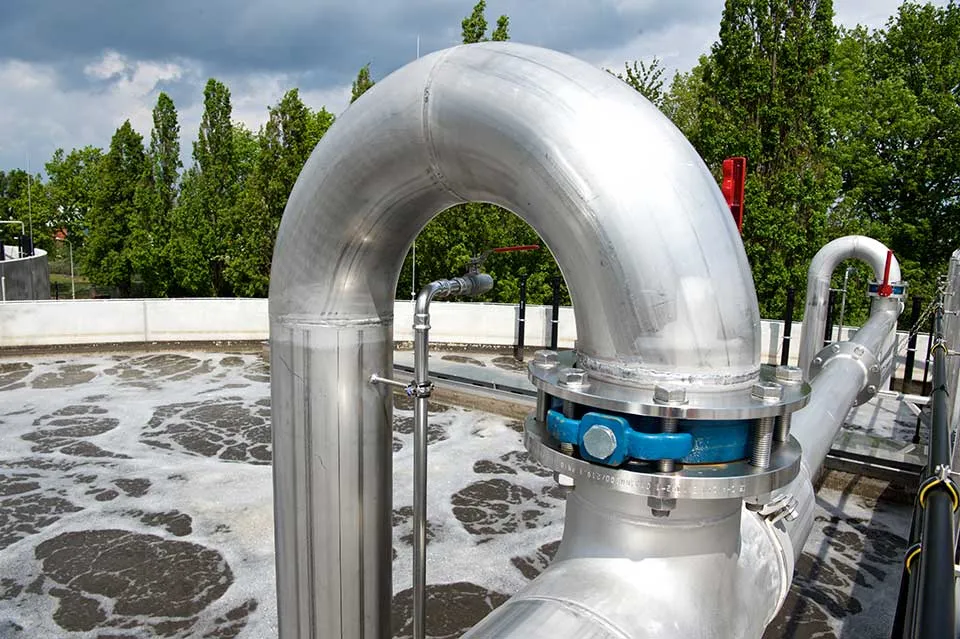
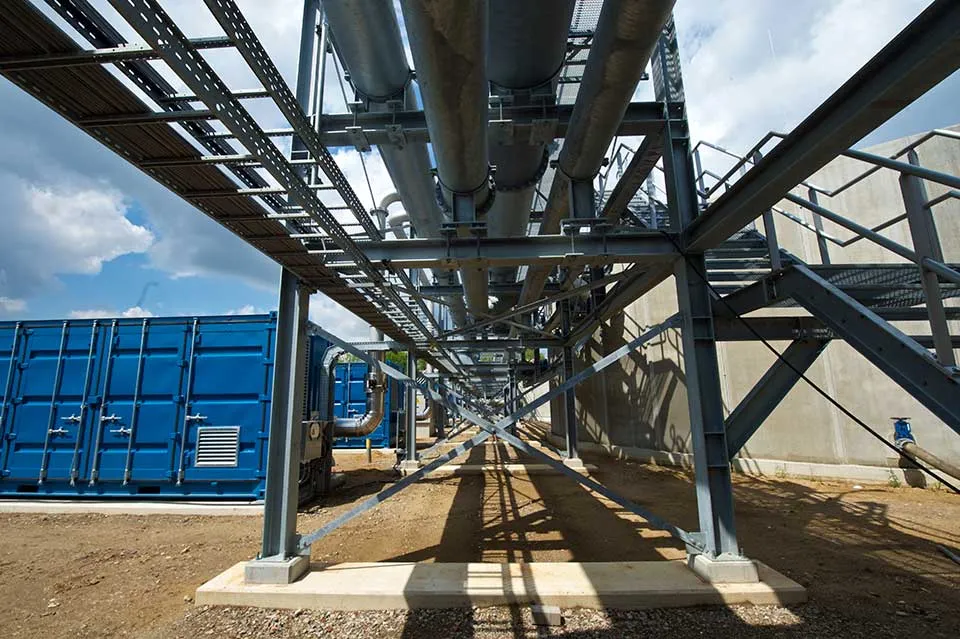
We walk from the site office to the four basins. One striking feature is that everything is above ground. A large, gleaming tangle of pipes runs in front of the basins, with a long walkway above it running alongside them. Beneath it are various blue containers, separate modules housing the plant.
The single pipe corridor is already a much more efficient arrangement. The whole plant is impressive in scale, yet takes up only a third of the area of the old installation, which was spread out across the site and needed many more tanks and basins to treat the sewage.
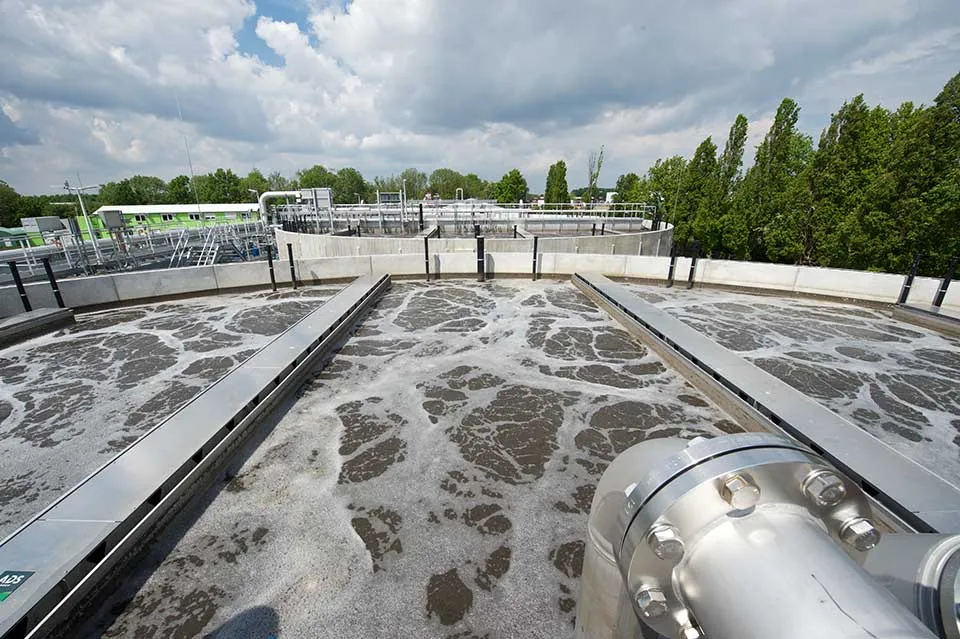
‘Look, we start with one buffer tank, then two Nereda reactors, followed by that relatively small sludge tank,’ Paridaans points out. ‘The smart thing about the Nereda concept is that it uses granular sludge with good settling properties. It is entirely biological. It is now a proven concept,’ Seghers adds. ‘Before the sewage flows into the tanks, screens remove all the coarse material, including the sand. In the Nereda tank, the treated water is left to settle and the sludge sinks to the bottom. Clean water remains on the surface. It really is that simple.’
It can hardly be called a traditional construction site any more. The site fencing and office are still there, but the four circular basins are fully operational, with the water swirling and bubbling. The first tank is covered by a large tarpaulin. ‘That is mainly to keep the smell down, since it is mostly urine and faeces, and to stop leaves falling into the water.’ A loader and tipper truck are still moving around here and there, but the work is all but finished. ‘Next, we can demolish the old treatment plant. You want to wait until you are 100 per cent sure the new plant is running,’ Seghers explains.
Seghers and Paridaans have found working in a construction team a positive experience. ‘You draw on each other’s knowledge and expertise, and a construction team also helps avoid a lot of hassle over cost overruns and risks. Of course, we discuss the approach, the programme and the risks. That is inevitable on a project of this size, but the discussions have been constructive and “best for project” has always come first,’ Paridaans says.
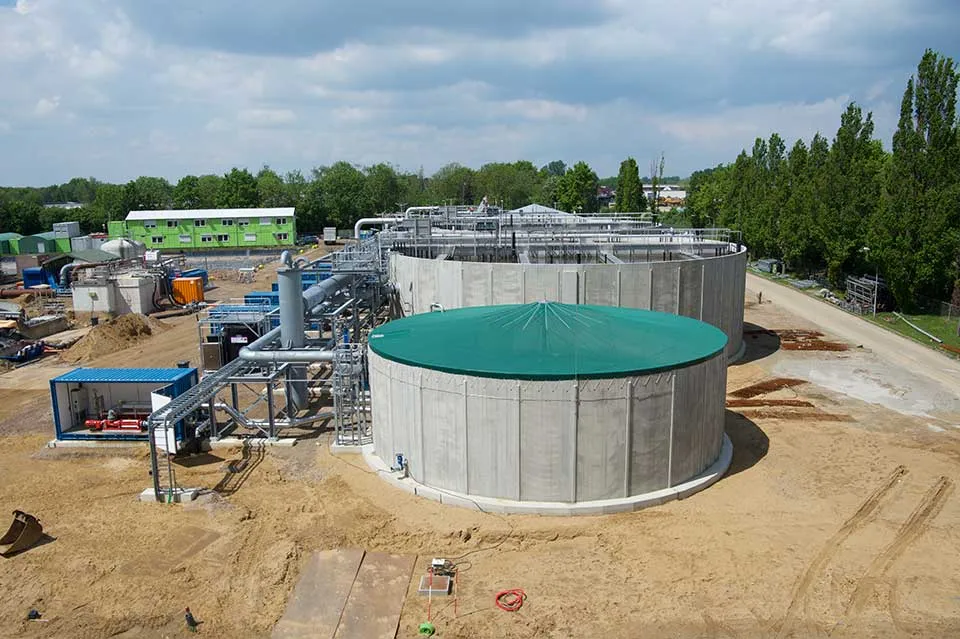
Three disciplines have to work together: civil engineering, mechanical engineering and electrical engineering. That alone presents plenty of challenges. The result is a modular, compact system. As on this project, the tight programme proved to be the biggest challenge. ‘And Covid was a constant concern too, with people sometimes unexpectedly having to take time off,’ says Seghers. ‘But safety always came first, and we completed the project without any accidents. That is worth mentioning too,’ Paridaans adds.
Croonwolters&dros project manager Ad van Oers is particularly pleased with the modular approach, which has been installed entirely above ground. ‘All the technology in the Verdygo modules was built inside factory walls, in a controlled environment. The separate units are easily accessible, identical in appearance and interchangeable. What’s more, if a blower or pump fails, you can replace a module in just a few hours. You remove it from the system, minimising disruption to the treatment process. That is exceptionally efficient compared with more traditional systems.’ The design already took a circular approach into account. Almost all the modules can be reused and interchanged.
In Panheel, Limburg, sewage from the surrounding municipalities comes together. For years, a Waterschapbedrijf Limburg treatment plant has operated on the outskirts of the village, on Heggerstraat. The old installations are still in use, ‘we are running them in parallel for now’, but not for much longer. Project manager Ellen van der Bend has overseen the testing phase in recent months, including the transition from the old treatment plant to the new one. Water quality is tested every day, but testing was much more frequent during start-up.
‘The bacteria clumped together and got to work surprisingly quickly. Within two weeks, the treated water from the new plant was already cleaner than that from the old one. And that was only halfway through starting up the Nereda process. That was a real buzz. Testing is genuinely nerve-racking. Each discipline tested its components individually, but the system also has to work when everything is connected. We had 34 lorry-loads of sludge brought in from the treatment plant in Weert for the start-up phase,’ she recalls of the challenging transition.
‘We started slightly behind schedule, but commissioning has gone more smoothly and quickly than expected. The pressure was pretty high as a result, and tempers were a little shorter. But when everything goes so well, everyone is proud and enthusiastic. We will be completely finished before the summer construction holiday.’ The treatment plants in both Panheel and Stein will be operational before the summer construction holiday. The official handover is scheduled for later this year.
Panheel wastewater treatment plant project details
- Project: RWZI Panheel
- Client: Waterschapsbedrijf Limburg
- Contractor: Mobilis and Croonwolter&dros
- Contract form: Construction team
- Construction phase: 12 months
- Project value: 20 million euros
WWTP installations
- Nereda buffer tank with mixers
- Two Nereda tanks
- Sludge collection tank
- Various modules with pumps and blowers
- Pipework and pipe bridge
- Sludge processing building
- Effluent buffer
Have a business enquiry for Mobilis? Get in touch
Who worked on RWZI Panheel
- clientWaterschapsbedrijf LimburgIn this story
- consultancy and engineering
 TauwMentioned in Framework contract for Tilburg WWTP awarded to Mobilis-Croonwolter&dros joint venture
- mechanical engineering activitiesRWB WaterMentioned in Framework contract for Tilburg WWTP awarded to Mobilis-Croonwolter&dros joint venture
- Nereda® technologyRoyal HaskoningDHVMentioned in Sharing knowledge and collaborating to accelerate sustainable wastewater treatment

Keep following this
Get an email when a new story is published. No account needed.
- ProjectRWZI Panheel
- SubjectNews
- CompanyMobilis
- CompanyCroonwolter&dros
- CompanyWaterschapsbedrijf Limburg
- CompanyTAUW | Consultancy and engineering firm







