









Ortelius is the latest addition to the Jan De Nul fleet
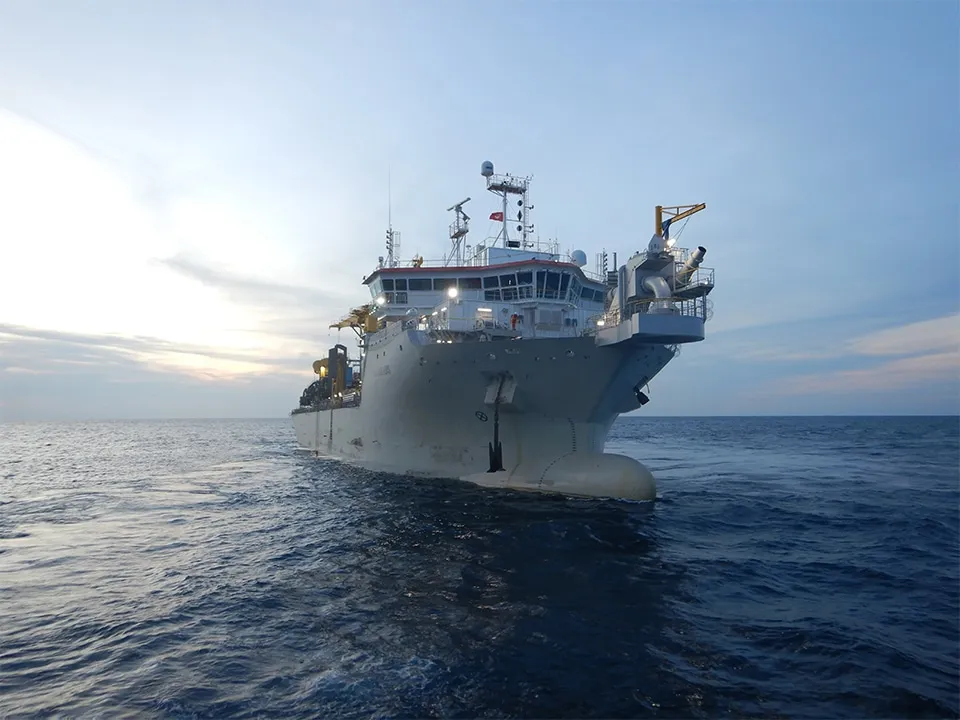
The new trailing suction hopper dredger Ortelius puts air quality first, filtering exhaust emissions to unprecedented levels for the shipping industry. This is a hallmark of the new generation of vessels built for Jan De Nul Group. Its identical sister vessel Sanderus has been working on the Scheldt in Belgium since February 2020.
Ortelius is the fifth trailing suction hopper dredger delivered by Keppel O&M to Jan De Nul Group. Three smaller hoppers, each with a hopper capacity of 3,500 m³, had already entered service, and Ortelius follows her sister vessel with a hopper capacity of 6,000 m³. All five vessels have ultra-low emissions thanks to Jan De Nul’s specialised onboard filter system.
Ortelius was built to meet the EU Stage V and Tier III requirements of the International Maritime Organization (IMO). It is diesel-electric and can dredge to a maximum depth of 35 m. The vessel has a shallow draught, is highly manoeuvrable and is suited to working in areas with very limited room to manoeuvre.
Robby De Backer, Director Newbuilding Department at Jan De Nul Group “Thanks to our new generation of hoppers, such as Ortelius, we can carry out dredging projects with the lowest possible emissions. Our teams worked closely with the teams at Keppel’s shipyard to overcome the challenges of COVID-19 and expedite the delivery of Ortelius. We are proud to work with market leader Keppel, whose technical expertise and excellent service ensure the safe delivery of high-quality vessels.”
Tan Leong Peng, Managing Director (New Builds) at Keppel O&M: “The delivery of a fifth dredger is testament to Keppel O&M’s shipbuilding capabilities and technological expertise. Our partnership with Jan De Nul has grown ever closer, and our holistic construction approach has enabled us to deliver all five ultra-low-emission dredgers safely and efficiently. In response to COVID-19, we introduced safe control measures, optimised operations and diversified our supply chain, enabling us to safely and efficiently make up the work backlog.”
New vessels focus on improving air quality
The latest generation of Jan De Nul vessels is leading the way in the shipping industry. They focus on exhaust after-treatment, which is the key to improving air quality across the sector.
Without after-treatment, internal combustion engines emit harmful exhaust gases. Vessels equipped with an advanced filter system do not. The catalytic converter neutralises nitrogen oxides, while the particulate filter traps the finest particles. In other words, there is no more air pollution or harmful particulate matter that directly affects our health and living environment.
With its ultra-low-emission vessels, Jan De Nul Group is working towards ever better air quality.
Question about this story? Ask your question
Keep following this
Get an email when a new story is published. No account needed.
- SubjectNews







