









New ductile iron columns for Leeuwarden station
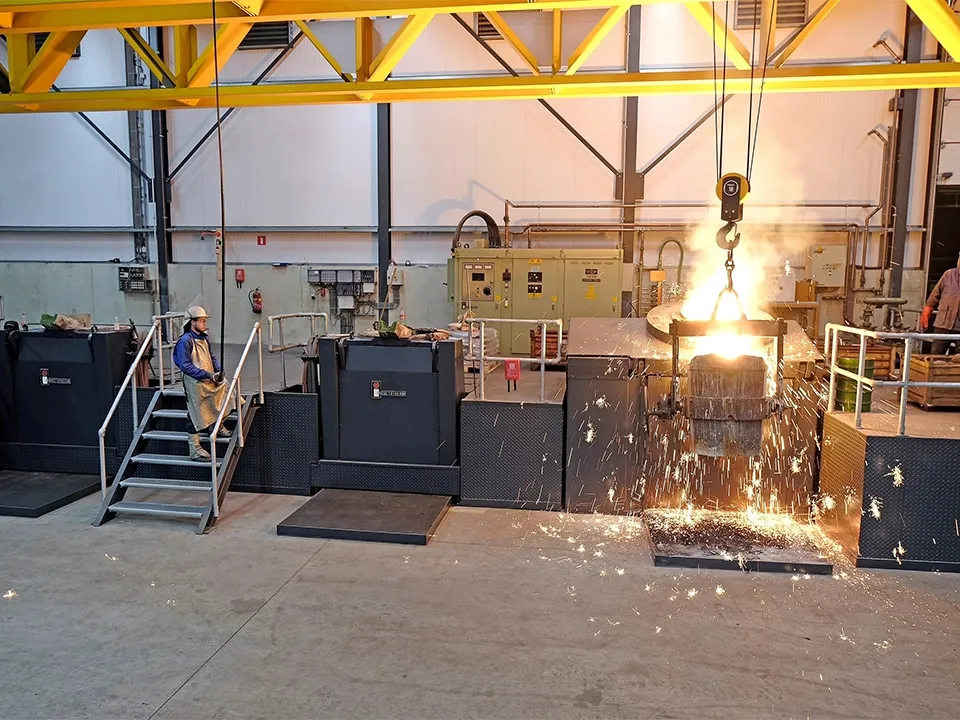
Where better to pass an old craft on to younger generations than in a family business? The answer is ‘nowhere’, and Dekens Metaalgieterijen BV in Sappemeer is a shining example.
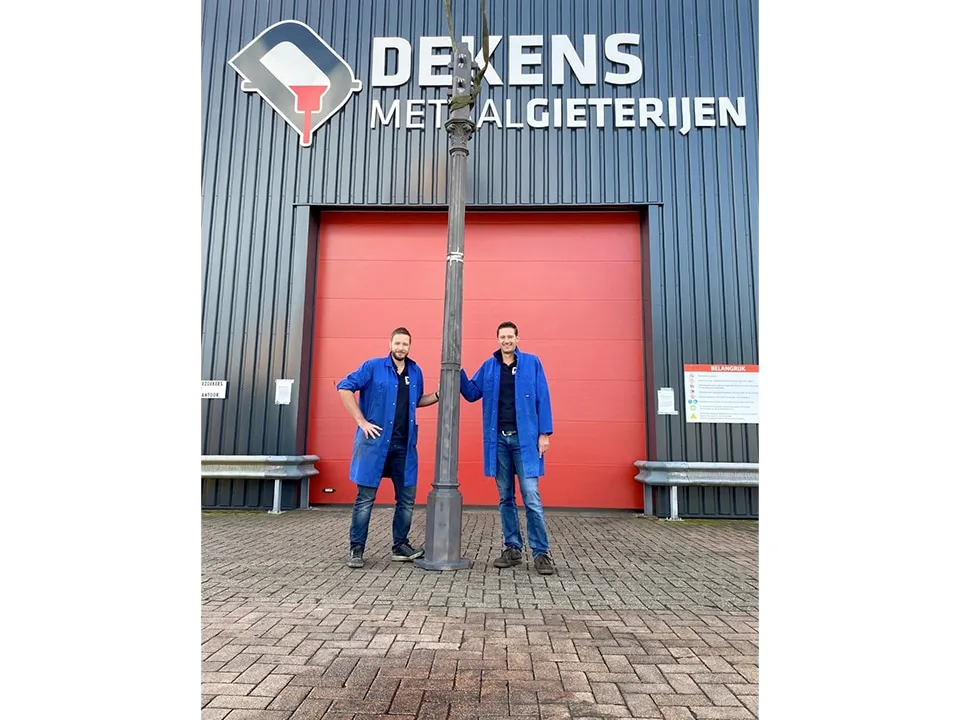
In 1996, Luuk Dekens took over the foundry, where he had started working in 1982, from his father, who had himself taken it over in 1956. Luuk’s father and mother, Luuk and Marjan Dekens, still work at the company today with passion, alongside their sons Harold and Herman.
It is no coincidence that Dekens was honoured with the task of reproducing the cast-iron columns to be supplied as replacements for the renovation of Leeuwarden station. The project requires not only traditional metal casting skills, but also a high-tech approach. Luuk and Harold explain
why.
In-house pattern shop
“Our employees make the columns by hand, using high-tech machines,” Harold begins. “First, we make a pattern, then cast it in sand, and finally finish it at our machine shop. A layperson might think we simply press an existing cast-iron post into a mould and fill it with molten iron, but that is not how it works. To get it right, we engineer the new post entirely in 3D, using precise measurements of the existing one. We then use that data to make the casting pattern. Sand moulds are made from the pattern, and the castings are produced by melting the metal in induction furnaces. So we combine traditional casting skills with high-tech techniques.”
Ductile iron
The new posts for Leeuwarden station will be cast in ductile iron. Luuk explains: “Cast iron is sustainable by definition. In the past, grey cast iron was used; today, it is ductile iron. Ductile iron is comparable in strength to grade 37 steel. Pouring molten cast iron at 1,400 ˚C into a sand mould at a temperature of 25˚C creates a cast skin on the metal. This protects the material.” “We have already started casting for Leeuwarden station,” Herman says. “What is good is that some of the old existing columns and scrap cast iron, such as railway base plates and old rails, are being used in the melting process. They will return in a new form, so we are working circularly. Track by track, you might say.” Once the columns have been cast, they are finished by drilling the mounting holes and holes in the ground flange. Dekens can do this in-house at its own machine shop.
‘Pride in your work’
Although this type of restoration work accounts for only a small part of Dekens’ day-to-day business, the family is very pleased to be involved. “We do restoration work every year,” says Luuk. “Windows, gutters and, in this case, columns… We are proud of our craft, and this kind of work lets us showcase our expertise. We also have a feel for historic work and are happy to be part of it. Most of the products we make disappear inside machines. This work is tangible and visible, and we can point to it with pride. That is pride in your work.”
Question about this story? Ask your question
Keep following this
Get an email when a new story is published. No account needed.
- SubjectNews







