









Innovative infiltration channel in the centre of Berlicum (NB)

Work began in April last year on the redevelopment of Mercuriusplein in Berlicum (municipality of Sint-Michielsgestel). The square serves many purposes, including parking, shopping, socialising, weekly markets and events. The municipality is actively promoting and implementing climate-adaptive solutions. Mercuriusplein in Berlicum shows that encountering obstacles along the way is no bad thing, quite the opposite!
WHY INFILTRATE
The climate is changing, and the effects of climate change can be seen everywhere. Heavy downpours and longer periods of drought call for sustainable water management. “Two years ago, during a visit to the Climate Trade Fair in Houten, I came across the ACO infiltration channel,” says Fred Knibbeler of Dolmans Landscaping Group. “We focus on circular and innovative solutions, so the infiltration channel immediately caught my attention. It collects rainwater and infiltrates it locally into the ground, close to the surface. This prevents the soil from drying out and reduces the load on the sewer system. I immediately saw the potential of this system, and it turned out to be the ideal solution for Mercuriusplein in Berlicum.” This created a win-win situation for the village, its people and nature!
HOW THE ACO INFILTRATION CHANNEL WORKS
The infiltration channel is available in stainless steel or Corten steel and has bottom outlets connected to infiltration wicks in the ground. “These wicks are made from environmentally friendly, fully circular stone wool. The number of bottom outlets and wicks is determined by the design requirements and the soil’s water permeability (K-value),” explains Kees-Willem Kamp, sales engineer at ACO, who supported the project from start to finish. “To protect the infiltration wicks and the subsoil from contamination, the channel base also incorporates filter elements made from circular stone wool. Once installed in the ground, the wicks ensure that rainwater infiltrates the soil and is released gradually. This prevents the soil from drying out and reduces the load on the sewer system during rainfall.”
APPLICATION AT MERCURIUSPLEIN
During the design phase for Mercuriusplein, it was decided not to connect the rainwater from the area used for the weekly market to the infiltration channel, because of the level of contamination. A standard ACO ExoDrain channel is therefore installed here, discharging into the wastewater sewer. The remaining rainwater, from around 4500 m2 of paved surface, is collected in the infiltration channel and infiltrated into the soil. “To manage this in a controlled way, the system is divided into compartments so that the water does not all flow to one point, but is released into the ground in a controlled manner. The infiltration channel system has overflows at various points, as well as additional storage in the form of a water-retaining foundation beneath the car park paving. This prevents flooding and potential damage even during heavy peak rainfall,” Fred Knibbeler explains.
QUICK INSTALLATION
Thanks to its unique ExoDrain construction, the infiltration channel does not require a concrete foundation or additional concrete haunching (Type I in accordance with NEN-EN1433) to meet the D400 load class requirement. The only requirement is a sufficiently load-bearing subgrade with adequate water permeability. It is therefore recommended that the channels be installed on a concrete bedding layer. Holes with a diameter of 25 cm for the infiltration wicks can be made using vacuum excavation, a mechanical earth auger or a post-hole spade. The resulting holes are then fitted with infiltration wicks measuring 1200 mm long and 150×200 mm in cross-section. Any voids are filled with crushed stone. The infiltration channel is installed over these wicks. At Mercuriusplein, the infiltration wicks are spaced two metres apart, centre to centre.
GRATE COVER WITH BEAR MOTIF
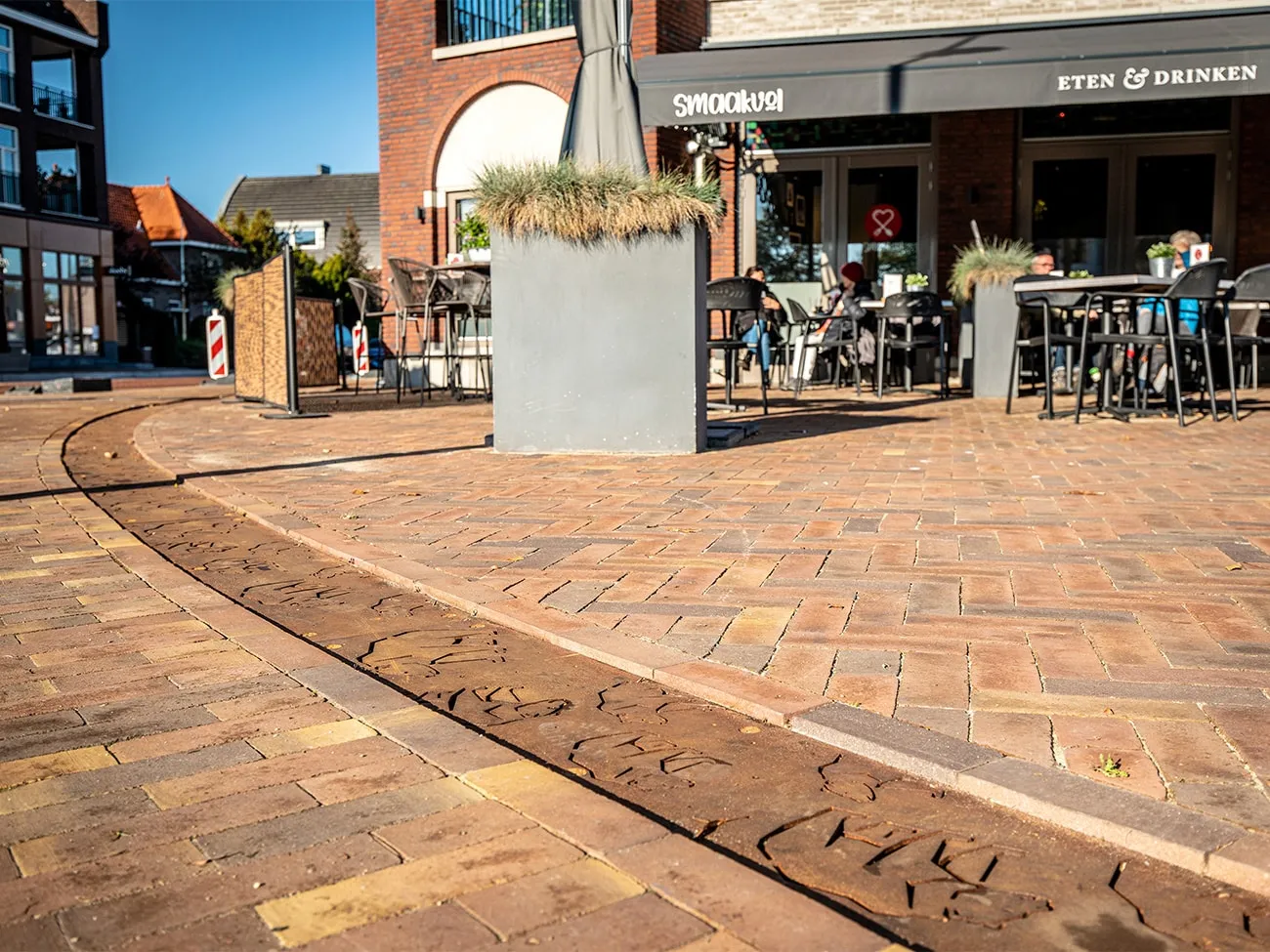
Like any channel with a grating, the infiltration channel can be fitted with custom-designed cast-iron or Corten steel grates. This option has been fully embraced for this project. The grate motif was designed by Susanne Dohmeier of Dolmans Landscaping Group: “In designing it, I tried to make a link with the past and bring something unique to Berlicum back to Mercuriusplein, also known as the village’s ‘living room’. The bear comes from Berlicum’s old coat of arms. I abstracted the figure to create a motif in which large and small bears alternate.” The distinctive look helps give the square its identity and gives drainage a character of its own. Residents have also responded very positively to the bear motif!
MAINTENANCE
The system must, of course, be accessible for inspection and cleaning. The infiltration channel should be checked periodically for contamination and to ensure it is functioning properly. If performance declines, the horizontally installed filter elements can be replaced. This is straightforward once the grates have been removed. The infiltration wicks require no further maintenance.
This infiltration channel fits into any design, making sustainable water management possible in every village and town.
Question about this story? Ask your question
Who worked on it
Mercuriusplein in Sint-Michielsgestel
- infiltratiegootACO
Keep following this
Get an email when a new story is published. No account needed.
- ProjectMercuriusplein
- SubjectNews
- CompanyACO







