









‘InfraTech excels in current issues, even now’
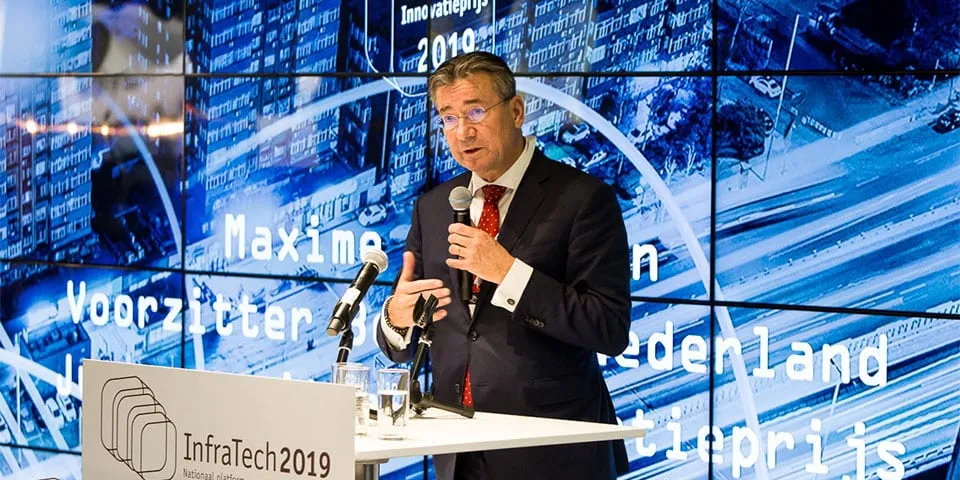
In the run-up to InfraTech 2021, InfraTech aims to be the platform where the various parties meet and learn from one another. That is one reason why online talk shows are held every month, with discussion and debate on the various themes of the trade fair. Two episodes are already available under the title ‘InfraTech Series’: one on mobility in a 1.5-metre society and one on digital infrastructure.
If the coronavirus crisis, which is still very much with us, has shown us anything, it is that unexpected situations can lead to radical change. The virus and its consequences have had an enormous impact on almost every subject discussed at InfraTech. The pandemic has shown that, as a society, we are able to radically change our mobility habits. Almost overnight, we were able to work from home en masse, leave the car at home and avoid public transport.
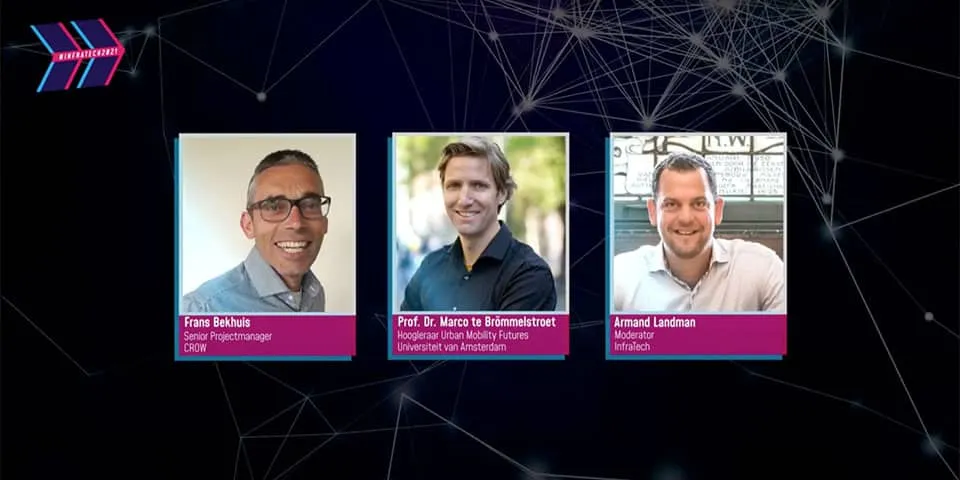
“The discussion about the kind of streets we want to live in has suddenly become more than relevant,” said Marco te Brömmelstroet, Professor of Urban Mobility Futures at the Faculty of Social and Behavioural Sciences of the University of Amsterdam (UvA), in the first episode of InfraTech Series. “And what role does mobility still play in our streets? We can see now that it no longer necessarily has to take centre stage. The Netherlands is an example to the world of how well you can organise different flows of traffic.”
Room to move
But according to Te Brömmelstroet, the coronavirus crisis has also revealed just how much space cars take up in public areas, even when they are stationary. “People suddenly realised that the space available to pedestrians and cyclists is quite limited compared with the square metres allocated to cars. And when you use your car much less, you suddenly start wondering why the pavement can’t be a little wider, or why there is so little greenery in a residential area. These are things that are suddenly being questioned.”
Frans Bekhuis, Senior Project Manager for Mobility and Space at CROW, has noticed this too. “We are now receiving more requests for designs that leave less space for motorised traffic. And the pandemic has accelerated this trend.”
Both say that thinking about mobility and the design of public areas also requires political courage. Bekhuis says: “Mobility is a public and collective interest. That calls for government leadership. And things are indeed happening. Take the former infrastructure fund. It is now called the Mobility Fund, and the money in it is no longer automatically allocated to motorways, but also to facilities for cycling. A broader perspective is being taken.”
Digital infrastructure
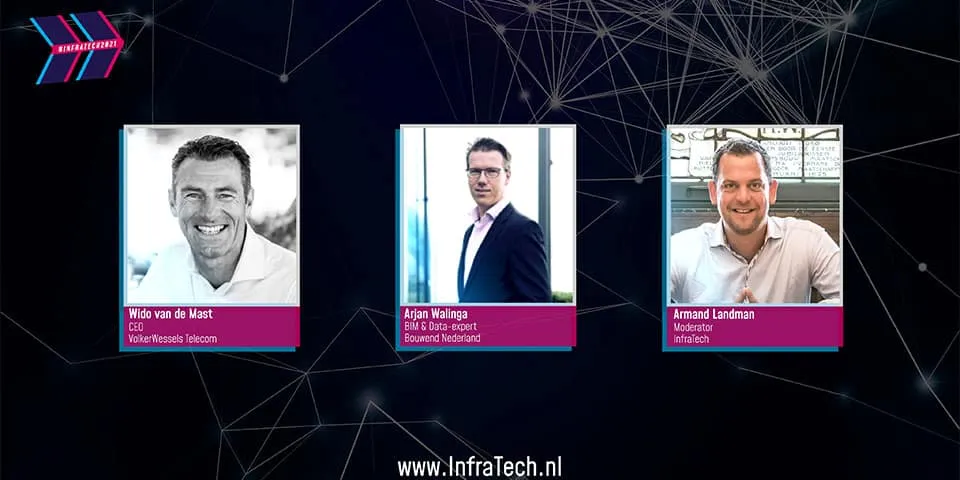
In 2020, designing public areas can no longer be done without also taking digital infrastructure into account. That was the message from Arjan Walinga, BIM&Data expert at Bouwend Nederland, during the second episode of InfraTech Series. “With all the different users of public areas, residents, pedestrians, cyclists, parcel couriers, businesses supplying shops and construction traffic, wouldn’t it be great if smart sensors and technologies could be used to predict how busy it will get, and exactly where? That would allow you to manage a great deal of traffic effectively and make a city more liveable.”
Wido van de Mast, CEO at VolkerWessels Telecom, believes that this in turn calls for stronger leadership. “There is certainly room for improvement, particularly in the permitting process. We will need to communicate better with each other about when there will be disruption and when a pavement or street needs to be opened up. There are still quite significant differences between municipalities. I see room for improvement there.” Van de Mast advocates a more integrated approach to installing digital infrastructure. “Telecom often comes in at the end of area development, as well as when homes or offices are being built. A structure is often completely finished before anyone realises that a fibre-optic cable should have been installed. Connectivity is overlooked. The main obstacle is the siloed way we have organised things. But if you think of connectivity as a skewer running through everything, you can decide much earlier how and when to install things.”
Knowledge platform
These are the kinds of current issues at which InfraTech excels. The 14th edition will be no different. Together with hosts Rijkswaterstaat and the Municipality of Rotterdam, and partners including Bouwend Nederland, CROW and the Bouwcampus, preparations are well under way for an engaging and substantive programme. This programme will have a hybrid element more than ever before. But it will of course be just as innovative and informative, with ‘connecting and moving forward together’ at its heart more than ever.
Visit www.infratech.nl for the latest information and follow the LinkedIn page.
A business enquiry for InfraTech? Get in touch
Companies in this story
Keep following this
Get an email when a new story is published. No account needed.
- SubjectNews
- CompanyInfraTech







