









Infiltration buffer used in climate-resilient redevelopment of Horst aan de Maas town centre
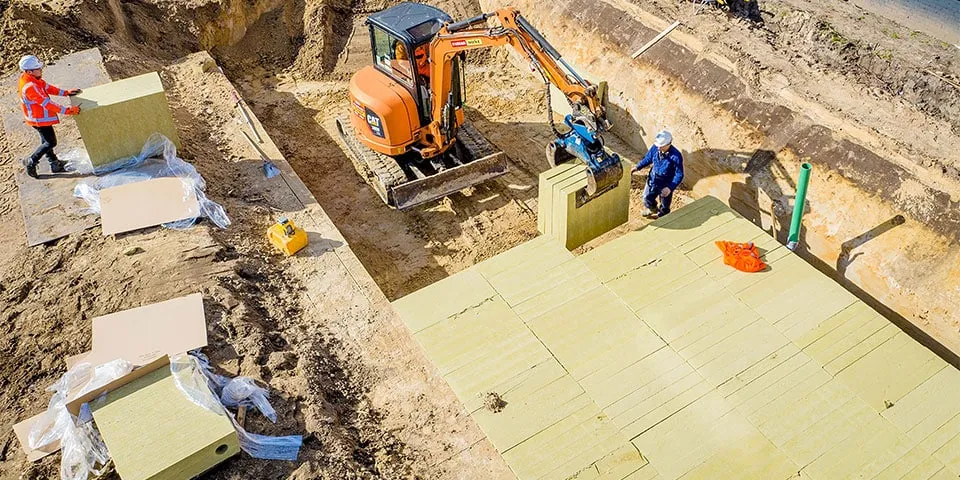
The project provides a test site to investigate the capillary action of the stone wool in an underground Rockflow water management system.
The area around the cultural centre ‘t Gasthoês in Horst aan de Maas, which is being renovated, is being redeveloped as a green space. This heavily paved area is facing current challenges including intense downpours, extreme drought and heat stress. Lapinus’s Rockflow infiltration buffer, part of ROCKWOOL Group, is being used in the area.
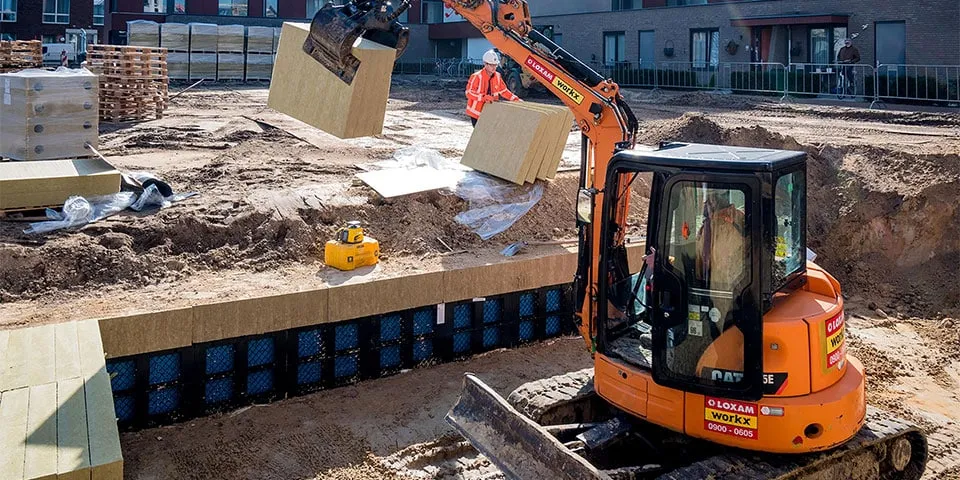
The 100% recyclable infiltration buffer helps reduce flooding on the paved surfaces around ‘t Gasthoês after heavy rainfall. The smart water management system stores rainwater and allows it to infiltrate into the soil, keeping groundwater levels stable. The climate atlas shows that temperatures in some locations in Horst aan de Maas are higher than elsewhere. During heavy downpours, the sewer system cannot drain away enough rainwater. The municipality of Horst aan de Maas has therefore decided to introduce climate adaptation measures as part of the redevelopment of the area around ‘t Gasthoês. The aim is to create a greener space that prevents flooding, heats up more slowly, combats desiccation and keeps groundwater levels stable.
A green space
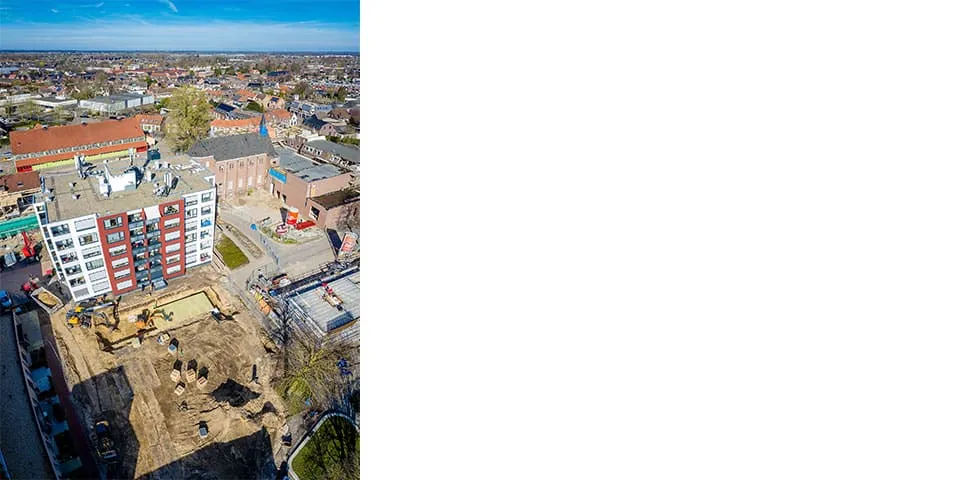
‘t Gasthoês was owned by housing association Wonen Limburg and is now owned by the municipality of Horst aan de Maas. Marleen van Ulft is a senior area development officer at Wonen Limburg. Her responsibilities include keeping neighbourhoods and communities liveable and providing people with a pleasant place to live. “Green space is an important part of this,” she says. “The municipality of Horst aan de Maas is increasingly focusing on climate adaptation. The sustainable area transformation around ‘t Gasthoês, known as Hof te Berkel, is a good example.” Wonen Limburg started the project in collaboration with the municipality of Horst aan de Maas, with the aim of making its existing buildings and the surrounding infrastructure more sustainable and greener. “To tackle flooding during peak rainfall, the municipality sets requirements for the living environment, spatial planning, sustainability, maintenance and, of course, the costs,” says Van Ulft. The municipality’s main aim is to transform the area around ‘t Gasthoês into an open, green space directly connected to the town centre. The existing car park has been completely redesigned to achieve this. Van Ulft says Wonen Limburg is working with a large number of parties on the plans for the public infrastructure, including residents, businesses and construction companies. “This collaborative approach allows us to make considered choices to create a sustainable, climate-resilient urban environment,” says Van Ulft. The project is due for completion this autumn.
Construction team
Wim Ramakers is a project manager at infrastructure contractor BLM Wegenbouw in Wessem. “We are delivering this project using a construction team approach,” says Ramakers. The construction team comprises the municipality as client, main contractor BLM Wegenbouw and consultancy Kragten, which supported the municipality with the preliminary design for the redevelopment of the Gasthoês area. Lapinus’s smart water management system has been incorporated as a complete solution. Lapinus regularly took part in the construction team’s discussions to help develop an integrated solution. “The area will have a varied, sustainable character, improving the environment and the living conditions in this heavily paved setting.” The car park that is remaining in place must stay accessible. Rainwater will be collected and infiltrated into the soil wherever possible. “All gullies in the paved area are connected to a separate stormwater sewer, which feeds into Lapinus’s Rockflow infiltration buffer. During peak rainfall, the buffers collect the rainwater and then release it gradually into the soil. This prevents flooding and soil desiccation.” In addition, water from the roof of ‘t Gasthoês is collected and channelled into a permavoid system, where the stone wool carries water to the plants. The system includes underground water storage beneath the planting beds, creating a capillary action that keeps the water level available to the plants stable. “We are testing in this project whether the proven permavoid system can be replicated using the Rockflow system,” says Ramakers.
Climate improvement
Joop Schaghen is an area development and community participation adviser at Kragten in Herten. “Flooding during heavy rainfall and cities heating up significantly in summer are pressing issues,” says Schaghen. “Municipalities are increasingly recognising the problems caused by paved surfaces in urban areas.” The fact that the Netherlands is once again experiencing a period of drought is a major factor. “Fewer paved surfaces and more green space in cities mean less flooding and more cooling in summer.” Schaghen explains that, for greening the Gasthoês area, the Rockflow water management system combined with water-absorbing ZOAK pavers and the proven permavoid system is an ideal way to collect water and retain it in the soil. “The infiltration buffer is a practical, sustainable solution to the water management problems that municipalities are increasingly having to deal with.
It has a high permeability and absorption rate, and can absorb water equivalent to 95% of its own volume,” Schaghen explains. “This permavoid system creates optimal growing conditions for plants and trees, ultimately making a significant contribution to improving the area’s climate,” says Schaghen.
Ralf Vaessen is director of landscaping company Herman Vaessen in Maasbree. He is involved in the Gasthoês project as a specialist in innovative ways of greening paved surfaces in urban areas. “The aim is for this area to be able to store around 400 cubic metres of water and infiltrate it into the soil.” Vaessen says collaboration between the contractors involved, working as a construction team, is the driving force behind the project. “During the preparatory phase, these parties were able to share and apply their specialist knowledge and experience in detail.” Vaessen installed the landscaping, which uses sensors and moisture monitoring to track and regulate water levels. Several car parks around ‘t Gasthoês have been repaved with TileSystems’ ZOAK pavers (highly open waste ceramic). These ZOAK pavers are made from ceramic tile production waste and can absorb rainwater quickly. “What’s interesting about these pavers is that they not only absorb and store water quickly, allowing it to infiltrate and drain into the underground Rockflow infiltration buffer, but also allow water to evaporate after a heavy summer shower. This has a cooling effect on hot summer days,” says Vaessen.
Test beds
Linda de Vries, a business developer at Lapinus, works on using stone wool in water management systems, focusing on urban green space and climate adaptation in urban areas, with circular materials. De Vries says the Gasthoês project is unusual in how it is being delivered, as an innovative construction team has taken it on. “It’s particularly interesting to be part of this and to see us working together to fulfil all the client’s requirements,” she says. “Knowledge is being shared to develop a design together for the green space, where water can be retained and reused.” This kind of collaboration is relatively unusual for infrastructure projects of this type. De Vries believes that, in future, contractors will increasingly work together on projects of this kind to find the right solutions to problems involving desiccation and water management in public spaces. She says that, as part of the Gasthoês project, planting beds have been installed with a substrate mixed with loose stone wool and capillary stone wool elements, to test how water can be retained just below the surface. Rather than infiltrating excess water as quickly as possible, the aim here is to retain water from light showers to combat drought. The substrate has a strong water-absorbing capacity, and its capillary action draws water from a buffer up to the surface, keeping the soil moist and preventing the plants from drying out. “Water is retained to help us get through periods of drought. This project is a fantastic opportunity for us, especially during this current dry spell, to carry out these tests,” says De Vries.
Een zakelijke vraag aan ROCKWOOL Rainwater Systems? Get in touch
Who worked on Hof te Berkel
- Rockflow infiltration buffer
 ROCKWOOLMentioned in Lapinus (part of ROCKWOOL Group) Rockflow infiltration storage system used in climate-adaptive urban development in Horst aan de Maas town centre
- clientMunicipality of Horst aan de MaasMentioned in Lapinus (part of ROCKWOOL Group) Rockflow infiltration storage system used in climate-adaptive urban development in Horst aan de Maas town centre
- landscapingHerman VaessenMentioned in Lapinus (part of ROCKWOOL Group) Rockflow infiltration storage system used in climate-adaptive urban development in Horst aan de Maas town centre
- porous asphalt paversTileSystemsMentioned in Lapinus (part of ROCKWOOL Group) Rockflow infiltration storage system used in climate-adaptive urban development in Horst aan de Maas town centre
Keep following this
Get an email when a new story is published. No account needed.
- ProjectHof te Berkel
- ThemeUnderground construction
- SubjectNews
- CompanyROCKWOOL Rainwater Systems
- CompanyBLM Wegenbouw BV







