









Efficient support system for the infrastructure sector
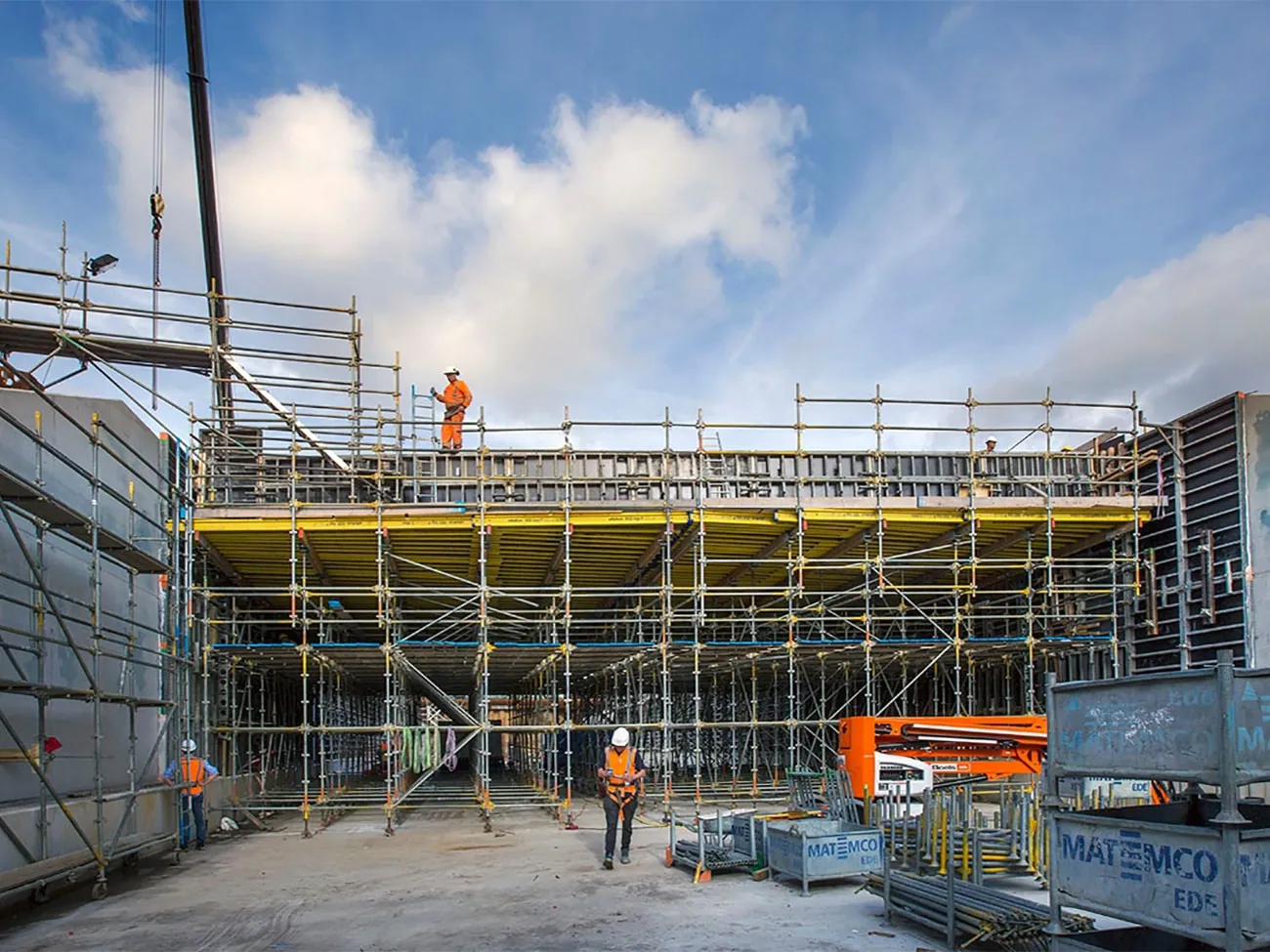
Matemco Hulpconstructies has been hiring out support structures, scaffolding and accessories for fifty years. The Kwiksteiger Support System is in high demand in the infrastructure sector for the temporary support of structures such as bridge decks.
In particular, the heavy-duty version, which can support loads of up to 75 KN per standard, enables a highly efficient support structure design as an alternative to traditional systems, which require more materials and labour.
The Kwiksteiger Support System has a wide range of applications, says Jos Hendriks of Matemco Hulpconstructies. “The heavy-duty version is generally used in the infrastructure sector. A standard support system can carry loads of up to 40 KN, while ours can handle at least 75 KN. The really heavy-duty systems, meanwhile, start at 100 KN. Our Kwiksteiger concept therefore fills the gap between the systems offered by other suppliers, enabling us to deliver and build highly efficient designs. These are much more economical in terms of both the amount of material and the labour required. In appearance, the heavy-duty version is a standard scaffold tube, and it is interchangeable and compatible with standard scaffolding materials. The difference lies in the higher-grade steel and thicker wall.”
Rotterdamsebaan
The Rotterdamsebaan is the new road between the Ypenburg interchange and The Hague’s inner ring road. “The Kwiksteiger concept was used for the tunnel entrances, the sunken crossings and to support several viaducts and sliding decks,” Hendriks explains. “These were substantial decks, with an average concrete thickness of 80 centimetres. In addition to the support structures, we also provided a vehicle passage, a portal structure allowing lorries to pass underneath. This is easy to achieve with Kwiksteiger. The system was therefore used on almost all the structures. At the tunnel entrances, Kwiksteiger with a decking system was used to build the floor structures of the buildings and control facilities. Our support structures were used in various configurations in The Hague for around three years. The main challenge for us was coordinating with the project phasing and logistics. The many sloping surfaces may seem challenging, but they are easy to accommodate with our system.”
RijnlandRoute
According to Hendriks, the use of the Kwiksteiger system on the RijnlandRoute was broadly comparable to its use on the Rotterdamsebaan. “The main complexity here was that four teams operated fairly autonomously. Two of the teams were also French-speaking, with English as their working language. As a result, each team had its own approach to engineering, work preparation, construction, safety supervision and administration. We always design in 3D BIM as standard. This simplifies the exchange of files and drawings and prevents potential clashes. One distinctive feature of the RijnlandRoute is the profiled walls, whose pattern continues into the end of the deck. This required a high standard of finish, which called for specific formwork and tighter flatness tolerances. However, this had no impact on our support system. We always deliver rock-solid support systems, complete where necessary with accessories such as rebar fixing platforms with brackets, stair towers and supplementary facilities,” Hendriks concludes.
Question about this story? Ask your question
Keep following this
Get an email when a new story is published. No account needed.
- SubjectNews







