









Ede-Wageningen station to become a modern public transport hub
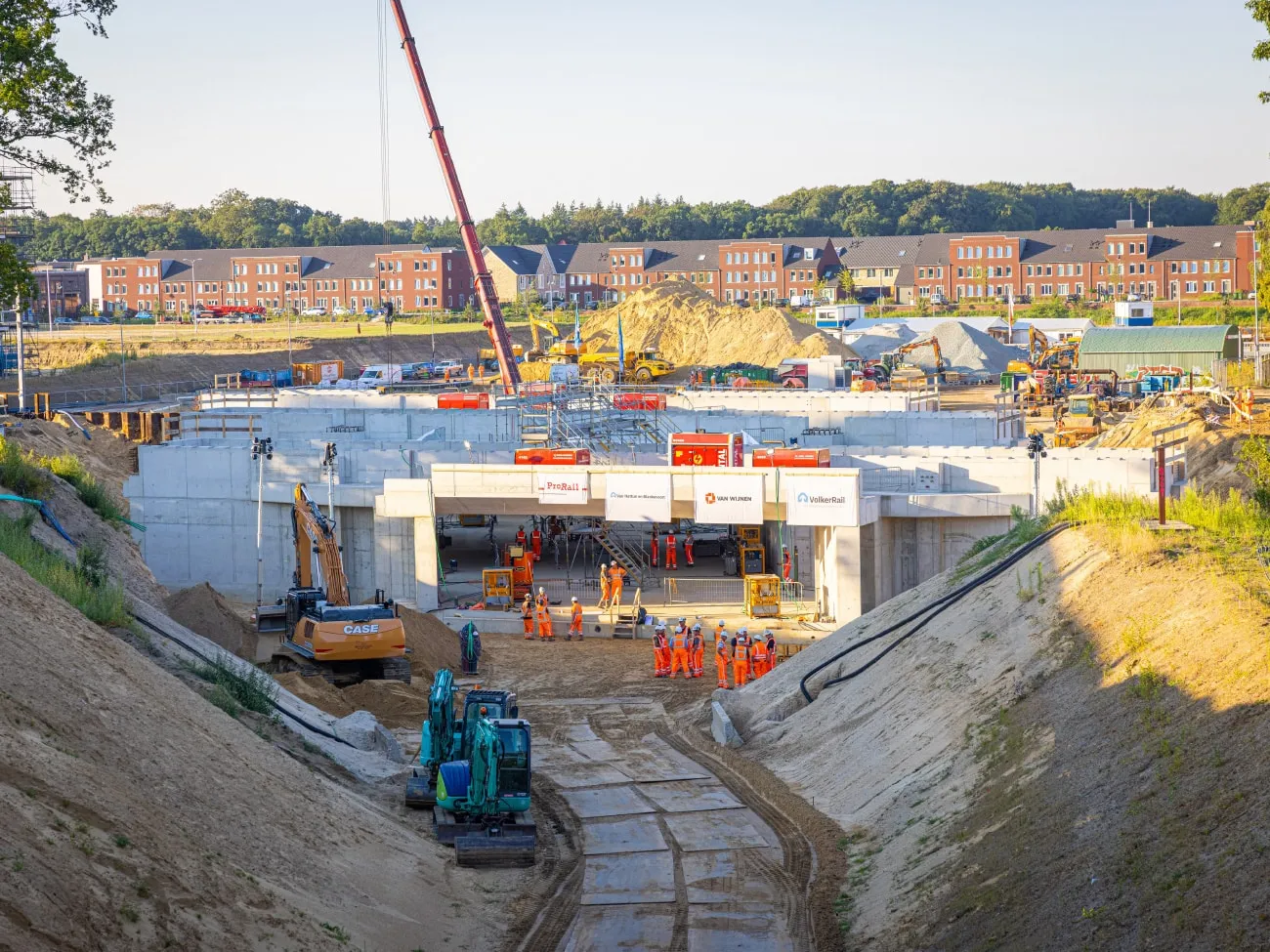
Ede-Wageningen station is undergoing a major transformation. ProRail has contracted the EdesPoort contractor consortium to renew the station and its surrounding area, creating a modern public transport hub. This is a large-scale and particularly complex project that brings together many disciplines. At the beginning of August, a major civil engineering milestone was reached when the eastern passenger tunnel was successfully slid into place. Weighing 8,000 tonnes, it was in a class of its own.
First civil engineering milestone achieved
An interview with Peter Vervooren, who is responsible for the civil engineering works on behalf of Van Hattum en Blankevoort in the EdesPoort consortium.
The EdesPoort contractor consortium comprises VolkerWessels Infrastructuur (Van Hattum en Blankevoort and VolkerRail) and Van Wijnen’s Arnhem branch. Lead partner Van Hattum en Blankevoort is responsible for the civil engineering scope, VolkerRail is carrying out the work on the railway infrastructure, and Van Wijnen is building the new station building. The consortium began work in spring 2021. “In response to the tender, we identified a number of objectives as the basis for our EMVI document. Several aspects are key, including maximum aesthetic quality, optimising the passenger experience and ensuring the highest possible satisfaction among the surrounding community,” explains Vervooren. “We ultimately translate these into a specific way of working that delivers the performance required under the contract.”
Milestone
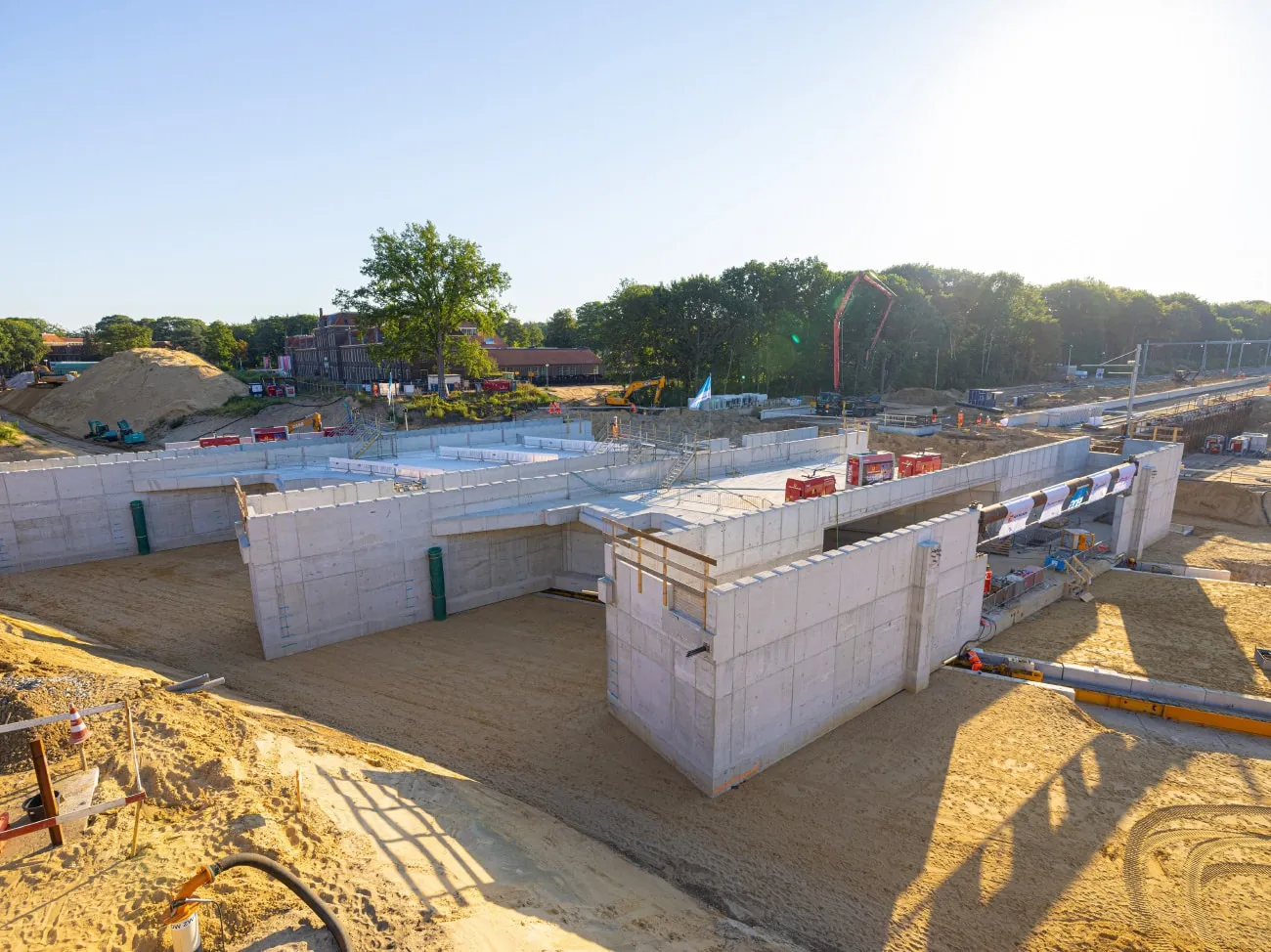
The successful sliding of the passenger tunnel into place marks the first civil engineering milestone. “We’re very proud of that,” says Vervooren. And rightly so, given the complexity and the many challenges involved. The tunnel is 65 metres long, 49 metres wide and 7.5 metres high, and weighs more than 8,000 tonnes. “With a broad-based, highly professional team, we turned a complex design into a practical, buildable concept. To minimise disruption to the surrounding area, the eastern tunnel was built at a pre-construction site beside the railway embankment. As well as the tunnel box, the stairwell structures for the escalators and the lift shafts were also built in advance as ‘boxes’. Lifting this entire structure and sliding it beneath two tracks therefore required considerable structural engineering analysis, on top of designing it in a short time and building it within a tight programme.”
A challenging schedule
The tender already allowed for a 17-day period without train services, during which the railway infrastructure could be modified and the tunnel slid into place, including installation of the roof structure foundations. “We knew from the outset that the schedule would be challenging, but we took it on,” says Vervooren. “In the run-up to construction, the period without train services was extended to 24 days. We safely completed a high-quality product on time, and it was slid into place over a weekend in early August with no outstanding work. Credit to everyone involved, who followed the operation closely with broad smiles.” Moving the passenger tunnel 75 metres was the first civil engineering milestone, but certainly not the last. “Another tunnel is planned, the West Tunnel. We’re taking the same EMVI approach, with as little disruption as possible for passengers and the surrounding area. We’ll build the West Tunnel on the nearby Frisopak site, a relatively quiet area, and install it in sections during a period without train services in 2024.”
The EdesPoort consortium is also building a bridge for pedestrians and cyclists over the railway. “We opted for a composite structure comprising steel beams with a composite cladding. This is one of the first times this design has been used for a railway crossing,” says Vervooren. “We’re also designing and installing 600 metres of noise barriers, and widening the existing Alberttunnel to make room for the new platform. Finally, we’re redesigning four squares. In early 2024, when the new station building is also ready, we’ll switch over in one go: passengers will leave from the old station in the morning and arrive at the new station building in the evening.”
Question about this story? Ask your question
Who worked on it
Ede-Wageningen station in Ede
- werkzaamheden aan de spoorinfrastructuurVolkerRail
- bouw van het nieuwe stationsgebouwVan Wijnen
Keep following this
Get an email when a new story is published. No account needed.
- ProjectEde-Wageningen station
- SubjectNews
- CompanyVolkerRail
- CompanyVan Wijnen







