









Drinking water is the next grid congestion challenge
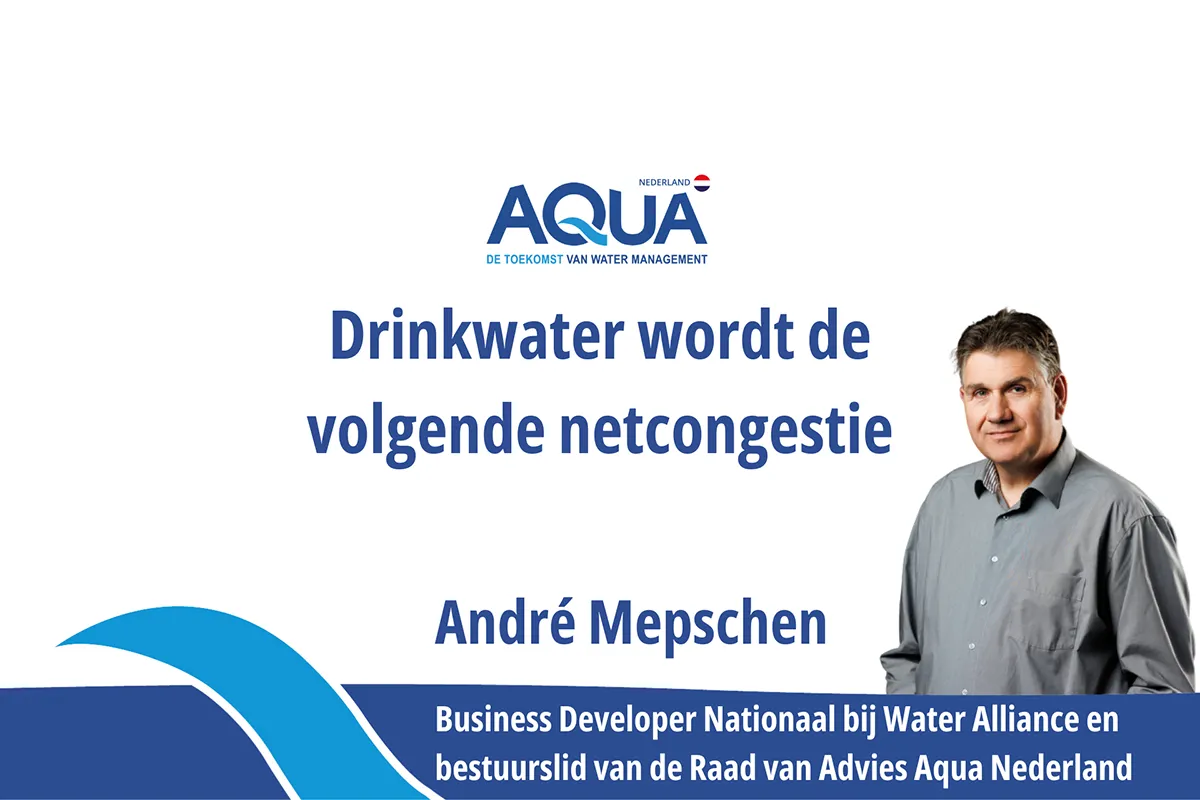
By André Mepschen, National Business Developer at Water Alliance and board member of the Aqua Nederland Advisory Board
There are few things as self-evident in the Netherlands as water. Turn on the tap and it flows. This assumption is not just part of household life, but deeply embedded in the way we build, expand and produce.
That is, until a company wants to build a new factory, scale up production or adapt a process, only to be told that no additional drinking water connection is available. In some parts of the Netherlands, this is already a reality. For those affected, it is an immediate and serious problem. For those not yet affected, it remains abstract.
At the same time, the Netherlands is aiming to build 100,000 homes a year. Those homes also need a drinking water connection. This is pushing up against the limits of water abstraction, permitting, infrastructure and spatial integration. This is happening now, not in the future.
Urgency on paper, concern in practice
The National Action Plan for Drinking Water Conservation is clear. Its target is to reduce consumption by 20 per cent compared with the 2016-2019 period, for both industry and consumers. By 2035, per capita drinking water use must move towards 100 litres a day.
These are ambitious targets. But targets alone do not bring about change.
The question that remains is simple and uncomfortable: are we in the Netherlands really taking action on this? With concrete measures, clear agreements and consistent follow-through? Or will it remain a matter of ambitions, pilots and good intentions while pressure on the system continues to grow?
Water is still cheap. As a result, scarcity does not feel like scarcity. Water is highly valuable, but you would not know it from the bill. What costs little rarely gets prioritised.
Consumers do not see it, industry feels it too late
Take household drinking water use. In 2023, the average was 118 litres per person per day. Around 40 per cent is used for showers and about 30 per cent for flushing toilets.
For many people, that remains an abstract figure. Yet it presents a straightforward opportunity. Relatively simple measures can save 10 to 20 per cent. That applies to households, but in practice just as much to industry.
In industry, however, water carries an additional significance. It is not just about consumption, but about operational reliability. A factory that has to shut down because of water scarcity or stricter discharge requirements pays a much higher price than its water bill alone. Lost production, process disruption and uncertainty in operations all weigh heavily.
WFD: water quality adds to the pressure
Availability is not the only issue: water quality is also playing an increasingly important role. The Water Framework Directive sets clear requirements for the quality of surface water and groundwater. This affects companies that discharge into surface water or otherwise affect a water body, for example through groundwater.
There is also a practical reality to contend with. The composition of surface water changes with the seasons, drought and peak loads. Companies that abstract surface water for process water notice this directly. And those using membranes or other technologies for treatment have to deal with concentrate streams that need a solution.
This calls for a different way of thinking. The traditional linear model of abstraction, use and discharge is reaching its limits. Circular thinking is becoming increasingly necessary.
FROGS IN A POT
As a sector, we seem to be like frogs in a pot on the stove. The water is getting warmer, but as long as it has not boiled, everyone stays put.
The national government, provinces, municipalities, drinking water companies and water authorities each have a role to play. This division of responsibilities has evolved over time and worked well for many years. In the current situation, with overlapping and complex issues, this fragmentation is becoming less and less helpful.
Who brings the various parties together and provides direction and coordination? That leadership is often lacking. As a result, we depend on early adopters: organisations that want to get ahead, prepare for the future and not wait until it is too late. That is valuable, but not enough to tackle the challenge as a whole.
Payback period or operational reliability
The same question invariably comes up when water measures are discussed: what is the payback period? It is a logical question, but a limited one.
Investing in water is not just about saving. It is about security. About whether you will be able to keep producing in the future, whether you will depend on restrictions on supply or discharge, and how resilient your operations are to changing circumstances.
Sometimes there is no immediate financial payback, but there is the assurance that you will not have to shut down during a dry spell. Sometimes there is little or no additional cost, but you avoid depending on a drinking water company that cannot supply more water or imposes stricter discharge requirements.
Jump out of the pot
Waiting will not help. Technology is rarely the problem. The question is how to get started.
Start by mapping your own situation. Establish where your water comes from, where it is used and where it goes. Then look at potential solutions and talk to organisations that can help, whoever they may be.
Those who take that step often discover that more is possible than they had thought. The biggest barriers are not in equipment or technology, but in choices, priorities and decision-making.
And that is precisely why water belongs not only in the technical department, but also wherever strategic direction is set.
This issue is at the heart of the wider discussion Aqua Nederland is having about the future of the water sector in the run-up to 2026.
About the author
André Mepschen is National Business Developer at Water Alliance and a board member of the Aqua Nederland Advisory Board.
Question about this story? Ask your question
Keep following this
Get an email when a new story is published. No account needed.
- SubjectNews







