









Deepest point of Nieuwe Sluis construction reached!
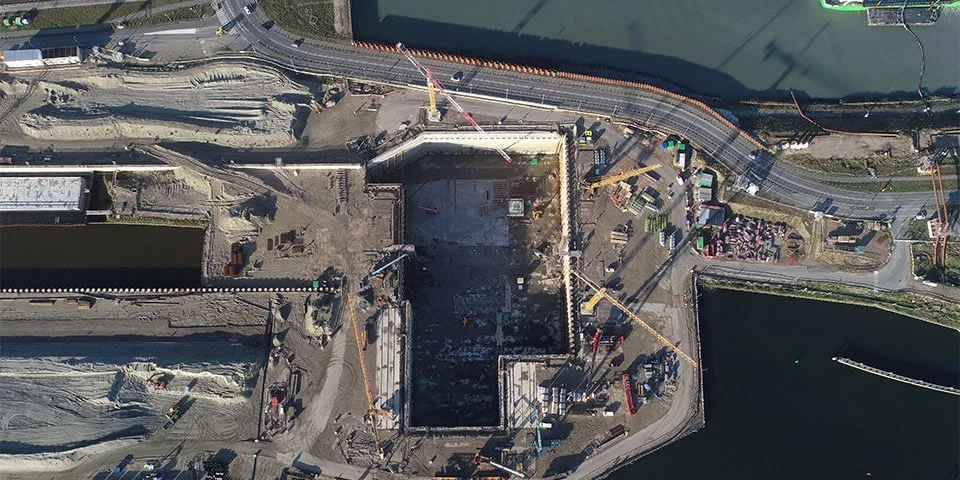
The outer lock head, the section of the lock where the gates and bridge will be built on the Western Scheldt side, has reached its deepest point.
The bottom of this lock head is at -22 metres NAP. The outer lock head is now a dry cofferdam some 25 metres deep. We marked this milestone in style. Today (Thursday 24 September 2020), the Nieuwe Sluis Terneuzen steering committee and project directors gathered at the viewing point to see and celebrate the deepest point of the outer lock head.
- Eric Marteijn, project director, Nieuwe Sluis Terneuzen: “Reaching the deepest point of the construction is a high point in the building of Nieuwe Sluis. Together with contractor consortium Sassevaart, we work enthusiastically every day to achieve these important milestones.”
- Gerben Turkstra, project director, contractor consortium Sassevaart: “Hundreds of our staff are working proactively and thoughtfully on the design, construction and surrounding area for this lock, and we are proud to have reached this milestone together.”
- Freddy Aerts, co-chair of the Nieuwe Sluis Terneuzen steering committee: “We have reached the deepest point, and we are looking ahead with confidence to the opening in 2023. This will boost economic development throughout the entire Canal Zone.”
- Theo van de Gazelle, co-chair of the Nieuwe Sluis Terneuzen steering committee: “I look forward to the day when Rijkswaterstaat takes over this impressive Nieuwe Sluis for operation and maintenance. It will then form part of a future-proof, sustainable and robust lock complex.”
Safe, watertight cofferdam
Creating a dry cofferdam for the outer lock head was no small undertaking. First, we excavated down to -11 metres NAP in dry conditions. We then filled the cofferdam with water so that we could excavate under water down to -22 metres NAP. Next, we laid a base of underwater concrete. The cofferdam was then gradually drained, while the walls and floor were closely monitored. We are now removing groundwater from beneath the base of the excavation. We discharge it back into the surrounding area. This recharge pumping is needed to reduce the pressure on the cofferdam, and returning the water keeps groundwater levels in the surrounding area stable. We are monitoring this closely. Now that we have a safe, watertight cofferdam, we can start the complex concrete works required for the gate recesses, bridge basement and levelling system. The inner lock head is expected to be a dry cofferdam by early 2021.
Question about this story? Ask your question
Keep following this
Get an email when a new story is published. No account needed.
- SubjectNews







