









Creative ground investigation
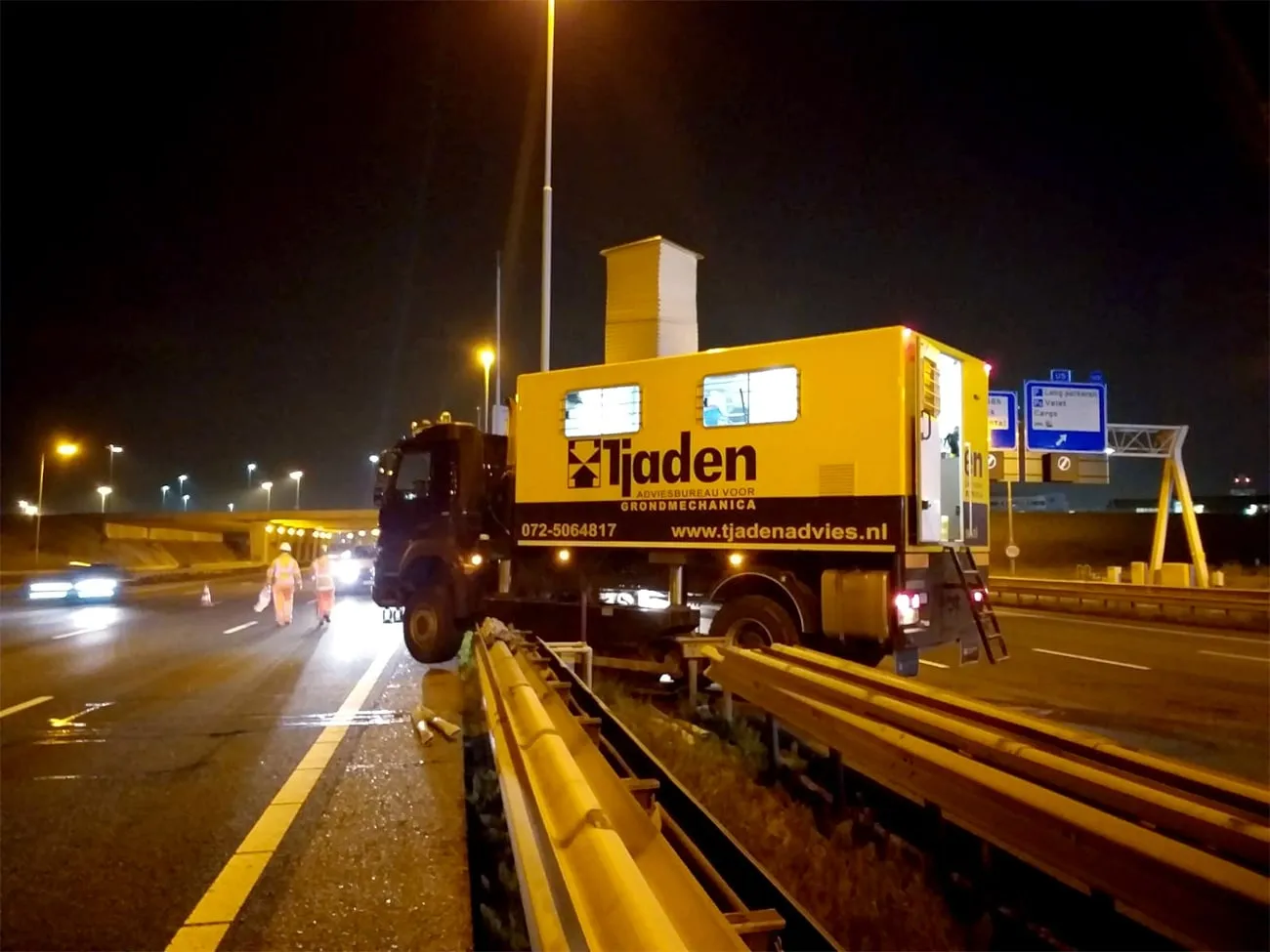
Carrying out ground investigations at Schiphol Airport is just a little different from a standard infrastructure project.
On the VDR project, Tjaden Adviesbureau voor Grondmechanica was able to make full use of its expertise and devise the creative solutions needed to uncover the right information for client Heijmans, quite literally.
For more than 50 years, Tjaden Adviesbureau voor Grondmechanica has specialised in geotechnical ground investigation, geotechnics and geohydrology. “We have been active at Schiphol for many years, both for the airport itself and for various infrastructure contractors carrying out work there,” says Arjen Verhoeven, Director of Operations at Tjaden Adviesbureau voor Grondmechanica. “Our staff are familiar with all the protocols and safety requirements, and are flexible in their availability. Responding quickly and working together to find practical solutions are hallmarks of our approach. That was certainly essential on this project.”
Unexploded ordnance
At Schiphol, no spade goes into the ground until the work area has been scanned for the possible presence of unexploded ordnance. “To carry out cone penetration tests in a suspect area without any problems, we use a cone fitted with what is known as a magnetometer,” Verhoeven explains. “This cone detects metal in the ground. That does not necessarily mean it is an explosive device, but whenever the meter records a reading above a certain threshold, the area is investigated further first. The readings are also monitored in real time by an unexploded ordnance specialist.”
Hollow sounding rods
The VDR project involved a very varied range of work for Tjaden. “We carried out a number of investigations both landside and airside, including boreholes and laboratory testing to map any settlement that might occur in the ground,” says Verhoeven. Tjaden made full use of its knowledge and experience beside the two ProRail tunnel bores, above which the new viaduct is being built. “The tunnel drawings were no longer available. So we used hollow sounding rods without cones to feel out how much space there was beside the bores. This was to assess whether there was enough room to install piles of a particular diameter. We also carried out cone penetration tests in the central reservations of the A4 in connection with the piles for the new viaduct. This work was carried out mainly at night.”
So it was far from a standard job for them too, Verhoeven concludes. “It is a unique site, with many ‘obstacles’ underground, which makes it an interesting project for us and our staff. The collaboration with Heijmans and Schiphol has also been very pleasant. Over the years, we have built a good relationship.”
Question about this story? Ask your question
Keep following this
Get an email when a new story is published. No account needed.
- SubjectNews







