









Completing the circuit
The taxiways around Schiphol Airport’s terminal, which handle departing and arriving aircraft, are now double throughout almost their entire length.
With the exception of taxiway Quebec, the section between the Kaagbaan and Zwanenburgbaan runways, the taxiway system is now complete. Through the Double Taxiway System Completion project (VDR), Schiphol is closing the loop. Doubling the taxiway system increases capacity and safety, and makes it much easier for air traffic control to manage. We spoke to Rogier Brans of NACO, part of Royal HaskoningDHV and a specialist in airport development, and Swen den Ouden, project manager at Royal HaskoningDHV, about the project’s mainly airside challenges.
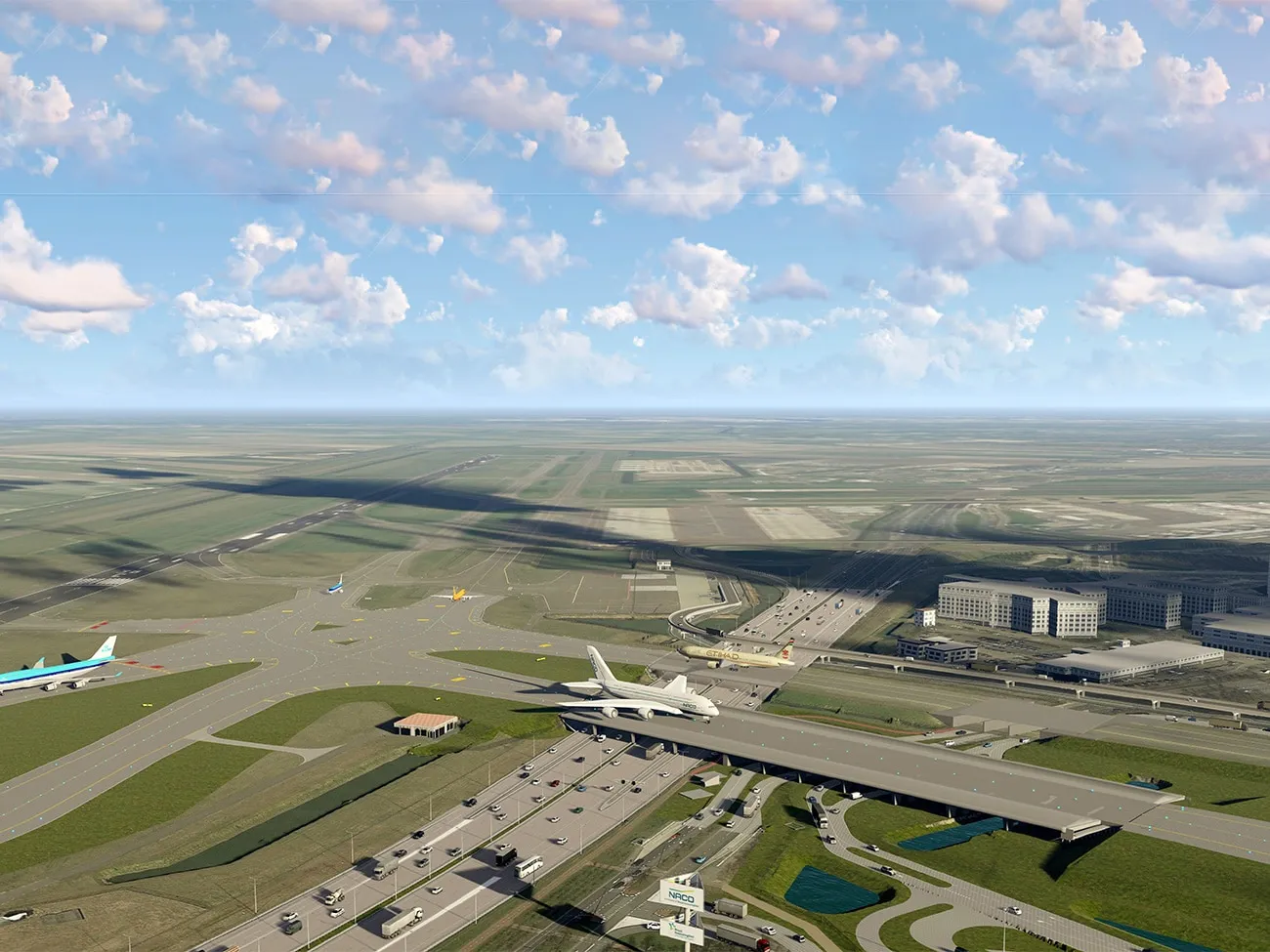
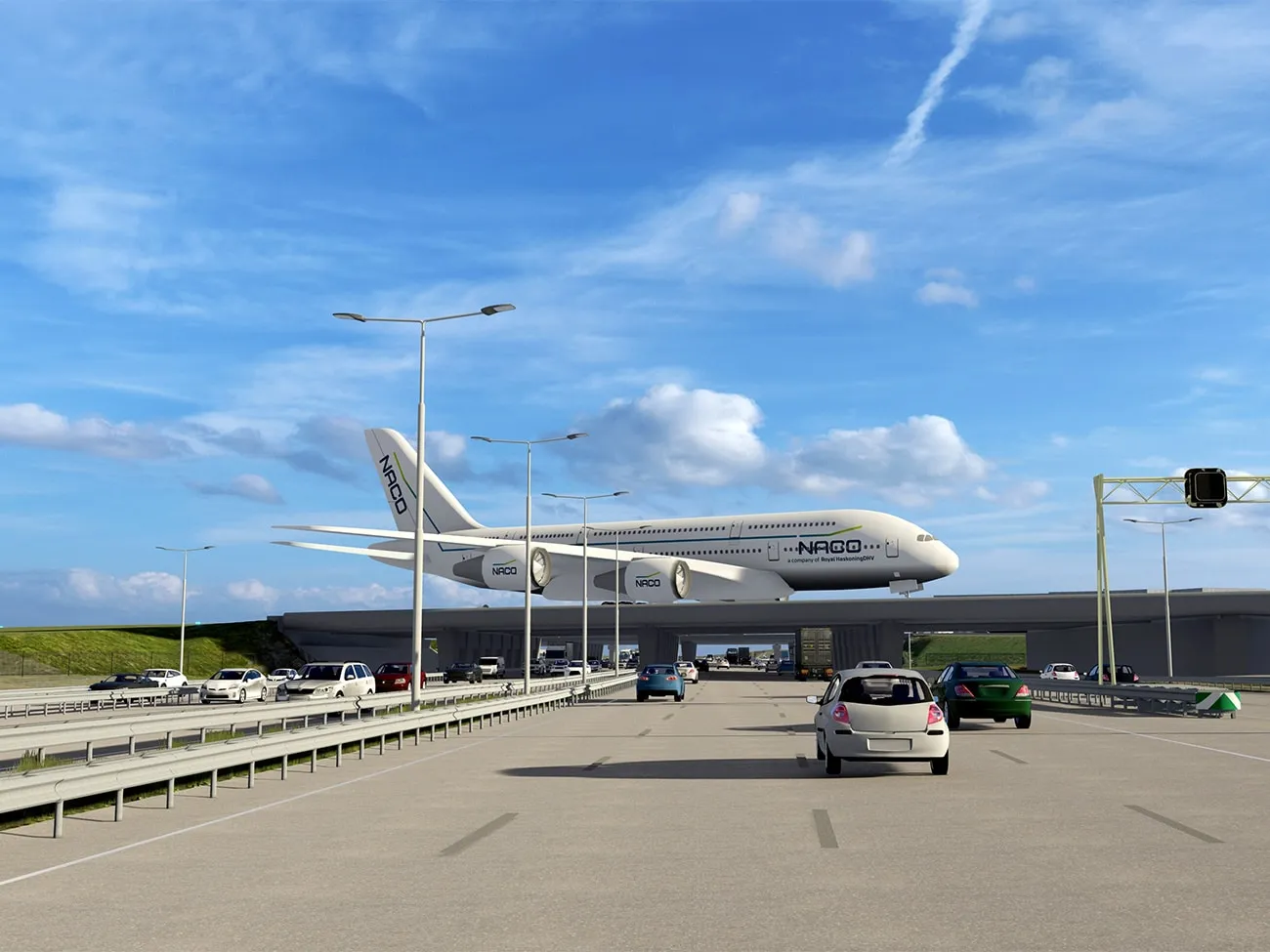
Six years ago, Schiphol asked NACO, a long-standing partner, to contribute to the master plan for doubling the taxiway system, including a new taxiway bridge over the A4 motorway. “The latter was more or less essential to allow the heaviest category of aircraft, including future types, to taxi across the motorway,” says Rogier Brans of NACO. “The existing taxiway bridge over the A4 was not designed for them. The initial idea was to build the new structure where the railway tunnel crosses the motorway, but it was virtually impossible to install piles at that location. This led to a change of plan, with the taxiway bridge moved to a position parallel to the existing structure. But that proved far from straightforward too.” Schiphol commissioned NACO to assess the situation and identify the challenges.
A buffer for the future
At its current location, the new taxiway bridge crosses not only the motorway, but also a public transport tunnel, two railway tunnels, a main gas pipeline, two secondary roads and a cycle path. “In short, a huge number of crossings converge at one point,” says Swen den Ouden, project manager at Royal HaskoningDHV. “Thorough preliminary investigations were crucial to prevent disruption or damage to existing infrastructure while building the new structure and installing the substantial foundation piles required.” Another challenge was deciding which parts of the new taxiway should be built as an embankment and which as a bridge. “An embankment is cheaper, but it would create a barrier between Schiphol and Schiphol-Zuid, which would be less favourable in the future,” Brans continues. “Schiphol has therefore planned ahead by making the taxiway bridge somewhat longer. This creates a buffer for anticipated future expansions of the metro, watercourse and local road network.”
Junction Zulu reconfigured
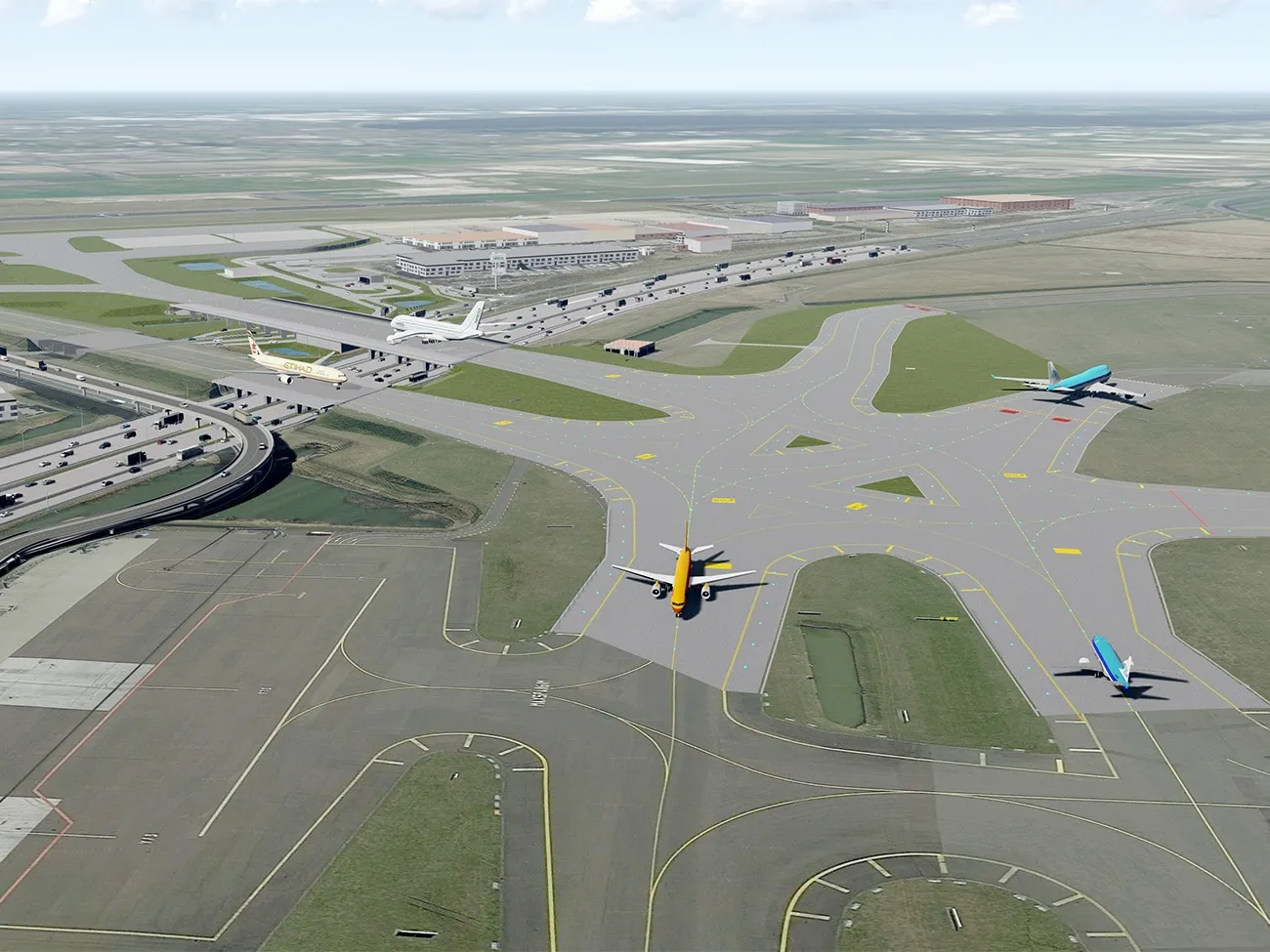
On the airside, junction Zulu is being reconfigured as part of the doubling of the taxiway system. Brans says: “In the existing layout, Zulu has six branches. We could not make it even more complex by adding a seventh, as that could have undermined the project’s aim of improving safety. We made an important contribution by designing the junction to make it less complex for users while retaining all the necessary taxi routes.
The changes do have significant implications, particularly with the new taxiway bridge. For example, the entire Zulu junction is being raised by up to 1 metre to meet cockpit visibility requirements. The effects extend all the way to the Zwanenburgbaan. The requirement is that pilots must be able to see an object on the taxiway from the cockpit at a distance of 300 metres. This creates a considerable challenge when an aircraft has to cross a taxiway bridge. It requires a vertical curve radius of no less than 15,000 metres (!). Gentle horizontal curves are also needed to allow aircraft to negotiate the turn at sufficient speed. These curve radii, together with the straight sections before and after the bridge that allow the aircraft to line up, made for a geometric puzzle.”
Suction effect
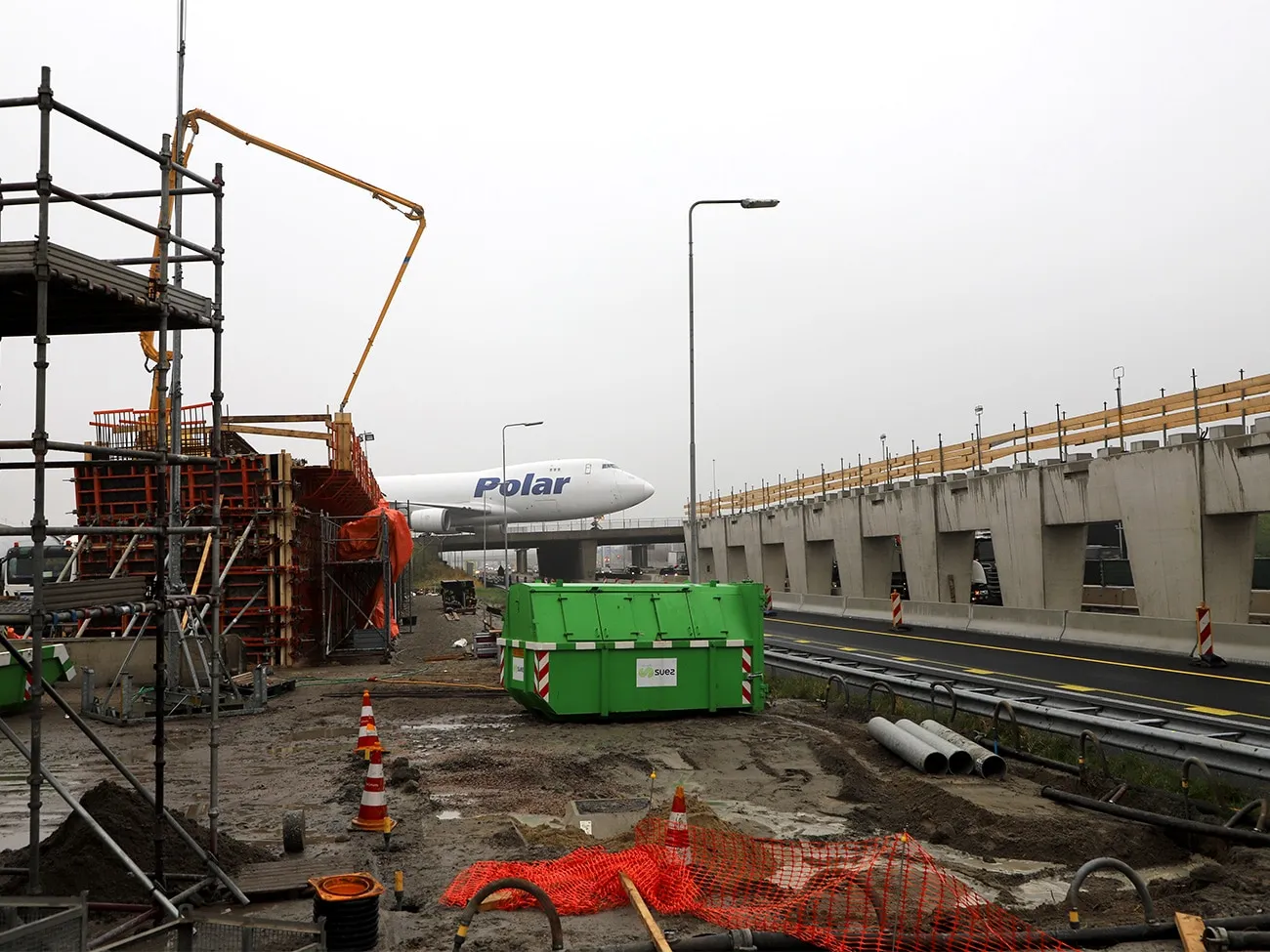
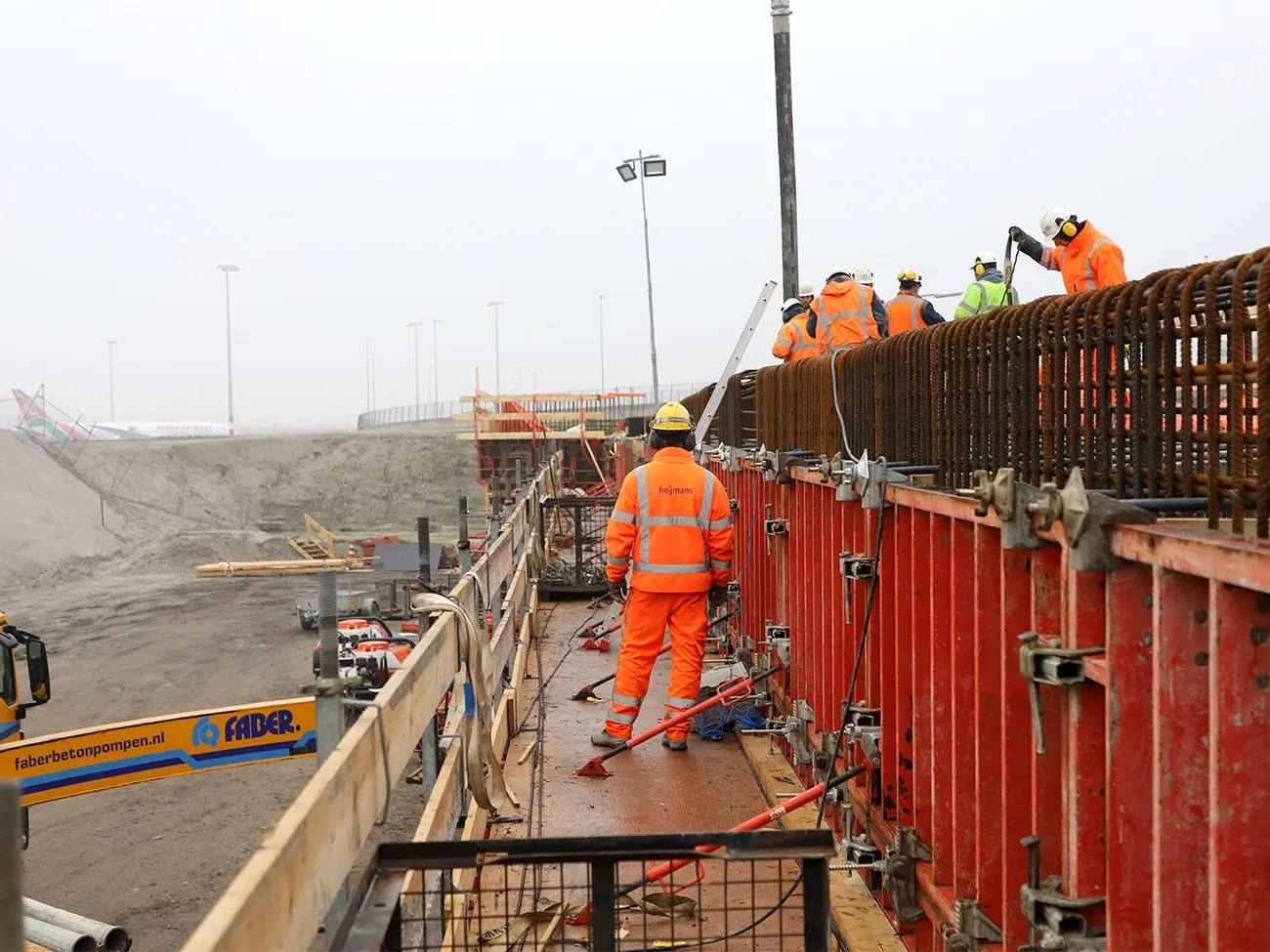
The new taxiway bridge is 250 metres long and, at 60 metres wide, considerably wider than usual. “Strictly speaking, a width of 47 metres would be sufficient,” says Brans. “But that would require additional measures, such as raised edges to prevent aircraft from leaving the taxiway. However, these ‘guides’ must not damage the landing gear, which makes them almost impossible to design. The bridge also needs to accommodate emergency vehicles driving around a stationary aircraft, and aircraft engines must not overhang the motorway because of the suction effect. That, in turn, requires additional measures, such as installing grilles. After much deliberation, a fully supported bridge spanning the full width of 60 metres proved to be the safest and most cost-effective option.”
Phasing
A huge taxiway bridge capable of carrying 725 tonnes and withstanding extremely high wheel loads is a major structure in its own right. “Shrinkage and creep in the concrete structure need to be properly managed,” says Den Ouden. “The detailed design of the flexible joints between the different sections of the bridge was a major headache for the contractor’s structural engineers. The transition between the embankment, or settlement structure, and the bridge, a fixed structure supported on piles, posed a similar challenge. There was also only a limited amount of time to allow the embankment to settle, for example. We advised the contractor on the phasing and on which activities needed to be carried out before construction began. For instance, the design allows for a certain amount of residual settlement to be dealt with through routine maintenance.”
Design work for the next phase is now in full swing. The preliminary design prepared by RHDHV is being developed into a detailed design. This work is being carried out by Schiphol’s various partners, including BAM, Heijmans, Volker Infra and Heras. RHDHV is advising the client. In light of the coronavirus crisis, a decision is being made on whether this part of the project will go ahead this year or at a later date.
Question about this story? Ask your question
Keep following this
Get an email when a new story is published. No account needed.
- SubjectNews







