









Climate-resilient city delivered quickly
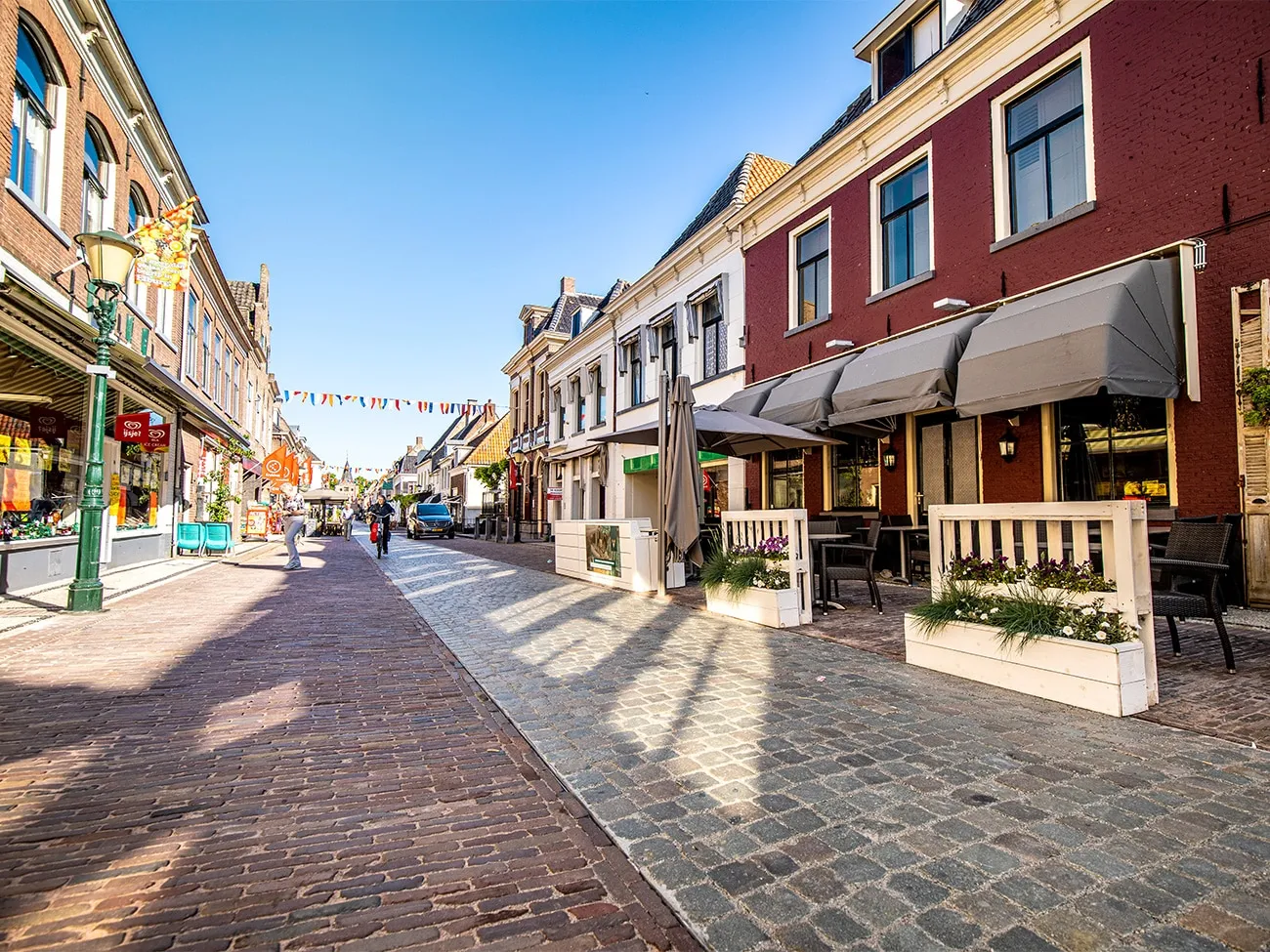
The local council in the fortified town of Elburg saw that extreme weather events were becoming increasingly frequent.
To prevent extreme downpours from causing flooding and damp basements in the historic buildings, they wanted to be able to store and discharge rainwater. They also wanted to prevent heat stress. However, there was no room for an infiltration system in the narrow street. In addition, the ground layers could not be disturbed because of their potential archaeological value. Curious to find out how this was resolved? ACO is happy to explain.
Time and potential archaeological finds the biggest challenge
Following a tender process, the Municipality of Elburg and Aannemingsmaatschappij Van Gelder worked together as a construction team. “Our contract involved resurfacing work and installing a stormwater sewer to disconnect homes from the sewer network,” says Erwin van Boven, design manager at Aannemingsmaatschappij Van Gelder. “All the rainwater had to be discharged into the stream that runs through the town. Given the character of this historic town, a linear drain was the preferred option.”
The contract seemed straightforward, but it was not. Time was the biggest enemy. Work on the project began in January 2021. As the tourist season traditionally begins at Easter, the aim was to have the terraces and the fortified town accessible again by then. “To meet the completion date, we wanted to avoid digging too deep in this historic fortified town, as there was a risk of coming across archaeological finds. So we looked for a stormwater sewer that could be installed with less cover,” says Erwin.
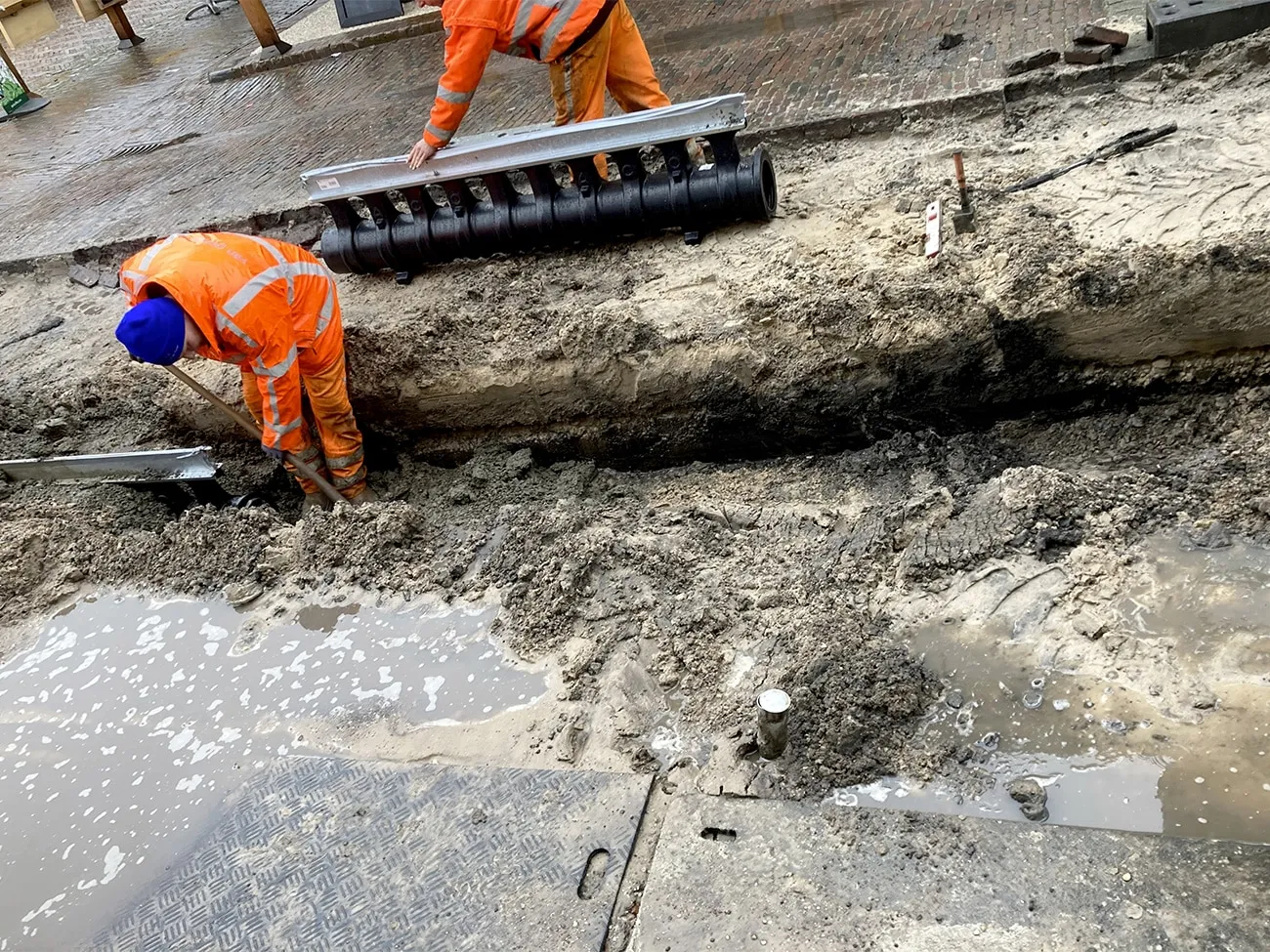
Rainwater collector for a climate-resilient town centre
In Elburg, it was also important to ensure that water could be stored and discharged during extreme downpours, preventing flooding as well as damp basements in the historic buildings. They also wanted to prevent heat stress on hot days. The limited time, the need to avoid archaeological finds and the ambition to create a sustainable, climate-resilient city were all important factors in finding the right solution. ACO’s Q-max provided the answer: a slot channel that requires no separate pipework and can be installed close to the surface. Unlike systems with separate collector pipes, this slot channel could be connected to the town moat.
Until recently, relatively clean rainwater always ended up in the sewer, but it is now increasingly being collected, simply because it can be put to good use. It can be used sustainably, for example to water trees and plants and reduce heat stress on hot days, while also relieving pressure on the sewer system during extreme rainfall. In Elburg, they chose to disconnect rainwater falling on house roofs from the sewer network and carry it via the Q-max to De Beek, which flows into the Vestinggracht. Gerard is pleased with the choice of the Q-max. “Some time ago, Rieks Hulst, sales engineer at ACO, told me about the Q-max during one of his interesting coffee conversations. It stayed with me because this product is a great combination of a linear drain that collects rainwater and then discharges it in a climate-adaptive way. ACO’s products may be a little more expensive, but we get quality in every respect in return. In my view, ACO makes the best products on the market.”
Quick to install and cost-saving solution
We were also keen to find out how the Q-max was installed, so we spoke to Henri Struik, site manager at Van Gelder. “Disconnecting the stormwater was very straightforward with the Q-max, because we could install the side connections ourselves. I would definitely like to use the Q-max more often in urban areas. It is a lightweight product, which makes it very easy to position and quick to install. There was much less earthmoving involved, and we did not need to make cut-out holes as we would for gullies. ACO gave me excellent support, always ready to offer advice and assistance. It was a special project for me because it was in a beautiful old town, with Van Gelder’s head office just around the corner. It is one of the best projects I have worked on.”
“This linear drain is slightly more expensive than gullies and installing a separate stormwater drain,” says Erwin. “But we saved so much time during installation that it made the option very attractive. Fortunately, we were able to run this product over the Vitens water main, which meant we did not have to dig as deep. This also eliminated the risk of archaeological finds and allowed us to stay on schedule and meet the target completion date.”
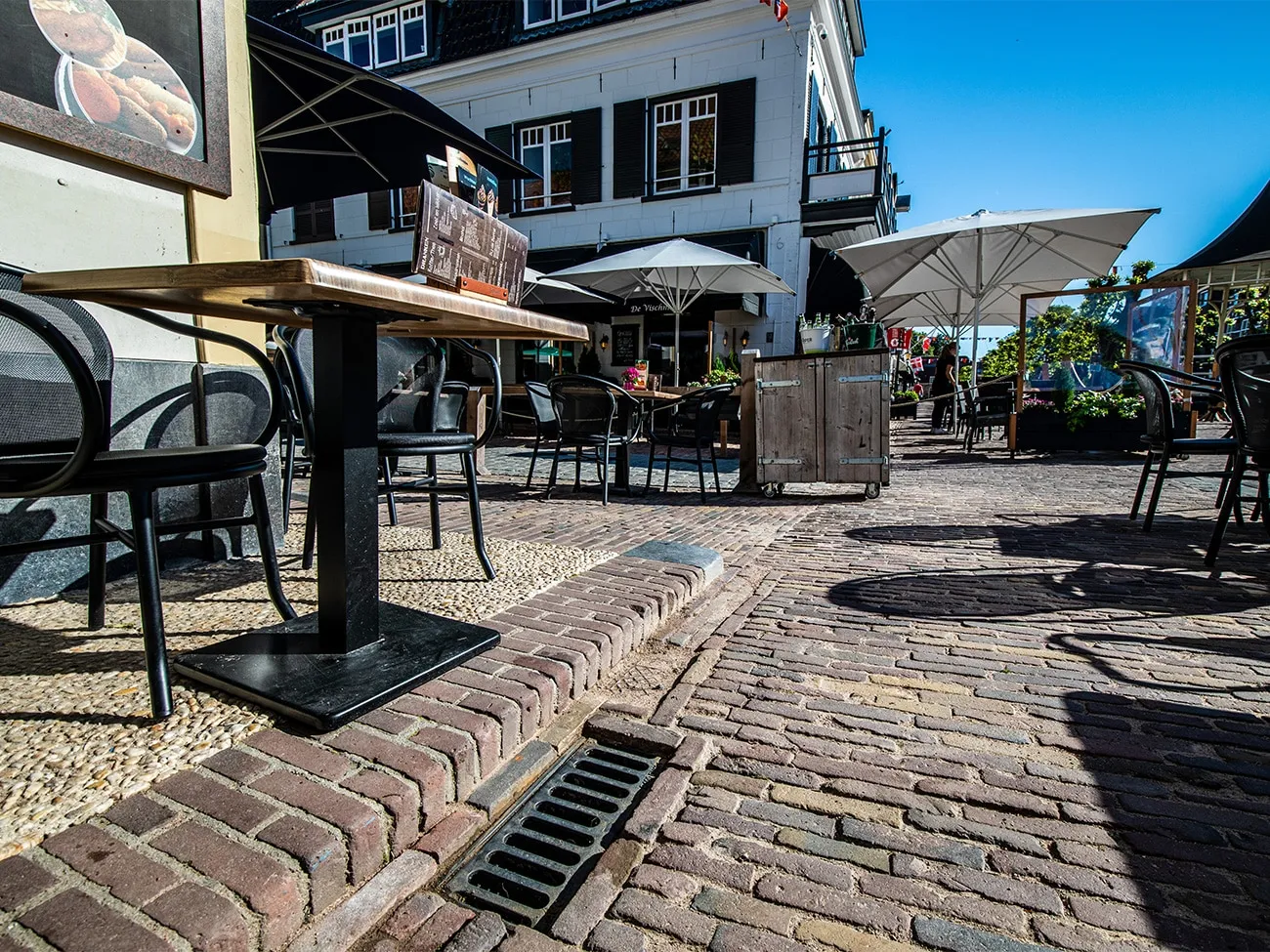
A distinctive appearance
As the old street profile was considered uncomfortable, the paving also needed to be replaced. When resurfacing Vischpoortstraat and Jufferenstraat, Van Gelder ensured that rainwater flowed towards the sides of the streets and into the Q-max slot channel. The relatively clean rainwater then flows into the town moat, helping to cool the fortified town. Thanks to its narrow slot, the Q-max linear drain is barely noticeable in the streetscape.
Erwin looks back proudly on the project and the collaboration. “We faced a few challenges with the technical design of the project, including an old town and differences in elevation. Johannes Doornbosch, ACO’s account manager, gave careful thought to every aspect. I only knew ACO for its linear drains, but now I know they have many other solutions too. Everything is open for discussion and can be resolved with ACO, so we should definitely work together more often.” Gerard is also pleased with the result. “We completed the town-centre redevelopment on time, so the terraces could open as planned. By disconnecting the homes and carrying the rainwater to De Beek, the water stays where it falls instead of being sent for treatment. The ACO system can drain a rainfall event with a factor of 10, leaving the fortified town well prepared for the future. Creating a cool island helps prevent heat stress. In summer, tourists will be able to enjoy the city’s cool islands, with water points, benches and trees.”
More innovations for smart rainwater use
Using rainwater sustainably is important for relieving pressure on the sewer system. Unlike in Elburg, there are also situations where runoff needs to be cleaner. For example, when stormwater has to be directed to a swale, or stored for later use in watering plants. In these situations, an additional treatment system is often needed to remove contaminants from the runoff. This is because runoff from roofs and traffic surfaces is often contaminated with zinc from roofs, tyre-wear particles, brake dust, soot, silt or oil. At ACO, they are happy to tell you about the best available technology or develop an effective solution, so that the water is clean enough for further use. Invite them for an interesting coffee conversation, just as Gerard did, challenge them and develop a solution together. They enjoy doing that, and who knows, your project or municipality might make the news with the most innovative climate solution!
Question about this story? Ask your question
Keep following this
Get an email when a new story is published. No account needed.
- SubjectNews







