









3D concrete printing has come of age: from the drawing board to practice in Eindhoven
It is the most ‘sexy’ technology in the world of concrete construction, and it makes for a spectacle that is astonishing and never gets old: a robotic arm fitted with a nozzle, extruding a concrete mix.
Fed a 3D file encoding the object to be printed, the robot produces a concrete object out of thin air with almost painful precision. Can we claim the concrete sector as part of the manufacturing industry? Absolutely, 100%. The epicentre of this futuristic construction method is Eindhoven.
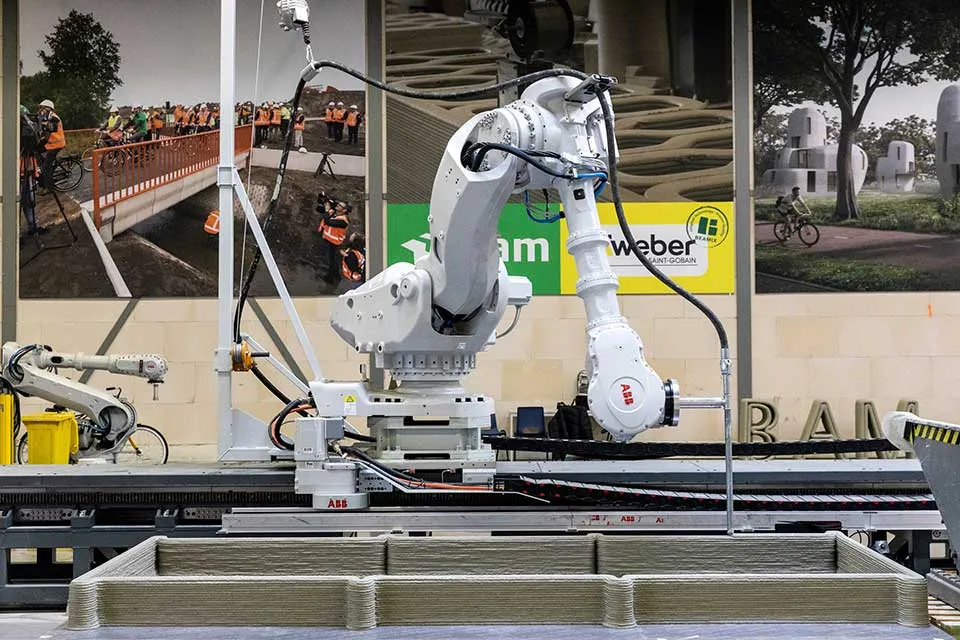
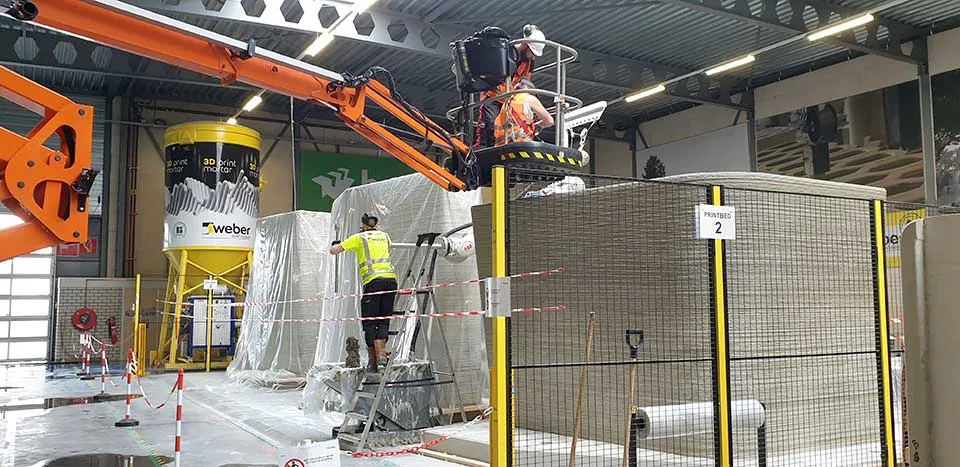
The concrete printing factory is owned by Saint Gobain Weber Beamix, whose 3D concrete printing adventure really gathered pace when the company joined TU Eindhoven’s 3D Concrete Printing research programme as an industrial partner. We speak to Marco Vonk, marketing manager, Peter Paul Cornelissen, international 3D project manager, and Gian Sterken, 3D sales project leader.
Disruptive technology
The ancient Egyptians, Babylonians, Phoenicians, Greeks and Romans already knew the benefits of using (unreinforced) concrete. Since then, concrete has evolved in terms of its composition and how it is placed, but no development has departed further from its origins than 3D printing. We are talking about a disruptive technology that, like any disruption, can only emerge through a drive to innovate, out-of-the-box thinking, determination and early adopters. The fact is, the roles held by the Saint Gobain Weber Beamix team did not exist 5 years ago. Thanks to the work carried out in Eindhoven, 3D concrete printing has come of age, is ready for full-scale use and has already notched up several impressive achievements.
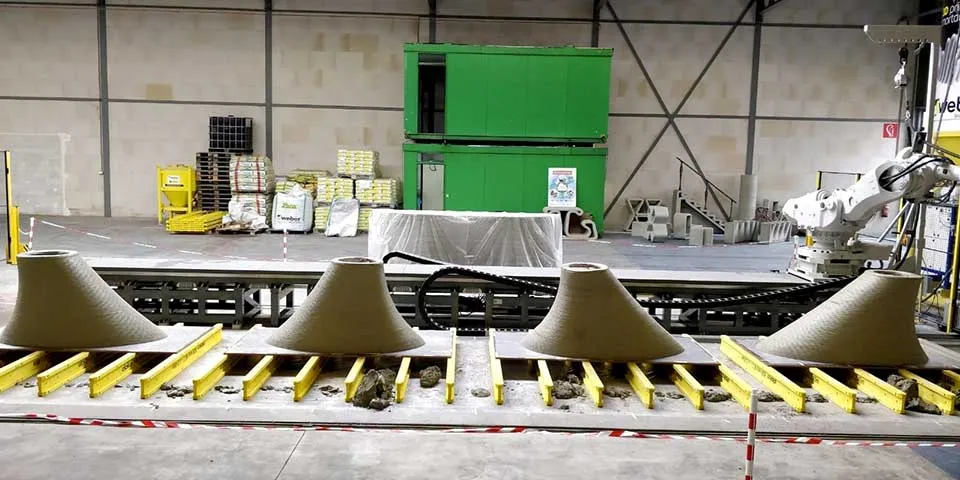
“This technology has to meet different requirements from those we are used to,” Peter Paul begins. “That starts with how a 3D model has to be built and ends with the composition of the concrete mix. We work with two types of concrete: fast-setting concrete made up of two components, and fluid concrete that forms its own load-bearing skin after extrusion. The latter is crucial, because the robot builds up the print in layers, and the weight of the top layers must not affect those below. At the same time, the layers have to fuse together to form a monolithic structure that can be designed and assessed. The printing material therefore needs to be optimised for load-bearing capacity and shape retention. We are now using the 5th generation of mortar developed by Weber Beamix’s R&D team, with great success. The balance is excellent.”
Printing directly or printing formwork
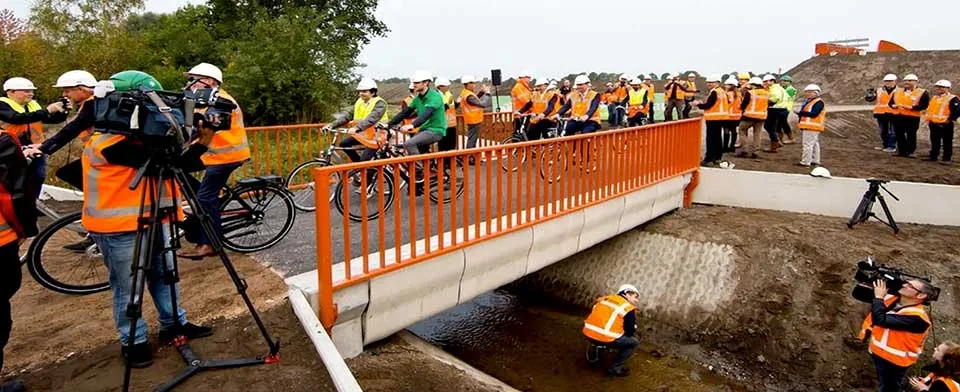
The possibilities offered by 3D concrete printing are endless. What about reinforcement, we ask. Gian replies: “There are several options. We can feed reinforcing wire into the mortar, add reinforcing fibres to it or, when we print 3D concrete formwork, manually insert steel pins into the printed formwork.” Peter Paul adds: “However, because the process is different, conventional reinforcement is sometimes unnecessary. The bridges we have printed so far are a good example: 3D engineering has given the finished product a degree of prestress.”
The world is there for the taking
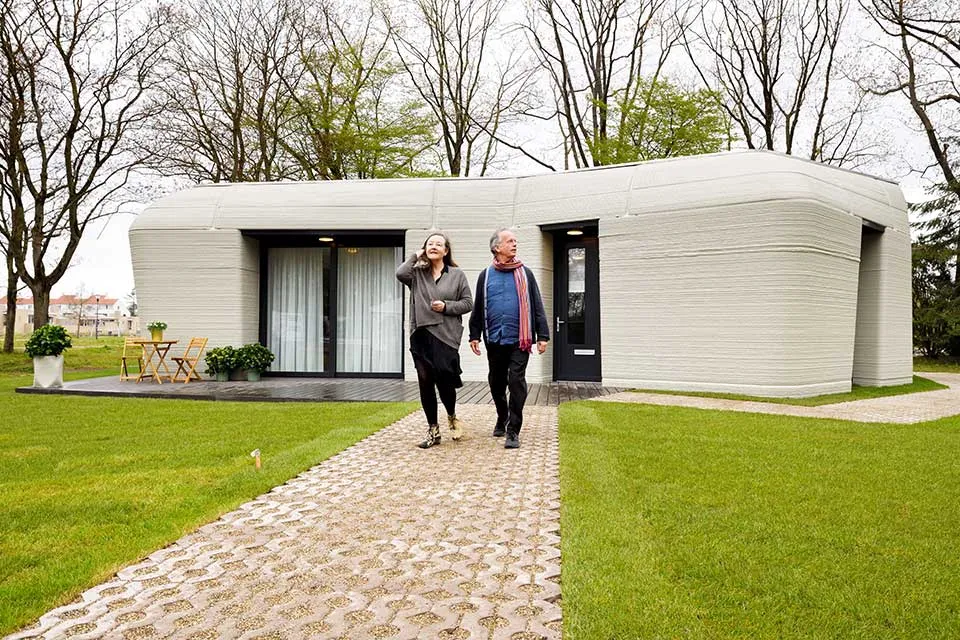
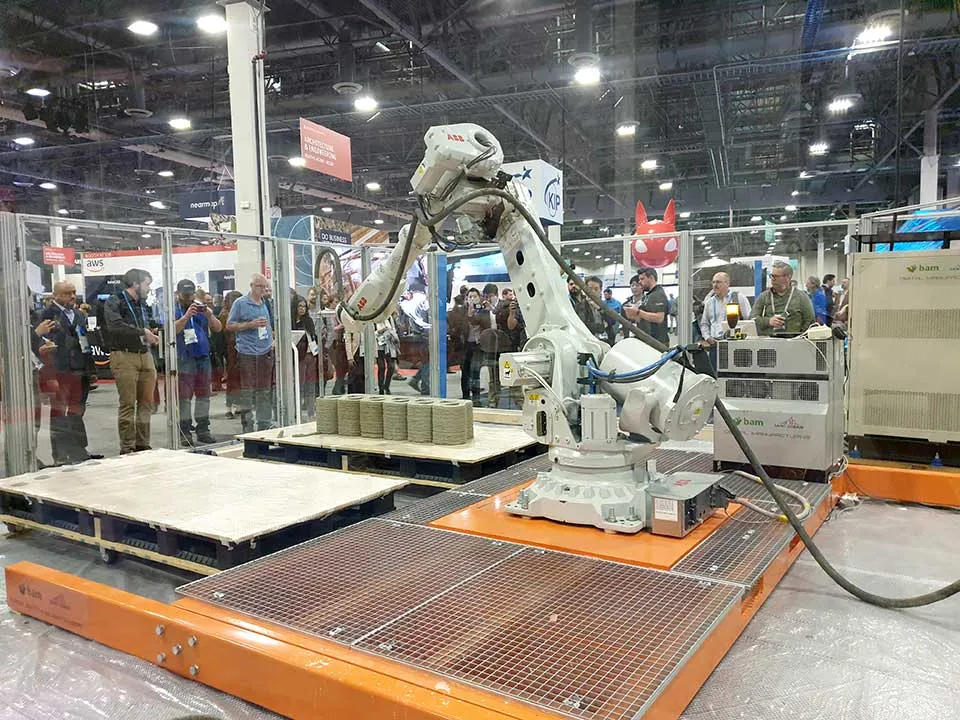
“We are now moving beyond the stage where everyone stops open-mouthed to watch, then walks away in amazement. The technology is well developed, it works and it is ready to be put to use. A good example is a trade fair in Las Vegas where we had a fully operational robot printing concrete live. Visitor figures showed that we attracted more attention than Elon Musk and his hyperloop. Looking at the real world, we see that more open-minded clients immediately recognise the benefits of 3D concrete printing and are proud to commission projects using it. The results speak for themselves. I am thinking, for example, of the printed bridges in Nijmegen and Gemert and, another remarkable feat, the 3D-printed Milestone House. So the world is there for the taking.”
Peter Paul says: “The Milestone House in particular shows that a different design language is possible. This gives designers new creative options that have never been seen before. It also means adapting to a different way of working with the 3D software you already know. If 3D concrete printing is to become commonplace, it is vital that we continue sharing our knowledge so that everyone can get used to it.” Knowledge-sharing is also a focus of collaboration within the consortium. Marco explains: “Since the factory opened, we have invited people to visit. TUe is doing everything it can to promote the technology, and we now have ambassadors who take every opportunity to champion it.”
There is still a lot to learn
“The reality is that I receive conventional 3D designs and convert them into designs suitable for 3D printing. We look at whether we can make the technology work for them, and I explain what would have needed to be different. The designer in question learns from that.” The learning process does not stop at work preparation or the printing itself. Peter Paul says: “It is about understanding the whole process.
There is a clear before and after. 3D concrete printing also brings social and economic benefits. You use less material, need less heavy transport, cause less disruption to the surrounding area and work much faster.”
‘You just have to dare’
Do the men see themselves as pioneers? Marco is clear: “Absolutely not. If you had asked that question in 1999, probably. Research into 3D concrete printing has been going on for that long. Alongside the mechanical and electronic developments, which offer more possibilities today than ever before, the focus has been and remains on the mortar. The mortar is special, and so is our factory. We call it ‘design by testing’.” Peter Paul adds: “Our material has been studied by the university and several institutes. We monitor quality all the way from dry mortar to silo, from silo to nozzle, from printed product to robot performance. The entire process is monitored, and these data are an integral part of our quality control, which gives us confidence. For various projects, this has been validated by TUe, including the product’s load-bearing capacity.”
Thanks to the partnership with TUe and a growing list of successful projects in practice, the case for 3D concrete printing is gaining considerable weight. Marco says: “It is now up to us to raise awareness of its applicability and reliability, so that more and more construction professionals can see for themselves that 3D concrete printing has become a mature technology. It is also economical, sustainable, flexible and reliable. What we need is even more clients who focus on the possibilities and experience the added value of 3D printing with us.”
A business enquiry for Saint-Gobain Weber? Get in touch
Companies in this story

Keep following this
Get an email when a new story is published. No account needed.
- ThemeMaterials and techniques for infrastructure
- SubjectNews
- CompanySaint-Gobain Weber







